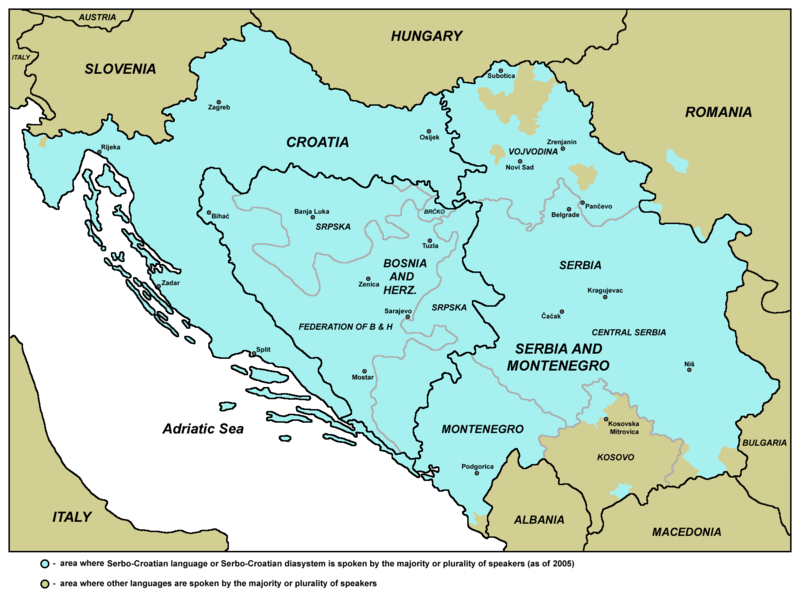
File:Serbo_croatian_language2005.png · Wikimedia Commons · See Wikimedia Commons
Serbo-Croatian
Sign in to saveAlso known as BHS, Serbo-Croat, Serbo-Croat-Bosnian, Bosnian-Croatian-Serbian, Bosnian-Croatian-Montenegrin-Serbian, Serbo-Croatian language, BCS, BCMS
Serbo-Croatian, also known as Bosnian-Croatian-Montenegrin-Serbian (BCMS), is a Western South Slavic language and the primary language of Serbia, Croatia, Bosnia and Herzegovina, and Montenegro. It is a pluricentric language with four mutually intelligible standard varieties, namely Serbian, Croatian, Bosnian, and Montenegrin.
Serbo-Croatian is a Western South Slavic language spoken primarily in Serbia, Croatia, Bosnia and Herzegovina, and Montenegro, where it serves as the main language for millions of people. Though it has four distinct standard varieties—Serbian, Croatian, Bosnian, and Montenegrin—speakers of these varieties can understand each other because they are mutually intelligible.
AI-generated from the Wikipedia summary — may contain errors.
Key facts
- Language.lc4
- srp
- Language.ld4
- Serbian
- Language.ietf
- sh
- Language.altname
- Bosnian-Croatian-Montenegrin-Serbian
- Language.nativename
- /
- Language.speakers
- million
- Language.date
- 2020–2023
- Language.familycolor
- Indo-European
- Language.fam2
- Balto-Slavic
- Language.fam3
- Slavic
- Language.fam4
- South Slavic
- Language.fam5
- Western South Slavic
- Language.stand1
- Bosnian
- Language.stand2
- Croatian
- Language.stand3
- Montenegrin
- Language.stand4
- Serbian
- Language.iso1
- sh
- Language.iso1comment
- (deprecated)
via Wikipedia infobox
Wikidata facts
- Instance of
- pluricentric language
- Subclass of
- Western South Slavic
- Country
- Yugoslavia
- Image
- Razvod.jpg
- Said to be same as
- Montenegrin
Show 15 more facts
- female form of label
- la langue serbo-croate
- writing system
- Latin script
- Commons category
- Serbo-Croatian language
- Wikimedia language code
- hbs
- native label
- српскохрватски језик
- topic's main category
- Category:Serbo-Croatian
- number of speakers, writers, or signers
- 19000000
- linguistic typology
- fusional language
- topic has template
- Template:Serbo-Croatian language
- category for films in this language
- Category:Serbo-Croatian-language films
- short name
- хрватскосрпски
- exact match
- afbo.info/languages/103
- Wikimedia Incubator URL
- incubator.wikimedia.org/wiki/Wy/sh
- on focus list of Wikimedia project
- Wikipedia:Vital articles/Level/4
- has characteristic
- agreement
Sources (7)
via Wikidata · CC0
~58 min read
Encyclopedic overview
31 sectionsContents
- Name
- History
- Early history
- Standardization
- Legal status
- Modern developments
- Demographics
- Grammar
- Phonology
- Vowels
- Consonants
- Pitch accent
- Orthography
- Writing systems
- Dialectology
- Classification by ''jat'' reflex
- Sociolinguistic debate
- Views of linguists in the former Yugoslavia
- Views of Croatian linguists
- Views of Serbian linguists
- Views within nationalist linguistics
- Views of international linguists
- Views of international organizations
- Derived words in English
- See also
- Notes
- References
- Citations
- Sources
- Further reading
- External links
Serbo-Croatian, also known as Bosnian-Croatian-Montenegrin-Serbian (BCMS), is a Western South Slavic language and the primary language of Serbia, Croatia, Bosnia and Herzegovina, and Montenegro. It is a pluricentric language with four mutually intelligible standard varieties, namely Serbian, Croatian, Bosnian, and Montenegrin.
The western Balkans' turbulent history, particularly due to the expansion of the Ottoman Empire, led to a complex dialectal and religious mosaic. Due to population migrations, Shtokavian became the most widespread supradialect in the region, encroaching westward into the area previously dominated by Chakavian and Kajkavian. Bosniaks, Croats, and Serbs differ in religion and were historically often part of different cultural spheres, although large portions of these populations lived side by side under foreign rule. During that period, the language was referred to by various names, such as "Slavic" in general, or "Serbian", "Croatian" or "Bosnian" in particular. In a classicizing manner, it was also referred to as "Illyrian".
Excerpted from Wikipedia’s “Serbo-Croatian” article, available under the CC BY-SA 4.0 licence.
Gallery (25)
Available in 112 languages
- Español
- Français
- Deutsch
- 中文
- 日本語
- Русский
- Português
- Italiano
- العربية
- हिन्दी
- Afrikaans
- Albanian
- Aragonese
- Armenian
- Asturian
- azb
- Azerbaijani
- Bahasa Indonesia
Show 93 more
- Bangla
- Bashkir
- Basque
- be_x_old
- Belarusian
- Bosnian
- Breton
- Bulgarian
- Catalan
- Church Slavic
- Croatian
- Czech
- Danish
- Egyptian Arabic
- eml
- Esperanto
- Estonian
- Fiji Hindi
- Finnish
- Galician
- Georgian
- Greek
- Hakka Chinese
- Hebrew
- Hungarian
- Icelandic
- Iloko
- Interlingua
- Irish
- Javanese
- Kashubian
- kge
- Komi
- Kyrgyz
- Ladino
- Latin
- Latvian
- Limburgish
- Lingua Franca Nova
- Lithuanian
- Lombard
- Low German
- Lower Sorbian
- Macedonian
- Malagasy
- Malay
- Malayalam
- Manipuri
- Marathi
- Nederlands
- Newari
- Northern Frisian
- Northern Sami
- Norwegian
- Norwegian Nynorsk
- Occitan
- Pashto
- Polski
- Punjabi
- Quechua
- Romanian
- Rusyn
- Santali
- Sardinian
- Scots
- Serbian
- Serbian (Latin)
- Silesian
- simple
- Slovak
- Slovenian
- Svenska
- Swahili
- Tajik
- Tamil
- Tatar
- Tiếng Việt
- Türkçe
- Udmurt
- Ukrainian
- Upper Sorbian
- Urdu
- Uyghur
- Uzbek
- Walloon
- Welsh
- Western Panjabi
- wikifunctions
- Wu Chinese
- zh_yue
- فارسی
- ไทย
- 한국어
via Wikidata sitelinks · CC0