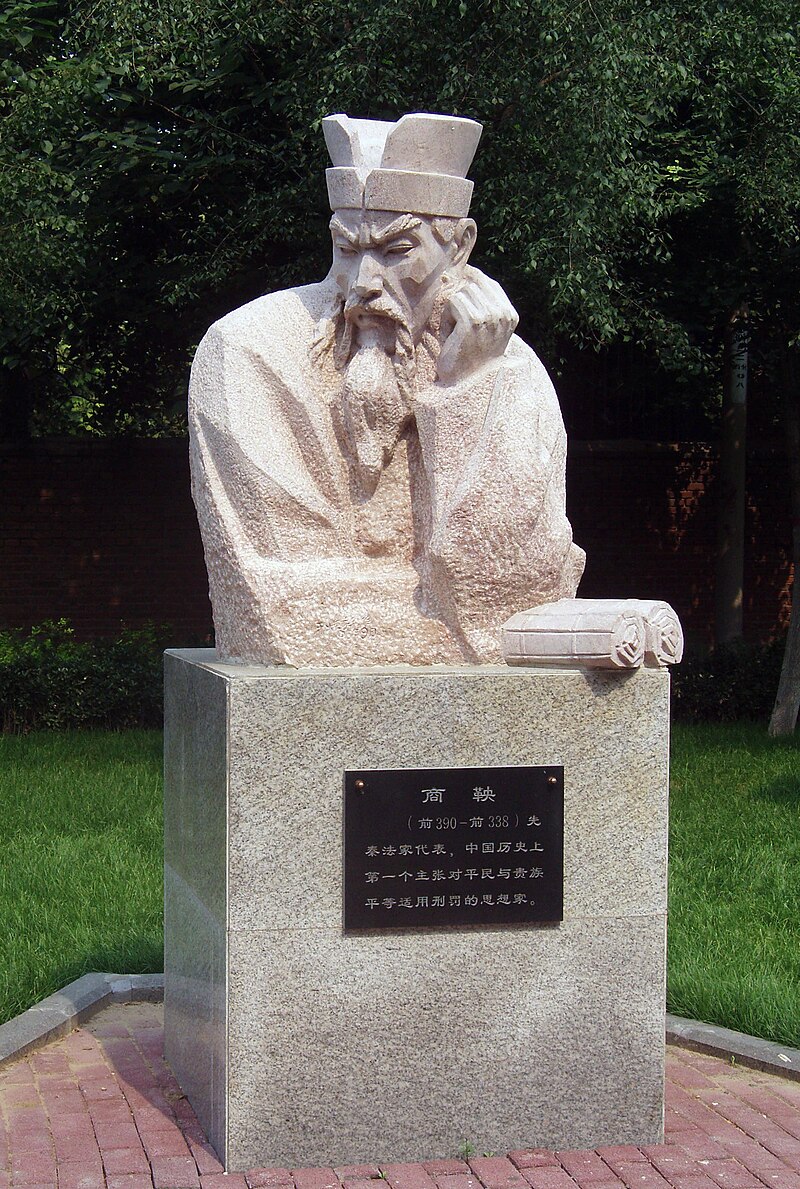
File:Statue_of_Shang_Yang.jpg · Wikimedia Commons · See Wikimedia Commons
Shang Yang
Sign in to saveQin State statesman, chancellor and reformer (c. 390–338 BC)
Key facts
- Chinese
- 商鞅
- Hanyu pinyin
- Shāng Yāng
- Bopomofo
- ㄕㄤ ㄧㄤ
- Gwoyeu romatzyh
- Shang Iang
- Wade giles
- Shang Yang
- Tongyong pinyin
- Shang Yang
- Ipa
- [ʂa ́ ŋ ja ́ ŋ]
- Yale romanization
- Sēung Yēung
- Jyutping
- soeng1 joeng1
- T i l
- Siong Ng
- Baxter sagart 2014
- * s.taŋ ʔaŋ
via Wikipedia infobox
Wikidata facts
- Instance of
- human
- Family name
- Jī
- Gender
- male
- Citizenship
- Qin
- Place of birth
- Puyang
- Place of death
- Xianyang
- Occupation
- philosopher
- Languages spoken
- Old Chinese
- Field of work
- philosophy
- Image
- Statue of Shang Yang.jpg
Show 8 more facts
- date of birth
- 0390-01-01
- on focus list of Wikimedia project
- Wikipedia:Vital articles/Level/4
- date of death
- 0338-01-01
- name in native language
- 商鞅
- Commons category
- Shang Yang
- manner of death
- capital punishment
- described by source
- Records of the Grand Historian
- birth name
- 公孫鞅
Sources (1)
via Wikidata · CC0
~19 min read
Encyclopedic overview
Shang Yang (Chinese: 商鞅; c. 390 – 338 BC), also known as Wei Yang (Chinese: 衞鞅) and originally surnamed Gongsun, was a chancellor and reformer of the State of Qin. More evidently famous in the late Warring States period outside Qin as a renowned military leader, he ultimately became arguably the "most famous and influential statesman" from the (early) Warring States period. Possibly going into broad circulation late in the period, writings associated with Shang Yang went on to influence the Han Feizi.
Born in the Zhou vassal state of Wey, he migrated to Wei, ultimately finding office in Qin in 359 BCE. Becoming Qin's chief minister for twenty years, he launched two series of reforms, laying the administrative, political and economic foundations that would eventually enable Qin to conquer the other six rival states, unifying China under centralized rule for the first time under the Qin dynasty. Scholars consider it likely that both he and his followers contributed to The Book of Lord Shang.
Excerpted from Wikipedia’s “Shang Yang” article, available under the CC BY-SA 4.0 licence.