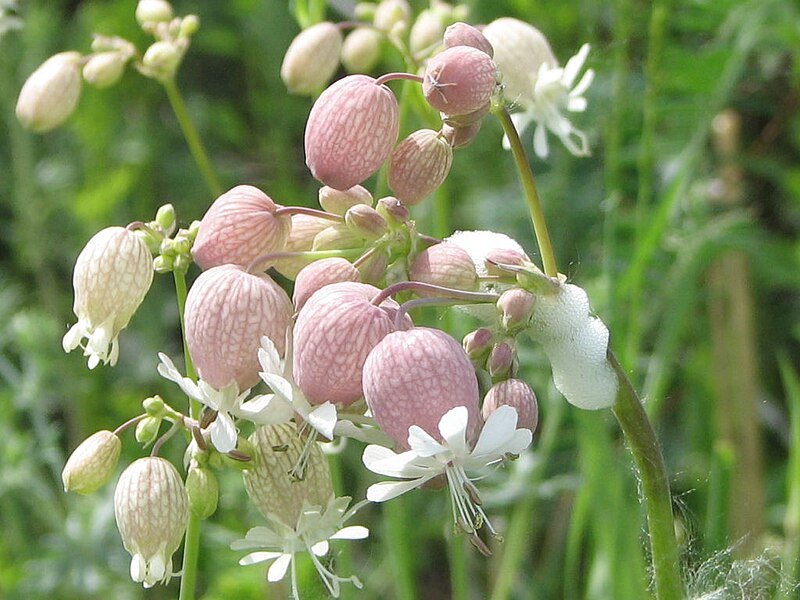
File:Bladder_Campion.jpg · Wikimedia Commons · See Wikimedia Commons
OverviewAI-generated
Silene vulgaris, commonly known as bladder campion, is a species in the family Caryophyllaceae. The scientific name is cited as Silene vulgaris (Moench) Garcke. It belongs to the genus Silene and is classified within the order Caryophyllales, class Magnoliopsida, phylum Tracheophyta, and kingdom Plantae. Other common names include maidenstears, Alcadicea, Ben blanco, and Gewöhnliches Leimkraut. The plant has uses as food and a medicinal plant.
The species is native to regions including Afghanistan, Albania, Algeria, Austria, Belarus, Belgium, Bulgaria, and the Baltic States. Its taxon range also includes China, Shanghai, and Xinjiang. Records indicate presence in the United States, Canada, Spain, Iran, and Chile. The IUCN Red List assessed the species as Least Concern in 2015.
Synthesized by Vinony from 41 facts across 8 sources: Wikidata, GBIF, iNaturalist, Gbif Occ, IUCN Red List, Plants of the World, iDigBio, Vinony graph. Generated from structured data (not the Wikipedia text) and checked against those facts — may still contain errors.
Species
Least Concernbladder campion
Silene vulgaris
SPECIES
- KingdomPlantae
- PhylumTracheophyta
- ClassMagnoliopsida
- OrderCaryophyllales
- FamilyCaryophyllaceae
Das Taubenkropf-Leimkraut (Silene vulgaris), auch Gewöhnliches Leimkraut, Aufgeblasenes Leimkraut, Klatschnelke, Blasen-Leimkraut oder Knirrkohl genannt, ist eine Pflanzenart innerhalb der Familie der Nelkengewächse (Caryophyllaceae). Obwohl diese Wiesenpflanze zur Gattung der Leimkräuter zählt, ist sie nicht klebrig.[1] Vom Namen Taubenkropf-Leimkraut her kann diese Art leicht mit dem Taubenkropf oder Hühnerbiss (Cucubalus baccifer) verwechselt werden, der auch eine ähnliche Blütenform aufweist. Inhaltsverzeichnis 1 Beschreibung 1.1 Vegetative Merkmale 1.2 Generative Merkmale 2 Ökologie 3 Vorkommen 4 Systematik 4.1 Unterart Gewöhnliches Taubenkropf-Leimkraut 4.2 Unterart Kies-Leimkraut 5 Verwendung 6 Bilder 7 Quellen 7.1 Einzelnachweise 8 Weblinks Beschreibung Illustration aus Flora Batava, Volume 11 Ausschnitt eines Blütenstandes Vegetative Merkmale Das Taubenkropf-Leimkraut ist eine ausdauernde krautige Pflanze, die Wuchshöhen von meist 20 bis 50 (15 bis 60) Zentimetern erreicht.[2] Die Wurzeln können bis in eine Tiefe von 1 Meter eindringen. Jedes Pflanzenexemplar besitzt einige wenige oder nur einen einzelnen aufsteigenden oder aufrechten Stängel, der im oberen Bereich verzwei
via GBIF · IUCN · Kew POWO
Museum specimens
- Specimen records
- 5,868
- With media
- 4,290
- Family
- Caryophyllaceae
- Collections
- USFWS, UNIVERSITY OF ALBERTA MUSEUMS, MEL, BHSC, CAS, RSA
- Recorded in
- United States, Canada, Spain, Iran (Islamic Republic Of), Chile, Romania
Wikidata facts
- Instance of
- taxon
- Parent taxon
- Silene
- Image
- SileneVulgaris-bloem.jpg
- Has use
- medicinal plant
Show 10 more facts
- taxon rank
- species
- taxon name
- Silene vulgaris
- Commons category
- Silene vulgaris
- taxon common name
- pokalica
- IUCN conservation status
- Least Concern
- Commons gallery
- Silene vulgaris
- taxon range
- Xinjiang
- short name
- S. vulgaris
- taxon author citation
- Garcke
via Wikidata · CC0
~2 min read
Encyclopedic overview
Silene vulgaris flowers
Silene vulgaris, the bladder campion or maidenstears, is a plant species of the genus Silene within the family Caryophyllaceae. Native to the Old World, the plant has been naturalized elsewhere, including North America. The young shoots and leaves are edible.
Excerpted from Wikipedia’s “Silene vulgaris” article, available under the CC BY-SA 4.0 licence.