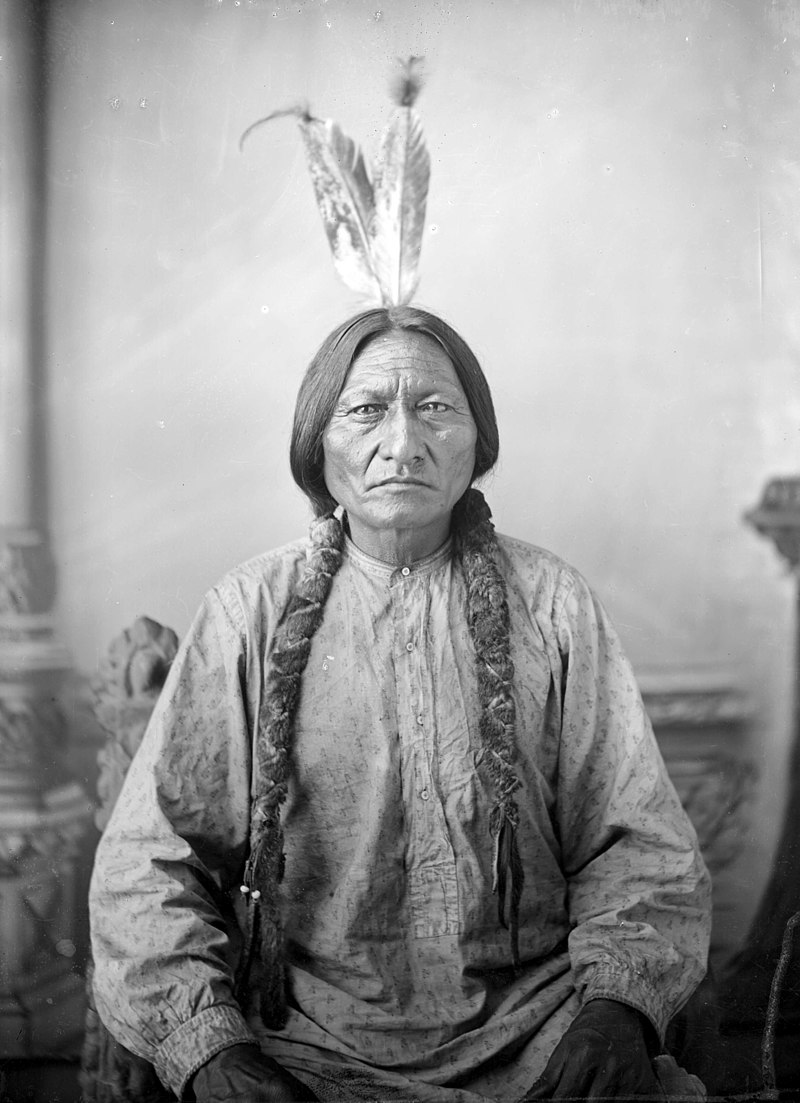
File:Sitting_Bull_by_D_F_Barry_ca_1883_Dakota_Territory.jpg · Wikimedia Commons · See Wikimedia Commons
The Sioux, also known as Oceti Sakowin, are groups of Native American tribes and First Nations people from the Great Plains of North America, divided into two major linguistic groups called the Dakota and Lakota peoples. The name "Sioux" comes from a French version of an Ojibwe word and can refer to any ethnic group or language dialect within the broader Sioux Nation.
AI-generated from the Wikipedia summary — may contain errors.
Key facts
- Ethnic group.group
- Sioux
- Ethnic group.native_name
- Očhéthi Šakówiŋ
- Ethnic group.image
- Sitting Bull by D F Barry ca 1883 Dakota Territory.jpg
- Ethnic group.image_caption
- Sitting Bull, a Hunkpapa Lakota chief and holy man, 1831 – December 15, 1890.
- Ethnic group.population
- 170,110 (2010)
- Ethnic group.popplace
- United States: (South Dakota, Minnesota, Nebraska, Montana, North Dakota, Iowa, Wisconsin, Illinois, Wyoming)Canada: (Manitoba, Saskatchewan)
- Ethnic group.rels
- Wocekiye, Christianity (incl. syncretistic forms), traditional religion
- Ethnic group.langs
- Sioux language (Lakota, Western Dakota, Eastern Dakota), English
- Ethnic group.related
- Assiniboine, Dakota, Lakota, Nakoda, and other Siouan-speaking peoples
via Wikipedia infobox
Wikidata facts
- Instance of
- people
- Subclass of
- indigenous peoples of North America
- Country
- United States
- Chairperson
- Red Cloud
- Location
- Montana
- Image
- Red Cloud and other Sioux.jpg
Show 3 more facts
- Commons category
- Sioux
- topic's main category
- Category:Sioux
- language used
- Sioux
Sources (2)
via Wikidata · CC0
Article · Deutsch
Sioux (franz.: [sju:], engl.: [suː], deutsch: [zi:ʊks]) ist sowohl die Bezeichnung für eine Gruppe von nordamerikanischen Indianervölkern als auch für eine Sprachfamilie. Als Sioux werden drei Gruppen nahe miteinander verwandter Sprachen bezeichnet: Lakota, Westliche Dakota und (östliche) Dakota. Das Volk der Dakota diente als Namensgeber für die beiden US-Staaten North Dakota und South Dakota. Um 1800 dominierten diese Gruppen der Sioux fast ganz Nord- und Süd-Dakota, Nord-Nebraska, Ost-Wyoming, Süd-Montana, Nord-Iowa sowie den Westen Minnesotas. Die Assiniboine, die sich von den Yanktonai-Sioux abgespalten hatten, dominierten die südlichen kanadischen Prärieprovinzen sowie den Nordosten Montanas und den Nordwesten Nord-Dakotas. Die mit ihnen eng verwandten Stoney lebten meist nördlich und westlich der Assiniboine auf den Prärieprovinzen und streiften vom Süden British Columbias bis ins nördliche Montana. Laut dem US-Zensus von 2010 bezeichneten sich 170.110 Personen in den Vereinigten Staaten als Angehörige der Sioux-Nation. Sprachlich verwandt sind die Stämme der Absarokee, Hidatsa, Iowa, Kansa, Mandan, Missouri, Omaha, Osage, Oto, Ponca, Quapaw und Ho-Chunk (Winnebago).
Abstract from DBpedia / Wikipedia · CC BY-SA
Gallery (52)
Available in 62 languages
- Español
- Français
- Deutsch
- 中文
- 日本語
- Русский
- Português
- Italiano
- العربية
- हिन्दी
- Atikamekw
- azb
- Azerbaijani
- Bahasa Indonesia
- Basque
- Bavarian
- Belarusian
- Breton
Show 43 more
- Bulgarian
- Catalan
- Cheyenne
- Croatian
- Czech
- Esperanto
- Estonian
- Finnish
- Galician
- Georgian
- Greek
- Hebrew
- Irish
- Kazakh
- Latvian
- Lithuanian
- Low German
- Macedonian
- Malagasy
- Malay
- Malayalam
- Nederlands
- Norwegian
- Norwegian Nynorsk
- Polski
- Quechua
- Romanian
- Scots
- Serbian
- Serbian (Latin)
- simple
- Slovenian
- Svenska
- Türkçe
- Ukrainian
- Uzbek
- Venetian
- Welsh
- Western Frisian
- Wu Chinese
- zh_min_nan
- فارسی
- 한국어
via Wikidata sitelinks · CC0