
File:Calgary.jpg · Wikimedia Commons · See Wikimedia Commons
Also known as winter skiing, snow skiing
moyen de transport, activité récréative et sport de glisse
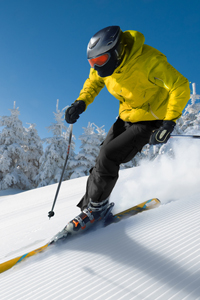
Skiing is the use of skis to glide on snow, practiced for transportation, recreation, or as a competitive winter sport. The sport is widely recognized internationally, with many skiing events included in the Olympic Games and governed by the International Ski and Snowboard Federation.
AI-generated from the Wikipedia summary — may contain errors.
Le ski est un moyen de locomotion individuel basé sur la glisse pratiqué à l'aide de patins longs et étroits appelés skis, fixés aux pieds, et un ensemble de disciplines sportives essentiellement hivernales. Vulgarisée grâce au ski sur neige, introduite dans les Alpes et les autres massifs européens à la fin du XIXe siècle, cette pratique est évidemment dépendante de la présence, de la résistance et de l'épaisseur du manteau neigeux, ce qui limite l'activité aux régions montagneuses ou nordiques, ainsi qu'à la saison hivernale, plus rarement en été, dans les stations d'altitude. Le ski peut également se pratiquer sur toutes surfaces glissantes possédant une tension superficielle non négligeable : l'eau — on parle alors de ski nautique —, des roches comme le sable ou la pouzzolane, les prairies en pente, voire des sols recouverts de neige ou de glace artificielles, d'aiguilles de pin, ou même d'armatures en treillis couvertes de feutres ou de textiles synthétiques sur des pistes en salle. Avant de devenir un sport de loisir, il n'était qu'un moyen de déplacement et un mode de transport, largement répandu pendant les longs hivers enneigés dans les pays nordiques, les contrées sibériennes et les montagnes de l'Asie centrale, sous une forme ressemblant à la fois au ski de randonnée nordique et au ski de fond, originaires de Scandinavie. Il a également servi de mode de déplacement hivernal dans certaines armées (guerre à ski). Originellement activité de pleine nature, le ski de descente, qui consiste à descendre des pentes de déclivité et de difficulté variables, a conduit à la construction de sites dédiés. Devenu ainsi sport de glisse prenant le nom en Europe de ski alpin, des domaines skiables et des stations de sports d'hiver ont été ainsi aménagées dans des sites jugés propices à une pratique ludique du ski moyennant travaux : terrassements, équipement de remontées mécaniques, de canons à neige, travail de la neige, etc. générant un vaste secteur touristique, notamment dans les Alpes. La pratique du ski en terrain à faible déclivité a conduit de son côté au développement de sports plus orientés pleine nature, comme les différentes disciplines du ski nordique. Bien que le ski de fond et le ski de descente soient regroupés sous la même appellation de « ski », aussi bien les techniques que le matériel sont très différents entre ces deux disciplines. Il existe aussi plusieurs techniques nordiques de ski de randonnée et de descente, qui portent le nom de localités ou de contrées de Norvège : le télémark, le christiania…
Abstract from DBpedia / Wikipedia · CC BY-SA
Discovered by embedding cosine similarity (sentence-transformers MiniLM, 384-dim).
via PubMed

What is Skiing | Skiing Information | Alpine Skiing | Go Skiing Go Snowboarding
What is skiing? Find the answer to that question, as well as a historical overview of alpine skiing by visiting us now!
skicanada.org →Alpine skiing is the sport of sliding down snow-covered hills on skis with fixed-heel bindings. It is also commonly known as downhill skiing, although that also incorporates different styles. Alpine skiing can be contrasted with skiing using free-heel bindings; ski mountaineering and nordic skiing – such as cross-country; ski jumping; and telemark. Alpine skiing is popular wherever the combination of snow, mountain slopes, and a sufficient tourist infrastructure can be built up, including parts of Europe, North America, Australia and New Zealand, the South American Andes, and East Asia. Alpine skiing began as a club sport in 1861 at Kiandra in Australia and a number of similar clubs in North America and the Swiss Alps. Today, most alpine skiing occurs at a ski resort with ski lifts that transport skiers up the mountain. The snow is groomed, avalanches are controlled and trees are cut to create trails. Many resorts also include snow making equipment to provide skiing when the weather would otherwise not allow it. Alternatively, alpine skiers may pursue the sport in less controlled environments; this practice is variously referred to as ski touring, backcountry skiing, or extreme skiing. In competitive alpine skiing races four disciplines exist: slalom, giant slalom, super giant slalom, and downhill. Slalom ski races have courses that require short tight turns, whereas giant-slalom races have courses which are set with more widely spaced turns. Super-giant slalom and downhill have few turns, the courses have gates spaced widely apart and skiers often reach 100 km/h. The majority of people who ski every year are recreational skiers. If you like to get out, ride the lifts and make a few turns at the local resort or on vacation a few times a year, you are a recreational skier. The whole idea when it comes to your skis is finding boards that make the experience more fun so that you can enjoy those precious days on the hill. You are in luck, recreational skier. New innovations in ski shapes and technology mean that it is far easier to ski than ever before. If you have not skied in a long time, you will soon learn that skis these days are shorter and feature more aggressive sidecuts (the difference between the width of the ski at the tip and waist), making it far easier to turn them. Recreational skis are built mostly to handle groomed runs, but that doesn’t mean you can’t push yourself and learn to ski bumps, trees and even powder on a good pair of recreational boards. Furthermore, rentals and demos have improved as well, making it easier for you to try out quality equipment at the resort to make a better decision about what ski is right for you. Freestyle Skiing is a form of skiing which originally encompassed two disciplines: aerials, and moguls. Besides those freestyle skiing now consists of skicross, half-pipe and slope style. Freeskiing is an Olympic discipline which shares characteristics with street skateboarding, BMX, and inline skating. Currently there are two main branches of freestyle skiing: one encompassing the more traditional events of moguls and aerials, and a newer branch often called new school, comprising events such as halfpipe, big air, slopestyle, and big mountain or free-skiing. New school skiing has grown so much that new ski companies were created, companies that strictly make twin-tip skis — skis that are designed for taking off and landing “fakie”, or “switch” (backwards) on jumps and rails. Skiing in the backcountry on un groomed and unmarked slopes or pistes, including skiing in unmarked or unpatrolled areas either inside or outside of a ski resort’s boundaries, sometimes in the woods. Unlike groomed cross-country and alpine skiing, the land and the snow pack are not monitored, patrolled, or maintained.
Excerpt from a page describing this subject · 4,490 chars · not written by Vinony
via Wikidata · CC0
via Wikidata sitelinks · CC0