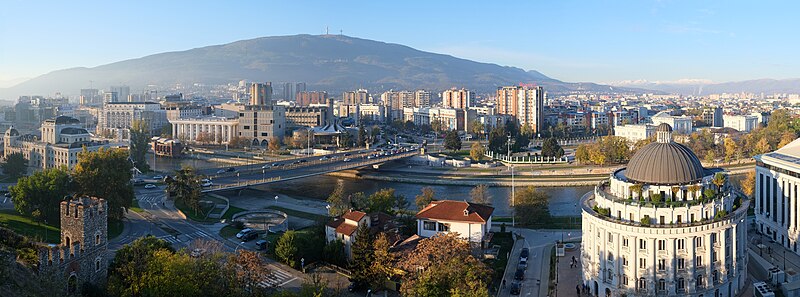
File:Skopje_view_from_Kale_3.jpg · Wikimedia Commons · See Wikimedia Commons
Skopje
Sign in to saveAlso known as Üsküb, Skoplje, Shkup, Shkupi, Escópia
Skopje is the capital and largest city of North Macedonia. It lies in the northern part of the country, in the Skopje Valley along the Vardar River, and is the political, economic, and cultural centre of the country. As of the 2021 census, the city had a population of 526,502. Skopje covers and includes both urban and rural areas, bordered by several municipalities and close to the borders of Kosovo and Serbia.
Skopje is the capital and largest city of North Macedonia, serving as the country's political, economic, and cultural hub. Located in the northern Skopje Valley along the Vardar River with a population of over 526,000 as of 2021, it is positioned near the borders of Kosovo and Serbia.
AI-generated from the Wikipedia summary — may contain errors.
Key facts
- Settlement.name
- Skopje
- Settlement.official_name
- Град СкопјеQyteti i ShkupitCity of Skopje
- Settlement.settlement_type
- Capital city
- Settlement.imagesize
- 280px
- Settlement.image_flag
- Flag of City of Skopje.svg
- Settlement.flag_link
- Flag of Skopje
- Settlement.image_shield
- Coat of arms of Skopje.svg
- Settlement.shield_link
- Coat of arms of Skopje
- Settlement.mapframe
- yes
- Settlement.mapframe shape
- yes
- Settlement.mapsize
- 230px
- Settlement.map_caption
- Location of Skopje in North Macedonia
- Settlement.pushpin_map
- North Macedonia#Europe
- Settlement.pushpin_relief
- 1
- Settlement.subdivision_type
- Country
- Settlement.subdivision_type1
- Region
- Settlement.subdivision_name1
- Skopje Statistical
- Settlement.subdivision_type2
- Municipality
via Wikipedia infobox
Wikidata facts
- Instance of
- capital city
- Official name
- Skopje
- Demonym
- scopiesi
- Located in
- Skopje Statistical Region
- Official language
- Albanian
- Population
- 386000
- Area
- 571.46
- Elevation
- 251
- Time zone
- UTC+01:00
- Body of water
- Vardar
- Capital of
- Kosovo Vilayet
- Official website
- skopje.gov.mk
- Image
- Stone Bridge Skopje 4.jpg
- Dialing code
- 02
- Licence plate code
- SK
- Flag
- flag of Skopje
- Patron saint
- Theotokos
- Connects with
- European route E65
Show 16 more facts
- P8168
- Matthias Bachinger
- category for honorary citizens of entity
- Category:Honorary citizens of Skopje
- native label
- Скопје
- Commons category
- Skopje
- postal code
- 1000
- topic's main category
- Category:Skopje
- twinned administrative body
- İzmir
- category for people born here
- Category:Births in Skopje
- category for people who died here
- Category:Deaths in Skopje
- category of associated people
- Category:People from Skopje
- Commons gallery
- Skopje
- located in/on physical feature
- Skopje Basin
- described by source
- Encyclopædia Britannica 11th edition
- P12749
- South West England
- different from
- City of Skopje
- number of viewers/listeners
- 422269
Sources (7)
via Wikidata · CC0
~84 min read
Encyclopedic overview
57 sectionsContents
- Name
- Geography
- Topography
- Hydrography
- Geology
- Climate
- Environment
- Urbanism
- Urban morphology
- Urban sociology
- Localities and villages
- Pollution
- History
- Origins
- Roman Scupi
- Middle Ages
- Ottoman period
- Balkan Wars to present day
- Emblems
- Administration
- Status
- City Council
- Mayor
- Municipalities
- Economy
- Economic weight
- Firms and activities
- Employment
- Demographics
- Population
- Ethnic groups
- Religion
- Health
- Education
- Media
- Sports
- Transport
- Main connections
- Rail and coach stations
- Public transport
- Airport
- Culture
- Cultural institutions
- Museums
- Architecture
- Festivals
- Nightlife
- People from Skopje
- International relations
- Twin towns – sister cities
- Partnerships
- See also
- Notes
- Citations
- General sources
- Further reading
- External links
Skopje is the capital and largest city of North Macedonia. It lies in the northern part of the country, in the Skopje Valley along the Vardar River, and is the political, economic, and cultural centre of the country. As of the 2021 census, the city had a population of 526,502. Skopje covers and includes both urban and rural areas, bordered by several municipalities and close to the borders of Kosovo and Serbia.
The area of Skopje has been continuously inhabited since at least the Chalcolithic period. The city — known as Scupi at the time — was founded in the late 1st century during the rule of Domitian, and abandoned in 518 after an earthquake destroyed the city. It was rebuilt under Justinian I. It became a significant settlement under the First Bulgarian Empire, the Serbian Empire (when it served briefly as a capital), and later under the Ottoman Empire, which ruled the city for over five centuries. In 1912, following the Balkan Wars, Skopje was annexed by the Kingdom of Serbia. It became part of Yugoslavia after World War I and, following World War II, became the capital of the Socialist Republic of Macedonia, one of its constituent republics. In 1963, a major earthquake devastated the city, after which it was largely rebuilt with international assistance. Skopje became the capital of independent North Macedonia in 1991.
Excerpted from Wikipedia’s “Skopje” article, available under the CC BY-SA 4.0 licence.
Gallery (52)
On the map
3 mapped locations
Available in 170 languages
- Español
- Français
- Deutsch
- 中文
- 日本語
- Русский
- Português
- Italiano
- العربية
- हिन्दी
- Abkhazian
- Achinese
- Afrikaans
- Albanian
- Albanian
- Amharic
- Aragonese
- Armenian
Show 151 more
- Asturian
- azb
- Azerbaijani
- Bahasa Indonesia
- Balinese
- Bangla
- Bashkir
- Basque
- bat_smg
- be_x_old
- Belarusian
- Betawi
- Bhojpuri
- Bikol
- Bosnian
- Breton
- Bulgarian
- Catalan
- cdo
- Cebuano
- Central Kurdish
- Chechen
- Church Slavic
- Chuvash
- Cornish
- Crimean Tatar
- Croatian
- Czech
- Danish
- Egyptian Arabic
- Erzya
- Esperanto
- Estonian
- Faroese
- Fiji Hindi
- Filipino
- Finnish
- fiu_vro
- Galician
- Georgian
- Gothic
- Greek
- Haitian Creole
- Hakka Chinese
- Hausa
- Hebrew
- Hungarian
- Icelandic
- Ido
- Interlingua
- Interlingue
- Irish
- Javanese
- Kashmiri
- Kazakh
- kge
- Komi
- Kongo
- Kotava
- Kurdish
- Ladino
- Latin
- Latvian
- Ligurian
- Lingala
- Lingua Franca Nova
- Lithuanian
- Lombard
- Lower Sorbian
- Luxembourgish
- Macedonian
- Malagasy
- Malay
- Malayalam
- Maltese
- Manx
- Māori
- Marathi
- Mazanderani
- Minangkabau
- Mingrelian
- Moksha
- Mongolian
- Moroccan Arabic
- Nederlands
- Northern Frisian
- Northern Sami
- Norwegian
- Norwegian Nynorsk
- Novial
- Occitan
- olo
- Ossetic
- Papiamento
- Pashto
- Piedmontese
- Polski
- Pontic
- Punjabi
- Quechua
- roa_rup
- Romanian
- Romany
- Rusyn
- Sardinian
- Scots
- Scottish Gaelic
- Serbian
- Serbian (Latin)
- Shona
- Sicilian
- Silesian
- simple
- Sindhi
- Slovak
- Slovenian
- Svenska
- Swahili
- Tajik
- Talysh
- Tamil
- Tatar
- Tibetan
- Tiếng Việt
- Türkçe
- Udmurt
- Ukrainian
- Upper Sorbian
- Urdu
- Uyghur
- Uzbek
- Venetian
- Veps
- Volapük
- Waray
- Welsh
- West Flemish
- Western Frisian
- Western Panjabi
- Wolof
- Wu Chinese
- Yakut
- Yiddish
- Yoruba
- Zaza
- Zeelandic
- zh_min_nan
- zh_yue
- فارسی
- ไทย
- 한국어
via Wikidata sitelinks · CC0