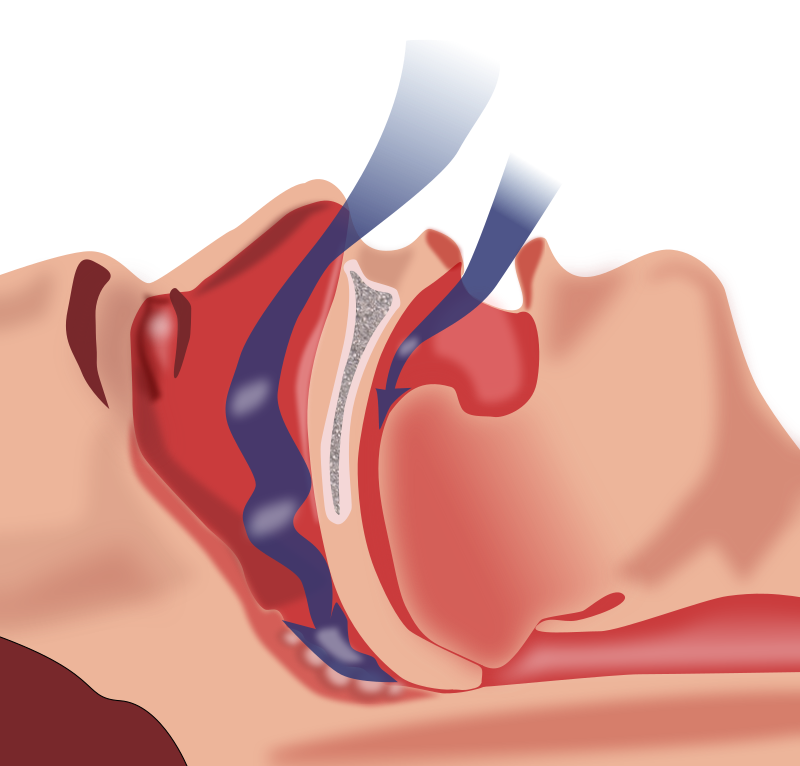
File:Obstruction_ventilation_apnée_sommeil.svg · Wikimedia Commons · See Wikimedia Commons
sleep apnea
Sign in to saveAlso known as sleep apnea syndrome, kos, sleep apnea syndromes, sleep apnoea, sleep apnœa
sleep disorder characterized by repeated cessation and commencing of breathing that disrupts sleep
Sleep apnea is a sleep disorder where your breathing repeatedly stops and starts during the night, which disrupts your sleep. It matters because these breathing interruptions prevent you from getting quality rest and can affect your overall health and daytime functioning.
AI-generated from the Wikipedia summary — may contain errors.
Research
69,490 papers- Sleep apnoea and ischaemic stroke: current knowledge and future directions.ReviewThe Lancet. Neurology · 2022Baillieul S, Dekkers M, Brill AK et al.DOI: 10.1016/S1474-4422(21)00321-5
- Sleep disordered breathing: management update.ReviewInternal medicine journal · 2017Mohammadieh A, Sutherland K, Cistulli PADOI: 10.1111/imj.13606
- [Sleep apnea in women : prevalence, symptoms, phenotypes, and treatment].ReviewRevue medicale suisse · 2025Fonseca AL, Chheang C, Eskioglou E et al.DOI: 10.53738/REVMED.2025.21.939.47832
- Sleep apnea.Indian journal of pediatrics · 2006Nanaware SK, Gothi D, Joshi JMDOI: 10.1007/BF02759925
- [Sleep apnea syndromes in adults].ReviewRevue d'electroencephalographie et de neurophysiologie clinique · 1987Krieger JDOI: 10.1016/s0370-4475(87)80029-1
- Evaluation of isotretinoin effects on depression, sleep apnea and sleep quality.Cutaneous and ocular toxicology · 2024Orenay OM, Temel B, Capci AK et al.DOI: 10.1080/15569527.2024.2340435
- Sleep apnoea and stroke.ReviewStroke and vascular neurology · 2016Sharma S, Culebras ADOI: 10.1136/svn-2016-000038
- Sleep-disordered breathing - clinical spectrum.ReviewAustralian dental journal · 2024Mohammadieh AM, Chan A, Cistulli PADOI: 10.1111/adj.13043
via PubMed
Wikidata facts
- Instance of
- symptom or sign
- Subclass of
- disease
- Image
- Obstruction ventilation apnée sommeil.svg
Show 10 more facts
- health specialty
- pulmonology
- Commons category
- Sleep apnea
- ICPC 2 ID
- P06
- exact match
- purl.obolibrary.org/obo/SYMP_0000581
- NCI Thesaurus ID
- C26884
- ICD-9-CM
- 780.57
- different from
- amnesia
- possible treatment
- weight loss
- on focus list of Wikimedia project
- WikiProject Medicine
- drug or therapy used for treatment
- continuous positive airway pressure
Sources (7)
via Wikidata · CC0
~34 min read
Encyclopedic overview
Sleep apnea (sleep apnoea or sleep apnœa in British English) is a sleep-related breathing disorder in which repetitive pauses in breathing, periods of shallow breathing, or collapse of the upper airway during sleep result in poor ventilation and sleep disruption. Each pause in breathing can last for a few seconds to a few minutes and often occurs many times a night. A choking or snorting sound may occur when breathing resumes. Common symptoms include daytime sleepiness, snoring, and non-restorative sleep despite adequate sleep time. Because the disorder disrupts normal sleep, those affected may experience sleepiness or feel tired during the day. It is often a chronic condition.
Sleep apnea may be categorized as obstructive sleep apnea (OSA), in which breathing is interrupted by a blockage of air flow, central sleep apnea (CSA), in which regular unconscious breath simply stops, or a combination of the two. OSA is the most common form. OSA has four key contributors; these include a narrow, crowded, or collapsible upper airway, an ineffective pharyngeal dilator muscle function during sleep, airway narrowing during sleep, and unstable control of breathing (high loop gain). In CSA, the basic neurological controls for breathing rate malfunction and fail to give the signal to inhale, causing the individual to miss one or more cycles of breathing. If the pause in breathing is long enough, the percentage of oxygen in the circulation can drop to a lower than normal level (hypoxemia) and the concentration of carbon dioxide can build to a higher than normal level (hypercapnia). In turn, these conditions of hypoxia and hypercapnia will trigger additional effects on the body such as Cheyne–Stokes respiration.
Excerpted from Wikipedia’s “sleep apnea” article, available under the CC BY-SA 4.0 licence.