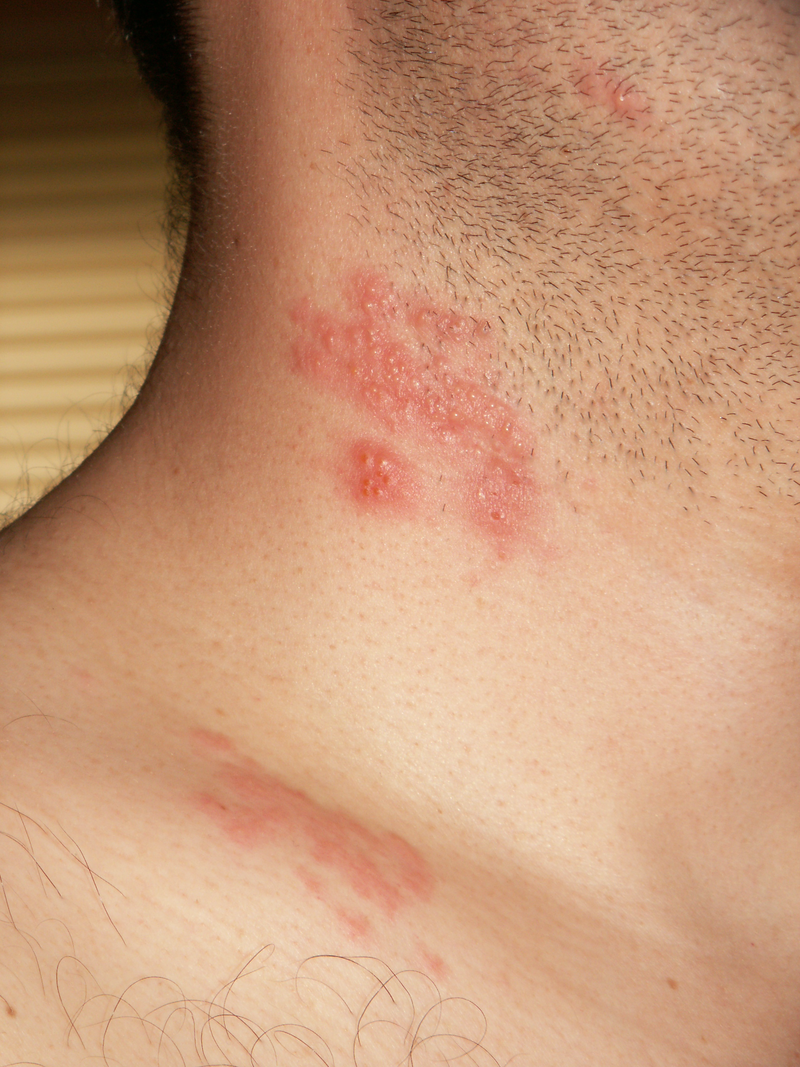
File:Herpes_zoster_neck.png · Wikimedia Commons · See Wikimedia Commons
herpes zoster
Sign in to saveAlso known as herpes zona, shingles, zoster, zona, Herpes zoster, Zoster, postherpetic neuralgia, St. Anthony's Fire
Shingles, also known as herpes zoster or zona, is a viral disease characterized by a painful skin rash with blisters in a localized area. Typically the rash occurs in a single, wide mark either on the left or right side of the body or face. Two to four days before the rash occurs, there may be tingling or local pain in the area. Other common symptoms are fever, headache, and tiredness. The rash usually heals within two to four weeks, but some people develop ongoing nerve pain which can last for months or years, a condition called postherpetic neuralgia (PHN). In those with poor immune function
Herpes zoster, also known as shingles, is a viral infection that causes a painful rash with blisters, usually appearing as a single stripe on one side of the body or face. While the rash typically heals within two to four weeks, some people experience lasting nerve pain that can persist for months or years after the rash disappears.
AI-generated from the Wikipedia summary — may contain errors.
Key facts
- Medical condition (new).name
- Shingles
- Medical condition (new).synonyms
- Herpes zoster
- Medical condition (new).image
- Herpes zoster neck.png
- Medical condition (new).caption
- Herpes zoster blisters on the neck and shoulder
- Medical condition (new).field
- Dermatology
- Medical condition (new).symptoms
- Painful rash
- Medical condition (new).complications
- Meningitis, facial nerve palsy, keratitis, postherpetic neuralgia
- Medical condition (new).duration
- 2–4 weeks
- Medical condition (new).causes
- Varicella zoster virus (VZV)
- Medical condition (new).risks
- Old age, poor immune function, having had chickenpox before 18 months of age
- Medical condition (new).diagnosis
- Based on symptoms
- Medical condition (new).differential
- Herpes simplex, chest pain, insect bites, cutaneous leishmaniasis
- Medical condition (new).prevention
- Shingles vaccine, chickenpox vaccine (before the child gets chickenpox)
- Medical condition (new).medication
- Aciclovir (if given early), pain medication
- Medical condition (new).frequency
- 33% (at some point)
- Medical condition (new).deaths
- 6,400 per year (including chickenpox deaths)
via Wikipedia infobox
Research
22,535 papers- Herpes Zoster.ReviewAnnals of internal medicine · 2018Schmader KDOI: 10.7326/AITC201808070
- [Diagnosis, treatment and prophylaxis of herpes zoster].ReviewZeitschrift fur Rheumatologie · 2020Ehrenstein BDOI: 10.1007/s00393-020-00915-y
- Herpes zoster - typical and atypical presentations.ReviewPostgraduate medicine · 2017Dayan RR, Peleg RDOI: 10.1080/00325481.2017.1335574
- Epidemiology, treatment and prevention of herpes zoster: A comprehensive review.ReviewIndian journal of dermatology, venereology and leprology · 2018Koshy E, Mengting L, Kumar H et al.DOI: 10.4103/ijdvl.IJDVL_1021_16
- Herpes zoster infection.ReviewBMJ (Clinical research ed.) · 2019Le P, Rothberg MDOI: 10.1136/bmj.k5095
- Herpes Zoster Ophthalmicus.ReviewPrimary care · 2015Johnson JL, Amzat R, Martin NDOI: 10.1016/j.pop.2015.05.007
- [Herpes Zoster Vaccine].ReviewUirusu · 2018Watanabe DDOI: 10.2222/jsv.68.21
- Herpes zoster infection in patients with inflammatory bowel disease.ReviewThe Korean journal of internal medicine · 2025Kim DH, Kang SBDOI: 10.3904/kjim.2024.342
via PubMed
Wikidata facts
- Instance of
- symptom or sign
- Subclass of
- disease
- Image
- Herpes zoster neck.png
Show 11 more facts
- Commons category
- Herpes zoster
- NCI Thesaurus ID
- C71079
- health specialty
- neurology
- ICPC 2 ID
- S70
- drug or therapy used for treatment
- pregabalin
- exact match
- identifiers.org/doid/DOID:8536
- has cause
- Human herpesvirus 3
- anatomical location
- ganglion
- ICD-9-CM
- 053
- symptoms and signs
- paresthesia
- on focus list of Wikimedia project
- WikiProject Medicine
Sources (7)
via Wikidata · CC0
~29 min read
Encyclopedic overview
20 sectionsContents
- Signs and symptoms
- Face
- Disseminated shingles
- Pathophysiology
- Diagnosis
- Differential diagnosis
- Prevention
- Treatment
- Analgesics
- Antivirals
- Steroids
- Zoster ophthalmicus
- Prognosis
- Epidemiology
- History
- Etymology
- Research
- References
- Further reading
- External links
Shingles, also known as herpes zoster or zona, is a viral disease characterized by a painful skin rash with blisters in a localized area. Typically the rash occurs in a single, wide mark either on the left or right side of the body or face. Two to four days before the rash occurs, there may be tingling or local pain in the area. Other common symptoms are fever, headache, and tiredness. The rash usually heals within two to four weeks, but some people develop ongoing nerve pain which can last for months or years, a condition called postherpetic neuralgia (PHN). In those with poor immune function the rash may occur widely. If the rash involves the eye, vision loss may occur.
Shingles is caused by the varicella zoster virus (VZV) that also causes chickenpox. In the case of chickenpox, also called varicella, the initial infection with the virus typically occurs during childhood or adolescence. Once the chickenpox has resolved, the virus can remain dormant (inactive) in human nerve cells (dorsal root ganglia or cranial nerves) for years or decades, after which it may reactivate and travel along nerve bodies to nerve endings in the skin, producing blisters. During an outbreak of shingles, exposure to the varicella virus found in shingles blisters can cause chickenpox in someone who has not yet had chickenpox, although that person will not suffer from shingles, at least on the first infection. How the virus subsequently re-activates is not well understood.
Excerpted from Wikipedia’s “herpes zoster” article, available under the CC BY-SA 4.0 licence.
Gallery (31)
Available in 75 languages
- Español
- Français
- Deutsch
- 中文
- 日本語
- Русский
- Português
- Italiano
- العربية
- Afrikaans
- Aragonese
- Asturian
- azb
- Azerbaijani
- Bahasa Indonesia
- Balinese
- Basque
- be_x_old
Show 56 more
- Belarusian
- Bulgarian
- Catalan
- cdo
- Central Kurdish
- Croatian
- Czech
- Danish
- Esperanto
- Estonian
- Finnish
- Galician
- gpe
- Greek
- Hausa
- Hebrew
- Icelandic
- Irish
- Kashmiri
- Kazakh
- Latin
- Latvian
- Luxembourgish
- Malagasy
- Malay
- Nederlands
- Nepali
- Northern Frisian
- Norwegian
- Odia
- Polski
- Punjabi
- Romanian
- Serbian
- Serbian (Latin)
- Sicilian
- simple
- Slovenian
- Svenska
- Swahili
- Tamil
- Telugu
- Tiếng Việt
- Türkçe
- Ukrainian
- Walloon
- Waray
- Welsh
- Wu Chinese
- Yiddish
- zh_classical
- zh_yue
- Zhuang
- فارسی
- ไทย
- 한국어
via Wikidata sitelinks · CC0