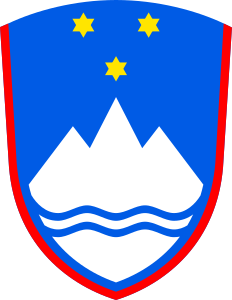
Also known as Slovenija, Republika Slovenija, si, svn, slo, Republic of Slovenia
मध्य यूरोप में स्थित एक देश
Slovenia is a small Central European country bordered by Italy, Austria, Hungary, and Croatia, with a coastline on the Adriatic Sea, known for its mountainous and forested terrain and a population of about 2.1 million people. It matters as a bridge between Central Europe and the Mediterranean, with its own distinct Slovene language and culture, and serves as an important regional player in European geography and politics.
AI-generated from the Wikipedia summary — may contain errors.
via Open-Meteo
thumb|240px|Cyclists tour the region of Upper Carniola. Slovenia is a relatively small country and getting around is generally quick and painless. However, the explosive growth in car ownership has meant tougher times for public transport, and bus schedules in particular have been slashed, so some planning ahead is required. Services are sparse on Saturdays and very limited indeed on Sundays. A handy online planning tool for intercity public transportation is www.simo.si .
Slovenian cities leave no doubt about historic influence played by Austrian and Italian architecture: Ljubljana is not unlike Prague and Piran could be easily mistaken for a small Italian town. While cities are far from boring, the real Slovenian must-see is its diverse and unspoiled nature.
250px|thumb|right|Ljubljana's Triple Bridge and Prešeren Square at night
Visit the alpine resort of Bled and its romantic lake with an island, but continue towards Srednja vas to see some traditional villages, or hitch a ride to Pokljuka mountain, a good starting point for hikes into Julian Alps. Enjoy the 5.3 km ride through Postojna caves, the longest publicly accessible depth of any cave system in the world, with massive stalactites and stalagmites. After visiting the lively coastal town of Piran, a trip to the serene salt works of nearby Sečovlje will feel like stepping out of this world. Soča river is said to be one of the few rivers in the world to retain their emerald green color throughout its length. The Trenta valley, through which it flows before crossing to Italy, is also well worth seeing. Slovenian pint-size baroque capital Ljubljana is nice in any season but especially popular in December due to its abundant but tasteful decoration.
thumb|Hiking in Triglavski Narodni Park
There are many great opportunities for activity holidays in Slovenia: The mountains and rivers of the Julian Alps provide the perfect location for hiking, mountain biking, rafting and kayaking. The southern part of Slovenia is an area of numerous caves. You can enjoy different spa resorts in the eastern part, take a dive in the Adriatic Sea, experience the Slovene cities, go skiing, or enjoy in the countryside tasting Slovene cuisine and local wine. Since Slovenia is a small country, you can discover it in a few days. Therefore you can visit Ljubljana (the capital city), the Julian Alps, Karst region, alpine lakes within several days. A more detailed look at the country, however, requires much more time.
6 mapped locations
via REST Countries
via World Bank Open Data · CC BY 4.0
via Wikimedia Pageviews API
via Wikipedia infobox
via PubMed
via Wikidata · CC0
Adrenaline adventures in the Posočje area, you can stay in Ljubljana and, in a short distance away, discover the amazing North-Western area of Slovenia called Posočje and Triglav National Park—canyoning (soteskanje), rafting and para-gliding are available. Because of the relatively new appearance of Slovenia on the national stage of extreme sports, these are much less expensive to participate in than other European countries, such as the UK or Switzerland. These activities are particularly prevalent in Bohinj, Bovec, Kranjska Gora, and other north-western cities. There are more than 8,000 known caves in Slovenia, including the tourist area of Postojna and the UNESCO listed Škocjan Caves. Take advantage of beautiful nature in the Alps …
People from Slovenia's northern neighbour Austria come to Slovenia just for the food; with a mixture of Subalpine, Italian, Austrian, Hungarian and Balkan cuisine, most people will find something to their liking, unless they're strict vegetarians. Many claim that the pizza here is as good as or even better than in neighboring Italy.
In proper Slovene style, all bases are covered for drinks and you can get very good Slovenian beers, wines and spirits. Tap water is generally drinkable.
thumb|Mountain hut at Petrovo Brdo Slovenia has a wide variety of accommodation, ranging from five star hotels to secluded cottages in the mountains.
thumb|Mounted police in Ljubljana Slovenia is one of the safest countries you can visit, but be aware of your surroundings in parts of Ljubljana.
The nationwide emergency number is 112. To call police, dial 113. There are emergency telephones interspersed along the main motorways. You can find the closest SOS-phone by the arrows on the reflection posts.
People may get a bit aggressive in crowded bars and discothèques, and it is not uncommon to be grabbed or groped.
Petty theft can occur everywhere. Don't worry about it, just don't leave your watch on the car seat while you go kayaking.
There are no unusual health concerns in Slovenia. Hygiene standards are high and tap water is potable.
While in nature, always use tick repellents, due to the Borreliosis and Meningitis danger. Borreliosis is very widespread in the country.
There are two species of venomous adders in the Julian Alps. You are unlikely to be bitten, but if you are, you should seek medical help as antiserums are available (although actually seldom administered). In the forests in the south, you may encounter a bear; Slovenia contains the highest bear population in Europe, but attacks are very rare. Normally, in countries that have been domesticated for several thousand years, the indigenous wild fauna will be either very skittish or very comfortable with humans. It depends on the area you are in, of course, but use your head. If you go camping in the Julian Alps and bring a lot of sausage and bacon, chances are you will attract some unwanted visitors.
Slovenians are generally open and friendly, so don't hesitate to address people as those younger than 50 understand English and will be eager to help you. You will impress them if you try using some basic Slovenian words. Slovenian is rarely spoken by foreigners, so your effort will be appreciated and rewarded.
Slovenians will insist when offering something, as "no" doesn't always mean "no," they just think it's polite for you to refuse, and polite for them to insist. Don't worry unnecessarily, but still you should take some normal precautions to study your host first.
Slovenians are proud for having preserved their national identity (especially the language) in spite of the pressures from neighboring nations in past centuries. Due to their economic success as well as historical and contemporary cultural bonds to Central Europe, they usually don't like their country to be described as part of "Eastern Europe". While Slovenian is closely related to Serbian and Croatian, it is not the same language. Another common misconception is that Slovenia was part of the Soviet Bloc, while it was in fact the northernmost country of Yugoslavia, which was neutral during the Cold War. You can, however, freely discuss these topics; just be aware that you can hear contrasting sides of the story, depending on who you talk to and his/her political affinity. There is still a strong division among leftists and rightists. Be careful if entering a discussion on open territorial issues with Croatia…
thumb|Internet cafe in Ljubljana
Travel guide from Wikivoyage (CC BY-SA 4.0)
via Wikidata sitelinks · CC0
Discovered by embedding cosine similarity (sentence-transformers MiniLM, 384-dim).