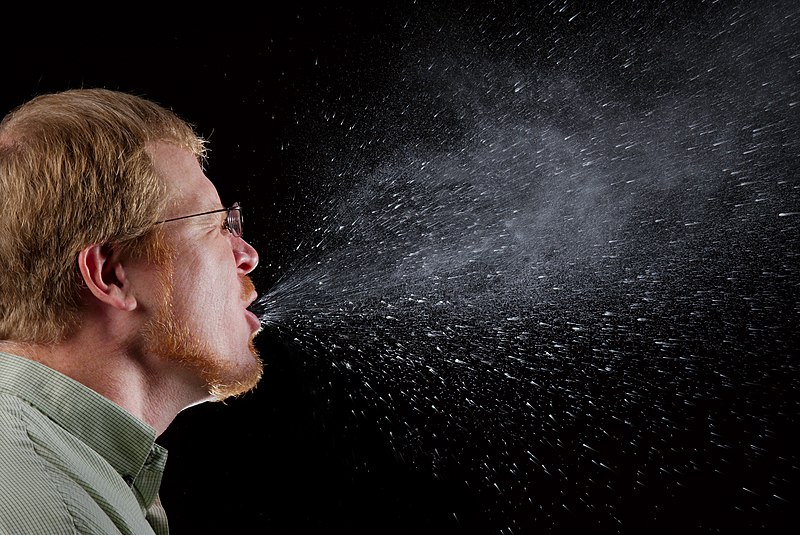
File:Sneeze.JPG · Wikimedia Commons · See Wikimedia Commons
starnuto
Sign in to saveAlso known as violent sneezing, sternutation, GO:0160023, sneezing, sneeze reflex
violenta emissione d'aria dai polmoni
A sneeze is a sudden, forceful expulsion of air from the lungs through the nose and mouth, typically triggered when foreign particles irritate the nasal passages. It matters because sneezes can spread airborne particles, which is why different methods of covering the nose and mouth—such as tissues, masks, and other devices—are used to reduce their dispersal.
AI-generated from the Wikipedia summary — may contain errors.
Key facts
- Body process.name
- Sneeze
- Body process.image
- Sneeze.JPG
- Body process.caption
- The function of sneezing is to expel irritants from the nasal cavity.
- Body process.biological system
- Respiratory system
- Body process.health
- Beneficial
- Body process.action
- Involuntary
- Body process.stimuli
- Irritants of the nasal mucosaLightCold airSnatiationAllergyInfection
- Body process.method
- Expulsion of air through nose/mouth
- Body process.outcome
- Removal of irritant
via Wikipedia infobox
Research
5,617 papers- Sneeze-induced chylothorax.Archivos de bronconeumologia · 2021Fornés S, Bielsa S, Porcel JMDOI: 10.1016/j.arbr.2021.05.017
- Wheeze, sneeze and genes.ReviewJournal of the Royal College of Physicians of London · 1994Hopkin J
- Sneeze and pop: a ruptured varicocele; analysis of literature, guided by a well-documented case-report.ReviewBMC urology · 2019Reesink DJ, Huisman PM, Wiltink J et al.DOI: 10.1186/s12894-019-0442-z
- Sneeze reflex: facts and fiction.ReviewTherapeutic advances in respiratory disease · 2009Songu M, Cingi CDOI: 10.1177/1753465809340571
- [Photic sneeze reflex or autosomal dominant compelling helio-ophthalmic outburst syndrome].ReviewNeurologia (Barcelona, Spain) · 2006García-Moreno JM
- The photic sneeze.Postgraduate medical journal · 1990Askenasy JJDOI: 10.1136/pgmj.66.781.892
- Why do we sneeze?Medical hypotheses · 2012Burke WDOI: 10.1016/j.mehy.2012.01.017
- Sneeze-induced pneumolabyrinth 15 years after stapedotomy.BMJ case reports · 2021Cheang YFA, Yeo SBDOI: 10.1136/bcr-2021-243575
via PubMed
Wikidata facts
- Instance of
- biological process
- Subclass of
- reflex
- Image
- Sneeze.JPG
Show 7 more facts
- Commons category
- Sneezing
- topic's main category
- Category:Sneeze
- ICPC 2 ID
- R07
- Unicode character
- 🤧
- on focus list of Wikimedia project
- WikiProject COVID-19
- exact match
- purl.obolibrary.org/obo/GO_0160023
- NCI Thesaurus ID
- C50746
Sources (2)
via Wikidata · CC0
Article · Italiano
Lo starnuto è una violenta emissione d'aria dai polmoni. Viene solitamente correlata ad uno stato di infiammazione virale, tipicamente nel raffreddore.La funzione del meccanismo per cui si starnutisce è eliminare tramite le vie aeree gli agenti patogeni.Si può anche starnutire a seguito di una reazione allergica verso qualche sostanza particolare oppure semplicemente per irritazione delle mucose nasali causata da polvere, pepe, ammoniaca e altre sostanze. Si può starnutire anche guardando il sole o altre fonti di luce, in questo caso si parla di starnuto riflesso fotico. La sindrome era nota già al tempo degli antichi greci con Aristotele, che ne fece menzione in alcune sue opere. Riguarda quasi il 15-35% della popolazione. Non solo gli umani starnutiscono, ma anche moltissimi mammiferi, fra cui gli animali domestici come il cane e il gatto.
Abstract from DBpedia / Wikipedia · CC BY-SA
Gallery (15)
Available in 86 languages
- Español
- Français
- Deutsch
- 中文
- 日本語
- Русский
- Português
- Italiano
- العربية
- हिन्दी
- Afrikaans
- Albanian
- Aragonese
- Armenian
- Asturian
- Azerbaijani
- Bahasa Indonesia
- Bangla
Show 67 more
- Banjar
- Basque
- Betawi
- Bikol
- Bosnian
- Bulgarian
- Catalan
- cdo
- Chuvash
- Croatian
- Czech
- Danish
- eml
- Esperanto
- Finnish
- Galician
- Greek
- Guarani
- Hausa
- Hebrew
- hyw
- Igbo
- Irish
- Javanese
- Kabyle
- Kannada
- Kashmiri
- Kazakh
- Kyrgyz
- Latvian
- Lithuanian
- Lombard
- Malagasy
- Malay
- Malayalam
- Marathi
- Mazanderani
- Nederlands
- Nepali
- Norwegian
- Norwegian Nynorsk
- Polski
- Punjabi
- Quechua
- Romanian
- Sardinian
- Serbian
- Serbian (Latin)
- simple
- Slovenian
- Svenska
- Swahili
- Tamil
- Telugu
- Tiếng Việt
- Türkçe
- Ukrainian
- Urdu
- Uzbek
- Walloon
- Wayuu
- Wu Chinese
- Yiddish
- zh_yue
- فارسی
- ไทย
- 한국어
via Wikidata sitelinks · CC0