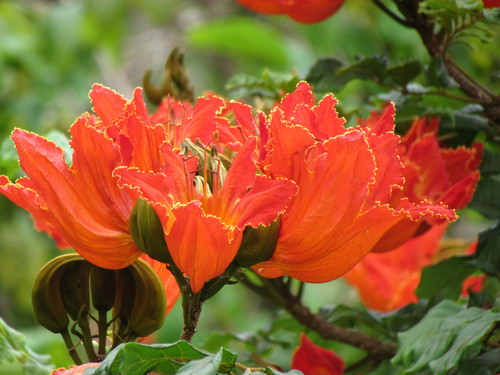
(c) squirrelwatcher019, some rights reserved (CC BY-NC), uploaded by squirrelwatcher019 · cc-by-nc
Spathodea
Sign in to saveAlso known as African tulip tree, African tuliptree
Spathodea is a genus in the plant family Bignoniaceae. The single species it contains, Spathodea campanulata, is commonly known as the African tulip tree or the Nandi Flame. The tree grows between tall and is native to tropical dry forests of Africa. It has been nominated as among 100 of the "World's Worst" invaders.
Species
African tulip tree
GENUS
- KingdomPlantae
- PhylumTracheophyta
- ClassMagnoliopsida
- OrderLamiales
- FamilyBignoniaceae
General: A monotypic genus with the only species, Spathodea
via GBIF · Kew POWO
Museum specimens
- Specimen records
- 65
- With media
- 36
- Family
- Bignoniaceae
- Collections
- MO, IAC, NY, MICH, BPBM, UFS
- Recorded in
- Guinea, Gabon, Central African Republic, Brasil, Kenya, United States, Spain, Philippines
Wikidata facts
- Instance of
- taxon
- Parent taxon
- Bignoniaceae
- Image
- Spathodea campanulata 3.jpg
Show 6 more facts
- taxon name
- Spathodea
- taxon rank
- genus
- topic's main category
- Category:Spathodea
- Commons category
- Spathodea
- taxon common name
- African Tuliptree
Sources (1)
via Wikidata · CC0
~5 min read
Encyclopedic overview
11 sectionsContents
- Description
- Flower anatomy
- Species associations
- Geographic distribution
- Pests and diseases
- Use
- Common names
- Gallery
- Footnotes
- References
- External links
Spathodea is a genus in the plant family Bignoniaceae. The single species it contains, Spathodea campanulata, is commonly known as the African tulip tree or the Nandi Flame. The tree grows between tall and is native to tropical dry forests of Africa. It has been nominated as among 100 of the "World's Worst" invaders.
This tree is planted extensively as an ornamental tree throughout the tropics and is much appreciated for its very showy reddish-orange or crimson (rarely yellow), campanulate flowers. The generic name comes from the Ancient Greek words σπαθη (spathe) and οιδα (oida), referring to the spathe-like calyx. It was identified by Europeans in 1787 on the Gold Coast of Africa.
Excerpted from Wikipedia’s “Spathodea” article, available under the CC BY-SA 4.0 licence.
Gallery (5)
Available in 13 languages
via Wikidata sitelinks · CC0