Murillo-Ramos, Leidys;Brehm, Gunnar;Sihvonen, Pasi;Hausmann, Axel;Holm, Sille;Ghanavi, Hamid Reza;Õunap, Erki;Truuverk, Andro;Staude, Hermann;Friedrich, Egbert;Tammaru, Toomas;Wahlberg, Niklas
Sterrhinae
Sign in to saveSterrhinae is a large subfamily of geometer moths (family Geometridae) with some 3,000 described species, with more than half belonging to the taxonomically difficult, very diverse genera, Idaea and Scopula (Hausmann, 2004; Sihvonen, 2005). This subfamily was described by Edward Meyrick in 1892. They are the most diverse in the tropics with the number of species decreasing with increasing latitude and elevation (Scoble et al., 1995; Hausmann, 2001, 2004; Brehm & Fiedler, 2003).
Museum specimens
- Specimen records
- 80
- With media
- 50
- Family
- Geometridae
- Collections
- VPI, YPM
- Recorded in
- United States, Jamaica, Kenya, Spain
Wikidata facts
- Instance of
- taxon
- Parent taxon
- Geometridae
- Image
- Idaea.aversata.6976.jpg
Show 4 more facts
- taxon rank
- subfamily
- taxon name
- Sterrhinae
- topic's main category
- Category:Sterrhinae
- Commons category
- Sterrhinae
Sources (1)
via Wikidata · CC0
~8 min read
Encyclopedic overview
7 sectionsContents
- Characteristics
- Larvae
- Systematics
- Former genera
- References
- Literature
- External links
Sterrhinae is a large subfamily of geometer moths (family Geometridae) with some 3,000 described species, with more than half belonging to the taxonomically difficult, very diverse genera, Idaea and Scopula (Hausmann, 2004; Sihvonen, 2005). This subfamily was described by Edward Meyrick in 1892. They are the most diverse in the tropics with the number of species decreasing with increasing latitude and elevation (Scoble et al., 1995; Hausmann, 2001, 2004; Brehm & Fiedler, 2003).
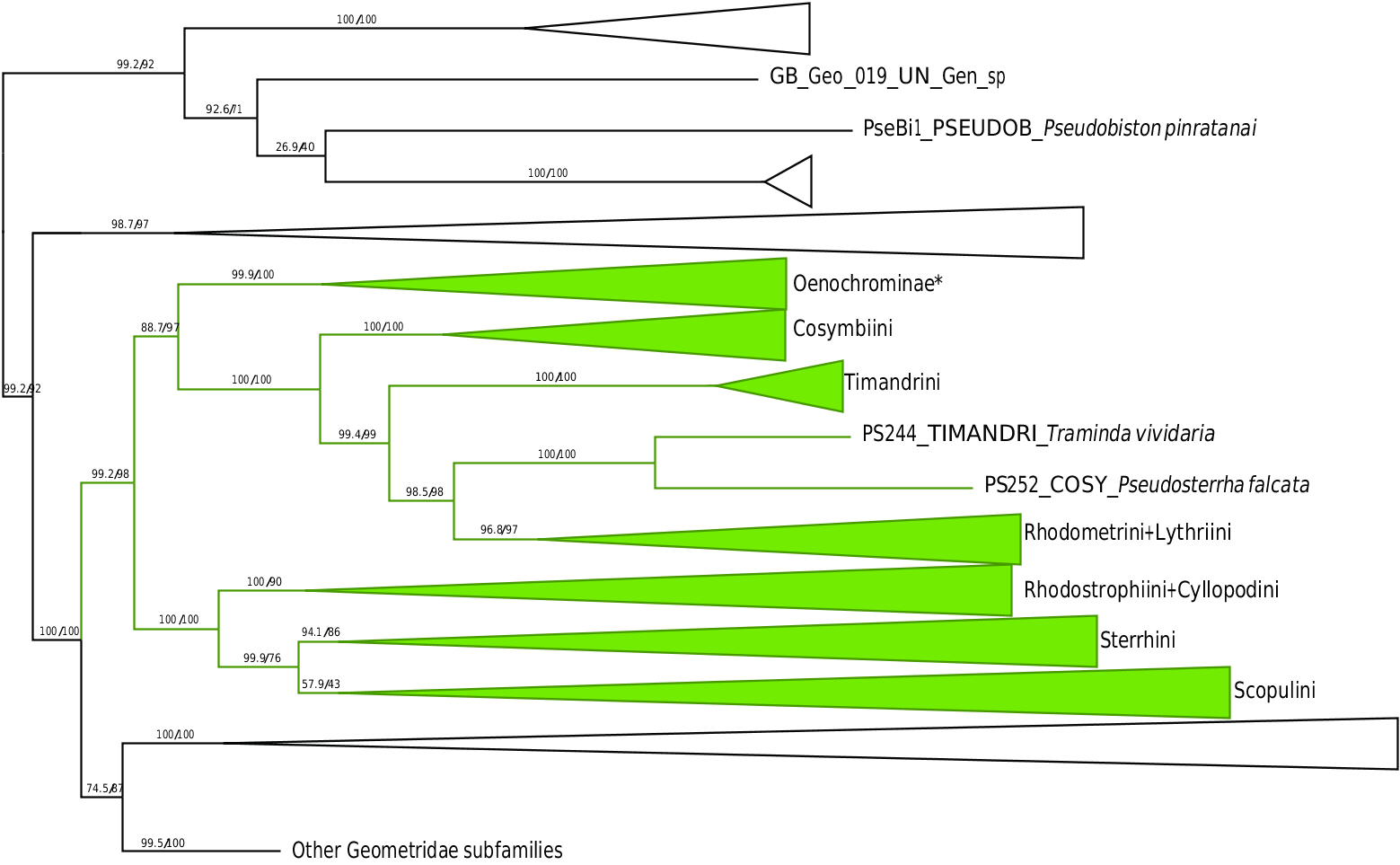
== Characteristics == Sterrhinae are called waves due to the numerous wavy fasciae on the fore- and hindwings. Compared to other Geometridae, the moths are often small in size (wing span (Butler, 1881). Seeing this name is hardly used in literature and Sterrhinae is widely used, this name is preferred. The tribe Lythriini with the genus Lythria (Hübner, 1823) and the species Lythria cruentaria (Hufnagel, 1767) was transferred from Larentiinae in 2008. The Larentiinae have been suggested to be the sister group of Sterrhinae based on morphology (Holloway, 1997). Characters that unite Sterrhinae and Larentiinae include the distribution of male secondary sexual organs, found mainly on the male second sternite or in the form of coremata more distally on the abdomen, the spinned or rugose signum of the female corpus bursae (Holloway, 1997), the hammer-head ansa in the tympanal organ, and the absence of a tympanic lacinia in most species (Cook & Scoble, 1992). However, a molecular study done by Abraham et al. (2001), based on a very limited taxon sample, did not support the relationship between Sterrhinae/Larentiinae (Sihvonen & Kaila, 2004). Instead, Sterrhinae was found to be the sister taxon to the Geometrinae + Ennominae + Alsophilinae + Archiearinae assemblage (Sihvonen & Kaila, 2004). Sterrhinae has the presence of olefinic acetates and derivates, unlike other geometrid families, and is sometimes placed as the most basal sister groups of Geometrinae (Young, 2006; Yamamoto & Sota, 2007; Sihvonen et al., 2011).
Excerpted from Wikipedia’s “Sterrhinae” article, available under the CC BY-SA 4.0 licence.
Gallery (2)
Available in 7 languages
via Wikidata sitelinks · CC0