Category
page 1Moth subfamilies

Arctiinae
The Arctiinae (formerly called the family Arctiidae) are a large and diverse subfamily of moths with around 11,000 species found all over the world, including 6,000 neotropical species. This subfamily includes the groups commonly known as tiger moths (or tigers), which usually have bright colours, footmen, which are usually much drabber, lichen moths, and wasp moths. Many species have "hairy" caterpillars that are popularly known as woolly bears or woolly worms. The scientific name Arctiinae refers to this hairiness (Gk. αρκτος = a bear). Some species within the Arctiinae have the word "tussoc

Lymantriinae
The Lymantriinae (formerly called the Lymantriidae) are a subfamily of moths of the family Erebidae. The taxon was erected by George Hampson in 1893.
Ennominae
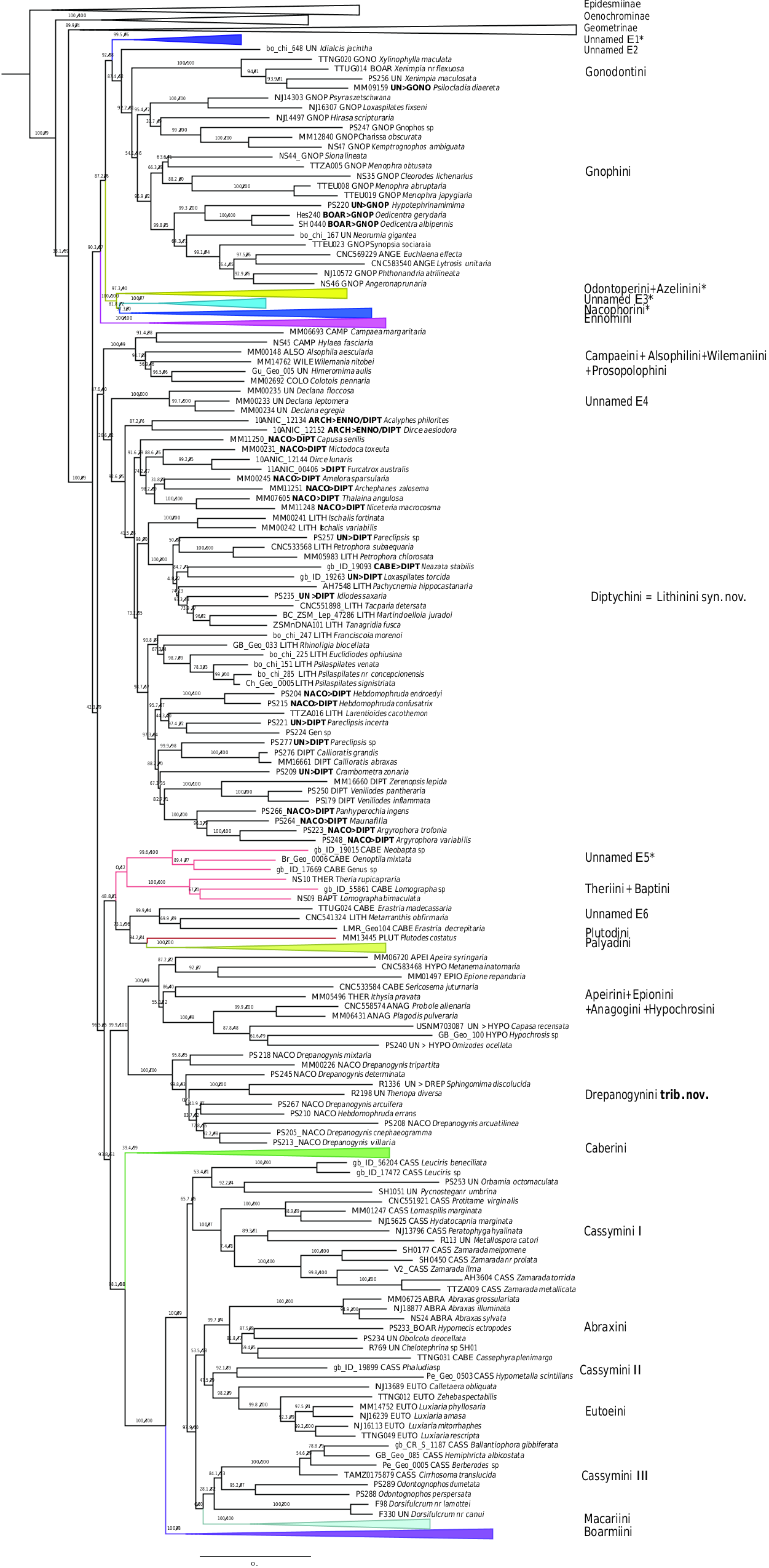
Ennominae is the largest subfamily of the geometer moth family (Geometridae), with some 9,700 described species in 1,100 genera. Most species are fairly small, though some (such as the peppered moth) grow to be considerably large. This subfamily has a global distribution. It includes some species that are notorious defoliating pests. The subfamily was first described by Philogène Auguste Joseph Duponchel in 1845.

Noctuinae
thumb|left|Garden dart (Euxoa nigricans) [[imago]]
thumb|left|Double square-spot (Xestia triangulum) [[caterpillar]]
thumb|left|Eupsilia sp., early instar caterpillar
thumb|left|Lacinipolia renigera
Sphinginae
The Sphinginae are a subfamily of the hawkmoths (Sphingidae), moths of the order Lepidoptera. The subfamily was first described by Pierre André Latreille in 1802. Notable taxa include the pink-spotted hawkmoth (Agrius cingulata), being a very common and recognizable species, the death's-head hawkmoths (Acherontia species) of Silence of the Lambs fame, and Xanthopan morganii with its enormous proboscis.
Macroglossinae
subfamily of insects

Cuculliinae
thumb| Cucullia asteroides, caterpillar on [[Euthamia.]]
thumb|Lithophane antennata, caterpillar on oak leaf.
Cuculliinae is one of the larger subfamilies of moths in the family Noctuidae.
Pantheinae
Pantheinae is a small subfamily of moth family Noctuidae. It used to be considered a family, under the name Pantheidae.

Larentiinae
Larentiinae is a subfamily of moths containing roughly 5,800 species that occur mostly in the temperate regions of the world. They are generally considered a subfamily of the geometer moth family (Geometridae) and are divided into a few large or good-sized tribes, and numerous very small or even monotypic ones which might not always be valid. Well-known members are the "pug moths" of the Eupitheciini and the "carpets", mainly of the Cidariini and Xanthorhoini. The subfamily was described by Philogène Auguste Joseph Duponchel in 1845.

Acronictinae
thumb|Acronicta radcliffei, larva
Acronictinae is a large subfamily of moths in the family Noctuidae.
Ceratocampinae
Ceratocampinae is a subfamily of moths in the family Saturniidae. Species can be found in the New World.
Hemileucinae
Hemileucinae is a subfamily of the family Saturniidae, including a number of taxa whose caterpillars have venomous urticating hairs.

Heliothinae
thumb|Heliothis virescens|Chloridea virescens larva
Heliothinae is a small, cosmopolitan subfamily of moths in the family Noctuidae, with about 400 described species worldwide. It includes a number of economically significant agricultural pest species, such as Helicoverpa armigera and Helicoverpa zea.
Smerinthinae
The Smerinthinae are a subfamily of Sphingidae moths in the order Lepidoptera.

Herminiinae
The Herminiinae are a subfamily of moths in the family Erebidae. The members of the subfamily are called litter moths because the caterpillars of most members feed on dead leaves of plants, though others feed on living leaves, and/or the mushrooms of fungi as in the case of genus Idia.

Ethmiinae
The Ethmiinae are a subfamily of small moths in the superfamily Gelechioidea sometimes included in the Elachistidae or the Oecophoridae, but mostly in the Depressariidae as a subfamily Ethmiinae.

Geometrinae
Geometrinae is the nominate subfamily of the geometer moth family (Geometridae). It is strongly split, containing a considerable number of tribes of which most are presently very small or monotypic. These small moths are often a light bluish green, leading to the common name of emerald moths, though a few species called thus are also found in the tribe Campaeini of the Ennominae. In 2018, a phylogeny and classification based on a molecular phylogenetic analysis was published in the Zoological Journal of the Linnean Society in which 13 tribes were accepted.
Rivulinae
The Rivulinae are a subfamily of moths in the family Erebidae described by Augustus Radcliffe Grote in 1895. Caterpillars in the subfamily typically have long, barbed hairs and have full prolegs on abdominal segments 3 through 6. The adults have a unique microsculpturing proboscis.
Eustrotiinae
The Eustrotiinae are a subfamily of moths, under family Noctuidae.
Arsenurinae
Arsenurinae is a subfamily of the family Saturniidae.

Crambinae
thumb|right|Parapediasia teterrellus

Pyraustinae
Pyraustinae is a large subfamily of the lepidopteran family Crambidae, the crambid snout moths. It currently includes about 1,280 species Most of them tropical but some found in temperate regions including both North America and Europe.

Acontiinae
thumb|Acontia guttifera, South Africa
thumb|Spragueia dama, Oklahoma
Acontiinae is a subfamily of bird dropping moths in the family Noctuidae. There are more than 50 genera and 430 described species in Acontiinae, found worldwide in temperate and tropical climates.

Thyatirinae
thumb|Euthyatira lorata
The Thyatirinae, or false owlet moths, are a subfamily of the moth family Drepanidae with about 200 species described. Until recently, most classifications treated this group as a separate family called Thyatiridae.
Drepaninae
Drepaninae are by far the largest subfamily of the Drepanidae moths. While it is usually split into two tribes, Drepanini and Oretini, its internal systematics and phylogeny are not well resolved.
Oxyteninae
Oxyteninae is a subfamily of the family Saturniidae, until recently classified as a separate family, Oxytenidae. Its members are mostly from Central and South America.

Phycitinae
The Phycitinae are a subfamily of snout moths (family Pyralidae). Even though the Pyralidae subfamilies are all quite diverse, Phycitinae stand out even by standards of their family: with over 600 genera considered valid and more than 4000 species placed here at present, they unite up more than three-quarters of living snout moth diversity. Together with the closely related Epipaschiinae, they are apparently the most advanced lineage of snout moths.
Cercophaninae
Cercophaninae is a subfamily of the family Saturniidae, and was, until recently, treated as a separate family, Cercophanidae.

Spilomelinae
Spilomelinae is a very species-rich subfamily of the lepidopteran family Crambidae, the crambid snout moths. With 4,180 described species in 351 genera worldwide, it is the most speciose group among pyraloids.

Pterophorinae
Pterophorinae is a subfamily of moths in the family Pterophoridae.
Erebinae
The Erebinae are a subfamily of moths in the family Erebidae erected by William Elford Leach in 1815. Erebine moths are found on all continents except Antarctica, but reach their greatest diversity in the tropics. While the exact number of species belonging to the Erebinae is not known, the subfamily is estimated to include around 10,000 species. Some well-known Erebinae include underwing moths (Catocala) and witch moths (Thermesiini). Many of the species in the subfamily have medium to large wingspans (7 to 10 cm, 3 to 4 inches), up to nearly 30 cm in the white witch moth (Thys
Calpinae
The Calpinae are a subfamily of moths in the family Erebidae described by Jean Baptiste Boisduval in 1840. This subfamily includes many species of moths that have a pointed and barbed proboscis adapted to piercing the skins of fruit to feed on juice, and in the case of the several Calyptra species of vampire moths, to piercing the skins of mammals to feed on blood. The subfamily contains some large moths with wingspans longer than 5 cm (2 in).
Psychinae
Psychinae is a subfamily of bagworm moths in the family Psychidae.
thumb|Bacotia claustrella larva in case
Sesiinae
The Sesiinae are a subfamily of clearwing moths, identified by Jean Baptiste Boisduval in 1828.
Aganainae
The Aganainae are a small subfamily of moths in the family Erebidae. The adults and caterpillars of this subfamily are typically large and brightly colored, like the related tiger moths. Many of the caterpillars feed on poisonous host plants and acquire toxic cardenolides that make them unpleasant to predators. Like the closely related litter moths, the adults have long, upturned labial palps, and the caterpillars have fully or mostly developed prolegs on the abdomen. The Aganainae are distributed across the tropics and subtropics of the Old World.

Pyralinae
The Pyralinae are the typical subfamily of snout moths (family Pyralidae) and occur essentially worldwide, in some cases aided by involuntary introduction by humans. They are rather rare in the Americas however, and their diversity in the Australian region is also limited. Altogether, this subfamily includes about 900 described species, but new ones continue to be discovered. Like many of their relatives in the superfamily Pyraloidea, the caterpillar larvae of Pyralinae – and in some cases even the adults – have evolved the ability to use unusual foods for nutrition; a few of these
Boletobiinae
The Boletobiinae are a subfamily of moths in the family Erebidae, containing about 956 species. The taxon was described by Achille Guenée in 1858.

Hypeninae
The Hypeninae are a subfamily of moths in the family Erebidae. The taxon was first described by Gottlieb August Wilhelm Herrich-Schäffer in 1851. A notable species is Mecistoptera griseifusa,

Archiearinae
thumb|Archiearis notha
Archiearinae is a subfamily of the geometer moth family (Geometridae). It was described by David Stephen Fletcher in 1953.
Chimabachinae
Chimabachinae, the chimabachid moths, is a subfamily of moths in the family Lypusidae. The subfamily used to be classified as a subfamily of Oecophoridae, but current phylogenetic research classifies it as a subfamily of Lypusidae. Some authors placed it as the subfamily Cryptolechiinae in the family Depressariidae. The subfamily is distributed in the Palearctic realm, ranging from Europe to Japan, although the blueberry leafroller (Dasystoma salicella) has been introduced to North America.

Galleriinae
The Galleriinae are a subfamily of snout moths (family Pyralidae) and occur essentially worldwide, in some cases aided by involuntary introduction by humans. This subfamily includes the wax moths, whose caterpillars (waxworms) are bred on a commercial scale as food for pets and as fishing bait; in the wild, these and other species of Galleriinae may also be harmful to humans as pests.
Holcopogoninae
__NOTOC__
Symmocidae
The Symmocinae are a subfamily of moths in the superfamily Gelechioidea. These small moths are found mainly in the Palearctic and Africa.
Sterrhinae
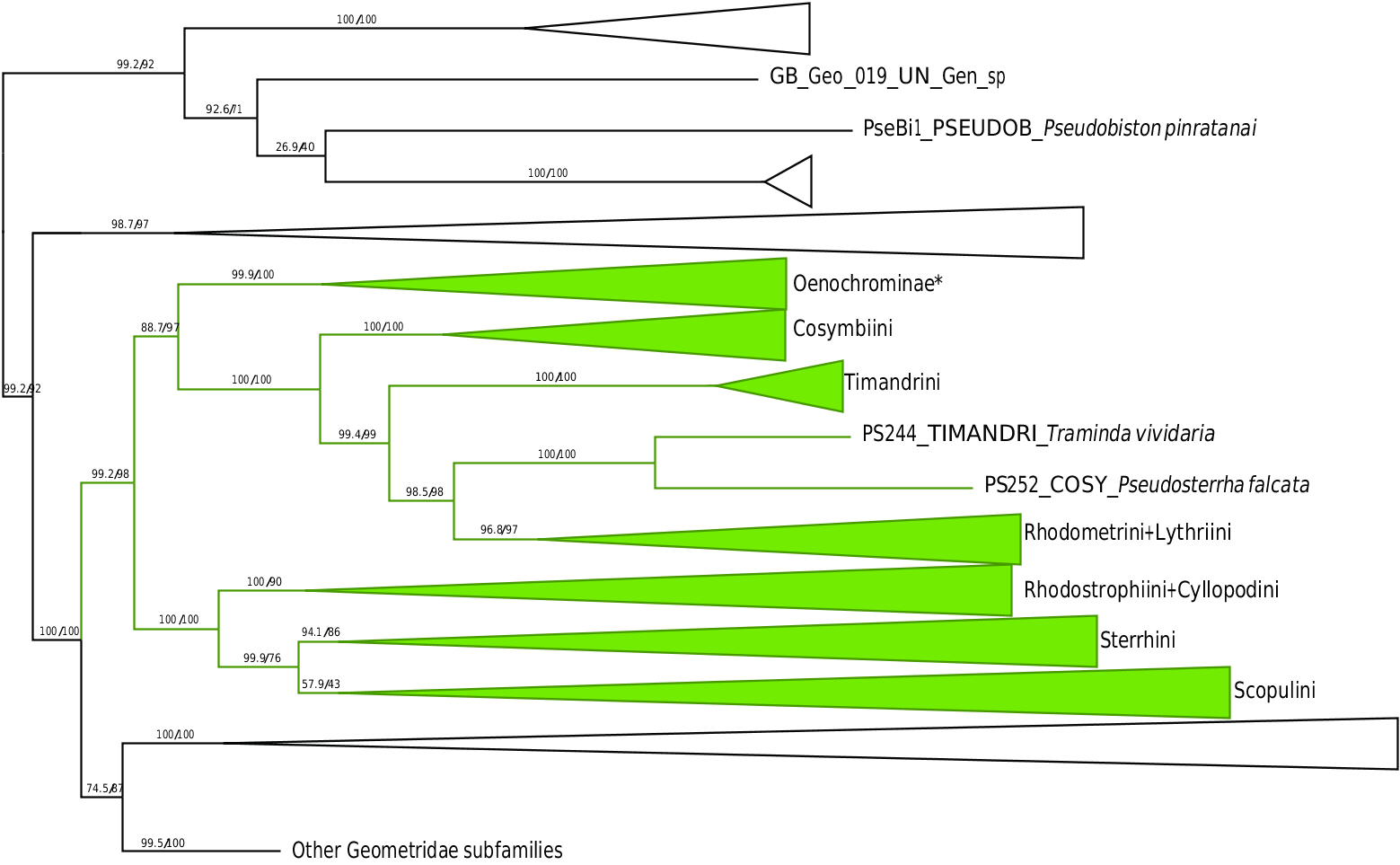
Sterrhinae is a large subfamily of geometer moths (family Geometridae) with some 3,000 described species, with more than half belonging to the taxonomically difficult, very diverse genera, Idaea and Scopula (Hausmann, 2004; Sihvonen, 2005). This subfamily was described by Edward Meyrick in 1892. They are the most diverse in the tropics with the number of species decreasing with increasing latitude and elevation (Scoble et al., 1995; Hausmann, 2001, 2004; Brehm & Fiedler, 2003).
Oenochrominae
Oenochrominae is a subfamily of the moth family Geometridae.
Salassinae
Salassa is a genus of moths in the family Saturniidae. It is the only genus in the subfamily Salassinae.
Scopariinae
Scopariinae is a subfamily of the lepidopteran family Crambidae. The subfamily was described by Achille Guenée in 1854.
Heliothelinae
Heliothelinae is a subfamily of the lepidopteran family Crambidae. It was described by Hans Georg Amsel in 1961.

Schoenobiinae
Schoenobiinae is a subfamily of the lepidopteran family Crambidae. The subfamily was described by Philogène Auguste Joseph Duponchel in 1846.
Hypenodinae
The Hypenodinae are a subfamily of moths in the family Erebidae. Adult moths of most species of this subfamily lack small, simple eyes near the large, compound eyes and have quadrifine (four-veined) hindwing cells. The micronoctuid moths are an exception because they possess simple eyes and bifine (two-veined) hindwing cells.

Lithocolletinae
thumb|Leaf mine on hickory made by Cameraria caryaefoliella
Lithocolletinae is a subfamily of insects in the moth family Gracillariidae. It is distributed worldwide, with most species in temperate regions.
Odontiinae
Odontiinae is a subfamily of moths of the family Crambidae. The subfamily was described by Achille Guenée in 1854.
Gracillariinae
Gracillariinae are a subfamily of moths which was described by Henry Tibbats Stainton in 1854.
Dichomeridinae
thumb|Dichomeris inserrata
Dichomeridinae is a subfamily of moths in the family Gelechiidae.
Depressariinae
The Depressariinae – sometimes spelled "Depressiinae" in error – are a subfamily of moths in the superfamily Gelechioidea. Like their relatives therein, their exact relationships are not yet very well resolved. It has been considered part of family Elachistidae sensu lato or included in an expanded Oecophoridae. In modern classifications they are treated as the distinct gelechioid family Depressariidae.
Phyllocnistinae
Phyllocnistinae is a subfamily of insects in the moth family Gracillariidae.
Toxocampinae
The Toxocampinae are a subfamily of moths in the family Erebidae. Moths in the subfamily typically have a primitive form of genital claspers similar to those of some subfamilies of the Noctuidae.
Uraniinae
{|border="0" cellpadding="2" cellspacing="0"
|Uraniinae phylogeny after Lees and Smith 1991
Eulepidotinae
Eulepidotinae is a subfamily of moths in the family Erebidae. Adult males in the subfamily have midtibial tufts of hairs. Adult females have the ostial opening located between the seventh and eighth abdominal sternites instead of located anteriorly on the seventh sternite.
Scoliopteryginae
The Scoliopteryginae are a subfamily of moths in the family Erebidae. Larvae have distinctive, extra setae on the first through seventh abdominal segments. Many adult moths in the subfamily have a proboscis adapted to pierce fruit skin, allowing consumption of the juice in the fruit.