
File:Skeppsbron_20-48,_2006.jpg · Wikimedia Commons · See Wikimedia Commons
Stockholm
Sign in to saveAlso known as Sthlm, STHLM
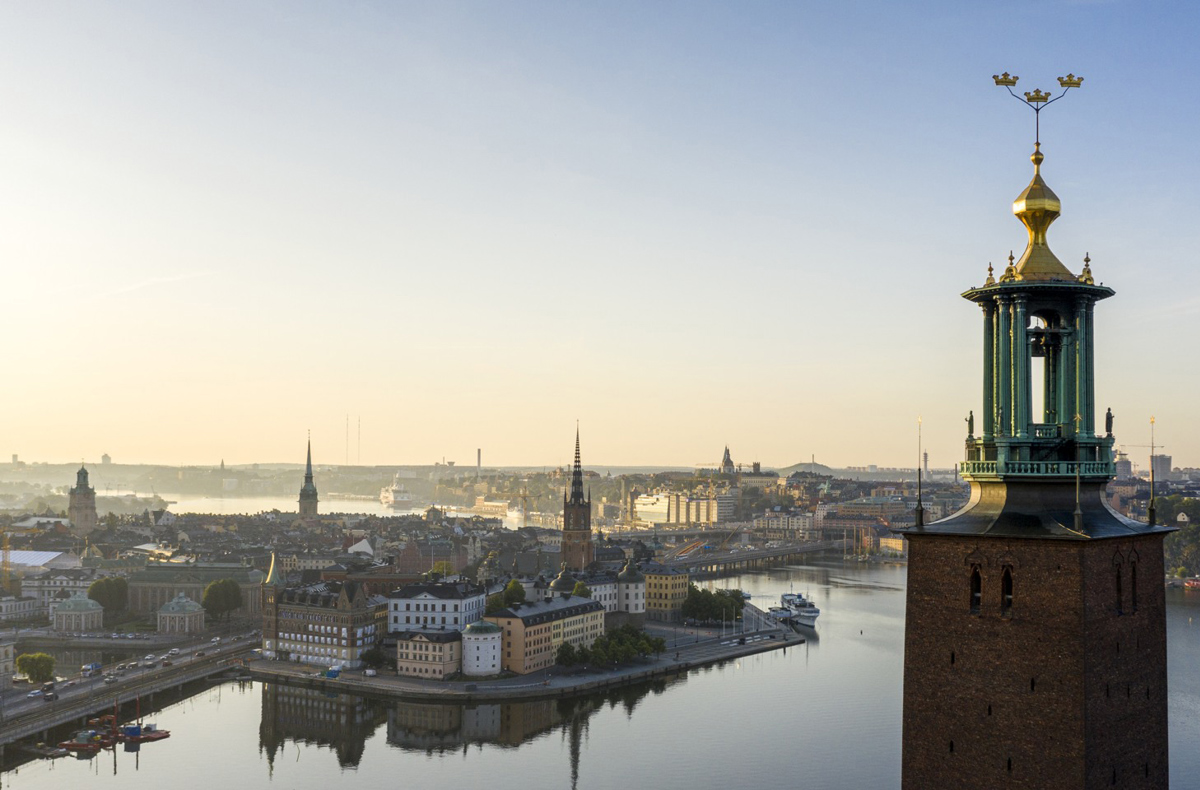
Stockholm (; ) is the capital and most populous city of Sweden, as well as the largest urban area in the Nordic countries. Approximately 1 million people live in the municipality, with 1.6 million in the urban area, and 2.5 million in the metropolitan area. The city stretches across fourteen islands where Lake Mälaren flows into the Baltic Sea. Outside the city to the east, and along the coast, is the island chain of the Stockholm archipelago. The area has been settled since the Stone Age, in the 6th millennium BC, and was founded as a city in 1252 by Swedish statesman Birger Jarl. T
OverviewAI-generated
Stockholm is a city and port city located in Sweden, situated on the Saltsjön and Mälaren bodies of water. It serves as the capital of Sweden, Stockholm County, and the Union between Sweden and Norway. The city has at various times been part of the Kalmar Union and the Union between Sweden and Norway. Its inception dates to 1187, with the earliest written record appearing in 1252.
The population of Stockholm is 1515017. It is located in the administrative territorial entity of Over-Governors office, Stockholm, and lies in the time zone Europe/Stockholm, which corresponds to UTC+01:00 and UTC+02:00. The local dialing code is 08. The city is described by sources including The Catholic Encyclopedia, Brockhaus and Efron Encyclopedic Dictionary, Encyclopædia Britannica 11th edition, and The Nuttall Encyclopædia.
Synthesized by Vinony from 53 facts across 8 sources: Wikidata, Open Meteo, Openweathermap, OpenStreetMap, Firecrawl, GeoNames, Vinony graph, Geo. Generated from structured data (not the Wikipedia text) and checked against those facts — may still contain errors.
Weather now
cached 13h ago7-day forecast
via Open-Meteo
Place details
- Locality
- Stockholm
- Country
- Sverige
- Population
- 1,515,017
- Timezone
- Europe/Stockholm
via OpenStreetMap · GeoNames
Key facts
- Settlement.official_name
- Stockholm
- Settlement.settlement_type
- Capital city
- Settlement.image_flag
- Flag of Stockholm.svg
- Settlement.image_blank_emblem
- Stockholm vapen bra.svg
- Settlement.blank_emblem_type
- Coat of arms
- Settlement.nicknames
- Sthlm, Eken, the Venice of the North, the Capital of Scandinavia, the Venice of Scandinavia
- Settlement.map_caption
- Location within Sweden##Location within Europe
- Settlement.pushpin_map
- Sweden#Europe
- Settlement.pushpin_relief
- 1
- Settlement.subdivision_type
- Country
- Settlement.subdivision_name
- Sweden
- Settlement.subdivision_type1
- Province
- Settlement.subdivision_type2
- County
- Settlement.subdivision_type3
- Municipality
- Settlement.subdivision_name1
- Södermanland and Uppland
- Settlement.subdivision_name2
- Stockholm County
- Settlement.leader_title
- Mayor
- Settlement.leader_name
- Karin Wanngård
via Wikipedia infobox
Official website
Stockholms stad
Stockholms stads webbplats med stadens alla tjänster och verksamheter. I staden bor det drygt 960 000 personer och i Stockholms stad arbetar cirka 40 000 personer.
start.stockholm →Link to the official site · 6,662 chars · not written by Vinony
Wikidata facts
- Named after
- islet
- Official name
- Stockholm
- Demonym
- Stockholmčanka
- Located in
- Stockholm
- Continent
- Europe
- Official language
- Swedish
- Population
- 984748
- Area
- 187.16
- Time zone
- UTC+02:00
- Body of water
- Mälaren
- Official website
- start.stockholm
- Image
- Stockholm gamlastan etc.jpg
- Dialing code
- 08
- Patron saint
- Eric IX of Sweden
- Significant event
- 1912 Summer Olympics
Show 20 more facts
- Commons category
- Stockholm
- topic's main category
- Category:Stockholm
- Commons gallery
- Stockholm
- time of earliest written record
- 1252-00-00
- inception
- 1187-00-00
- category for people born here
- Category:Births in Stockholm
- category for people who died here
- Category:Deaths in Stockholm
- category for films shot at this location
- Category:Films shot in Stockholm
- category of associated people
- Category:People from Stockholm
- category for people buried here
- Category:Burials in Stockholm
- native label
- Stockholm
- different from
- Stockholm
- postal code
- 100 00–200 00
- P8168
- Mato Kósyk
- hashtag
- Stockholm
- P11012
- North America
- on focus list of Wikimedia project
- Wikipedia:Vital articles/Level/4
- P12749
- neodymium
- nickname
- Venice of the North
Sources (11)
via Wikidata · CC0
Travel guide
Understand
thumb|right|The Royal Guard on parade at the Royal Palace
Due to the post-glacial rebound, Stockholm is slowly rising from the sea. Mälaren was a bay of the Baltic Sea throughout the Viking Age of the 9th and 10th centuries; today's Stockholm was the waterway for the first Swedish cities; Birka, Uppsala, and Sigtuna. As Sigtuna was sacked by pirates in AD 1187, the Swedes needed to fortify the strait.
As the rising land cut off Mälaren from the sea in the 13th century, Stockholm became an important trading post. The city is said to be founded by Birger jarl (jarl is a title corresponding to British earl), who had a fortress built on an island later known as Gamla Stan. The first known written records that mention Stockholm date from 1252; this is the considered year of foundation. In the 15th century Stockholm replaced Uppsala as the effective capital. Stockholm was an associate of the Hanseatic League, and since its liberation from Denmark by King Gustav Vasa in 1523, Stockholm has remained Sweden's most important center of commerce, although Gothenburg later became the largest international port. During the 17th century, Stockholm was the base of the Swedish Empire, with a land area twice the country's current size, nearly encircling the Baltic Sea.
Much of the inner city plan was laid out in the 19th century, and the inner city still contains buildings from all ages since the 15th century. Like the rest of Sweden, Stockholm was largely untouched by the World Wars, …
Get around
Stockholm is easy to access by public transport, and on bicycle during the warm season. Travelling by car is suitable outside built-up areas.
Do
thumb|Restaurant Gondolen at Katarinahissen
Buy
As in the rest of Sweden, VISA and MasterCard are accepted by nearly all stores, and ATMs are readily available. Stockholm, like the rest of Sweden, is very much a card-oriented place and quite a few smaller venues do not accept cash. Even fewer accept foreign currencies, such as euros or US dollars.
In contrast to many other European cities, most shops in Stockholm (except the small independent ones) are open all week, including Sundays; only closed down for a few major holidays a year. Closing time tends to be rigid, though.
Eat
thumb|Zum Franziskaner, a restaurant from the 1840s
Stockholm features a large variety of restaurants, and the dining scene has markedly improved since the turn of the century, both in terms of quality and variety. However, dining in Stockholm can be expensive if you aim for something else than the fast food bars, the run-of-the-mill British-style pubs or the ethnic restaurants that dominate the budget bracket. Be prepared to pay around 175–250 kr or more for most main courses at quality restaurants. If you are on a tight budget, self-catering is a good option.
Most hotels and hostels have a good breakfast buffet, in many cases included with the room.
A lot of restaurants have "dagens rätt" – a lunch offer, normally including a lower- or non-alcoholic drink, bread, butter, salad and coffee – usually M–F 11:00–14:00. Expect to pay around 100–150 kr, generally more in the centre and less in the suburbs. Many Asian, Indian and fast food restaurants offer rather cheap "all you can eat" lunch buffets.
Many restaurants' kitchens close at 22:00 even on weekends, so don't get out too late. A glass of house wine costs in the range 60– kr, 400–700 kr for a bottle. Sweden has enforced non-smoking in all bars, pubs, restaurants and enclosed areas.
Quite a few restaurants are closed for vacation for a few weeks in July or early August. In December, many restaurants offer a Christmas buffet (julbord), a variation of the classic Swedish smörgåsbord with traditional…
Sleep
thumb|Långholmen Prison ([[Stockholm/Södermalm|Södermalm) is converted to a hostel.]] Stockholm is primarily a business city, so beside the Grand Hôtel (Norrmalm) and a few other luxury venues, Stockholm has several business (typically 4-star) hotels, which charge 900-1200 kr for a single room. They usually have vacancies during weekends and summers, and might give special offers for tourists.
Many hotels have basement rooms without windows, often smaller and more austere than the regular rooms, and significantly cheaper, especially the singles. The hotels make no secret of the fact that this room category has no window, but do make sure to read the description of your room carefully before you book to avoid unpleasant surprises.
The cheap bunks are in short supply. Look for hostels at Svenska Turistföreningen and SVIF. Advance booking is usually needed, especially in summer, and for those in the inner city. Stockholm has some spectacular hostels, such as af Chapman (Skeppsholmen), Långholmen (Södermalm) and Jumbostay at Arlanda.
The lowest cost per bed can be found on the Baltic Sea ferries.
Hospitality exchange and home exchange options can be useful for Stockholm. The apartment rental market is strictly regulated, with waiting times over a decade.
When it comes to long-time accommodation, Stockholm has a harsh housing situation, with several years' waiting time for a rental apartment. Newcomers are dependent on the unreliable second-hand rental market. For consul…
Connect
thumb | 300px | Stockholm Public Library As of Sept 2021, central Stockholm has 5G from all Swedish carriers, but this hasn't rolled out across the city, which mostly gets 4G. Wifi is widely available in public places.
Stay safe
For its size, Stockholm is a safe city by international standards. Still, travellers should use common sense to avoid crime.
While police officers can be spread thin, Stockholm has patrolling security guards (ordningsvakt) in central neighbourhoods. These are usually helpful to visitors. Security staff at nightclubs might be more harsh, especially at intoxicated patrons. Drunkenness is less accepted in bars and clubs than in smaller towns, and could lead to the security staff forcibly ejecting the trouble-maker. Bouncers in Stockholm are stricter than in other European cities, and you may be kicked out for no reason.
Most crimes against travellers are crimes of opportunity, such as pickpockets, bicycle theft, auto theft, and auto vandalism. As always, do not leave valuable items in your car, and watch your bag in crowded places. Most shops and all major taxi companies accept credit and debit cards, so there is no need to carry a lot of cash.
Stockholm's road traffic is not too dangerous. Use common sense, and beware of slippery roads when temperature is around zero (which can happen from November to March). Animal collisions are a risk factor even in the inner suburbs; watch out for deer in particular.
Taxis are required to post pricing information in the rear side window. The comparison price is for a 15 km ride and not the maximum price, which could be a lot more when venturing outside the inner city. While some independent driver charge the maximum allowed (499&nb…
Respect
When using escalators, stand on the right and reserve the left side for walking. Standing still on the left side might annoy people. On train and metro platforms, passengers should be allowed to leave the car before passengers who want to board. When waiting in lines, be patient and polite. Swedes never jump queues - but make sure you actually stand in the line. If unsure, ask.
Avoid walking in the cycle lane. Dedicated cycle paths are clearly marked, but sometimes run directly next to the sidewalk. Stockholm cyclists are subject to a comparatively hilly landscape and are unwilling to slow down and lose momentum.
As most other Nordic people, Swedes value privacy and usually do not start unprompted conversations in public, especially in public transport. This means people are unlikely to approach a confused tourist to offer help on their own, but most will gladly help you if you ask for assistance or directions. If you are lucky enough to be invited to someone's home, you will discover that Swedes behave very differently and will be very social.
Travel guide from Wikivoyage (CC BY-SA 4.0)
~66 min read
Encyclopedic overview
46 sectionsContents
- History
- Geography
- Location
- Stockholm Municipality
- Stockholm City Centre
- Söderort
- Västerort
- Climate
- Daylight
- Government
- National government
- Economy
- Education
- Demographics
- Suburbs
- Religion
- Culture
- Literature
- Architecture
- Music
- Museums
- Art
- Theatre and music
- Amusement park
- Media
- Sports
- Cuisine
- Yearly events and festivals
- Environment
- Green city with a national urban park
- Role model
- Air quality
- Transport
- Public transportation
- The City Line Project
- Roads
- Congestion charges
- Ferries
- City bikes
- Airports
- Inter-city trains
- International rankings
- Twin cities and towns
- See also
- References
- External links
Stockholm (; ) is the capital and most populous city of Sweden, as well as the largest urban area in the Nordic countries. Approximately 1 million people live in the municipality, with 1.6 million in the urban area, and 2.5 million in the metropolitan area. The city stretches across fourteen islands where Lake Mälaren flows into the Baltic Sea. Outside the city to the east, and along the coast, is the island chain of the Stockholm archipelago. The area has been settled since the Stone Age, in the 6th millennium BC, and was founded as a city in 1252 by Swedish statesman Birger Jarl. The city serves as the county seat of Stockholm County.
Stockholm is the cultural, media, political, and economic centre of Sweden. The Stockholm region alone accounts for over a third of the country's GDP, and is among the top 10 regions in Europe by GDP per capita. Considered a global city, it is the largest in Scandinavia and the main centre for corporate headquarters in the Nordic region. The city is home to some of Europe's top-ranking universities, such as the Karolinska Institute (medicine), KTH Royal Institute of Technology, Stockholm School of Economics and Stockholm University. It hosts the annual Nobel Prize ceremonies and banquet at the Stockholm Concert Hall and Stockholm City Hall. One of the city's most prized museums, the Vasa Museum, is the most visited museum in Scandinavia. The Stockholm metro, opened in 1950, is well known for the decor of its stations; it has been called the longest art gallery in the world. The city was the host of the 1912 Summer Olympics, and has played host to several other international sports events since.
Excerpted from Wikipedia’s “Stockholm” article, available under the CC BY-SA 4.0 licence.
Gallery (53)
On the map
3 mapped locations
Available in 236 languages
- Español
- Français
- Deutsch
- 中文
- 日本語
- Русский
- Português
- Italiano
- العربية
- हिन्दी
- Abkhazian
- Achinese
- Afrikaans
- Akan
- Albanian
- Albanian
- Amharic
- Aragonese
Show 217 more
- Aramaic
- Armenian
- Arpitan
- Asturian
- Avaric
- Aymara
- azb
- Azerbaijani
- Bahasa Indonesia
- Balinese
- Bambara
- Bangla
- Bashkir
- Basque
- bat_smg
- Bavarian
- be_x_old
- Belarusian
- Betawi
- Bhojpuri
- Bikol
- Bislama
- Bosnian
- Breton
- Bulgarian
- Buriat
- Burmese
- Catalan
- cbk_zam
- cdo
- Cebuano
- Central Kurdish
- Chechen
- Cherokee
- Cheyenne
- Church Slavic
- Chuvash
- Cornish
- Corsican
- Crimean Tatar
- Croatian
- Czech
- Danish
- dty
- Egyptian Arabic
- eml
- Erzya
- Esperanto
- Ewe
- Extremaduran
- Faroese
- Fiji Hindi
- Fijian
- Filipino
- Finnish
- fiu_vro
- Gagauz
- Galician
- Georgian
- Gilaki
- Gothic
- Greek
- Guarani
- Haitian Creole
- Hakka Chinese
- Hausa
- Hawaiian
- Hebrew
- Hungarian
- hyw
- Icelandic
- Ido
- Igbo
- Iloko
- Inari Sami
- Interlingua
- Interlingue
- Inuktitut
- Irish
- Jamaican Creole English
- Javanese
- Kabardian
- Kabyle
- Kannada
- Kara-Kalpak
- Kashubian
- Kazakh
- kbp
- kge
- Komi
- Komi-Permyak
- Kongo
- Kotava
- Kurdish
- Ladino
- Latgalian
- Latin
- Latvian
- Ligurian
- Limburgish
- Lingala
- Lingua Franca Nova
- Lithuanian
- lld
- Lombard
- Low German
- Lower Sorbian
- Luxembourgish
- Macedonian
- Maithili
- Malagasy
- Malay
- Malayalam
- Maltese
- Manx
- Māori
- Marathi
- Mari
- Mazanderani
- Minangkabau
- Mingrelian
- Moksha
- Mongolian
- Moroccan Arabic
- Navajo
- nds_nl
- Nederlands
- Nepali
- Newari
- Northern Frisian
- Northern Sami
- Norwegian
- Norwegian Nynorsk
- Novial
- nrm
- Occitan
- Old English
- olo
- Ossetic
- Papiamento
- Pashto
- Picard
- Piedmontese
- Polski
- Punjabi
- Quechua
- roa_rup
- roa_tara
- Romanian
- Romansh
- Rusyn
- Sango
- Sardinian
- Saterland Frisian
- Scots
- Scottish Gaelic
- Serbian
- Serbian (Latin)
- Shona
- Sicilian
- Silesian
- simple
- Sindhi
- Slovak
- Slovenian
- Somali
- Southern Sotho
- Sranan Tongo
- Sundanese
- Svenska
- Swahili
- szy
- Tahitian
- Tajik
- Talysh
- Tamil
- Tatar
- Telugu
- Tetum
- Tibetan
- Tiếng Việt
- Tigrinya
- Tok Pisin
- Toki Pona
- Tongan
- Türkçe
- Turkmen
- Udmurt
- Ukrainian
- Upper Sorbian
- Urdu
- Uyghur
- Uzbek
- Venetian
- Veps
- Volapük
- Walloon
- Waray
- Welsh
- West Flemish
- Western Frisian
- Western Mari
- Western Panjabi
- Wolof
- Wu Chinese
- Yakut
- Yiddish
- Yoruba
- Zaza
- Zeelandic
- zh_classical
- zh_min_nan
- zh_yue
- Zulu
- فارسی
- ไทย
- 한국어
via Wikidata sitelinks · CC0