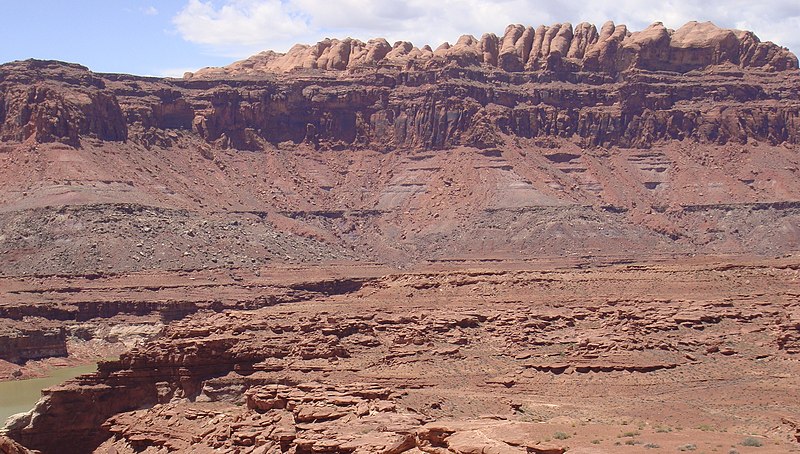
File:SEUtahStrat.JPG · Wikimedia Commons · See Wikimedia Commons
stratigraphy
Sign in to saveAlso known as stratigraphic geology
upright=1.35|thumb|The Permian through [[Jurassic strata of the Colorado Plateau area of southeastern Utah demonstrate the principles of stratigraphy.]] Stratigraphy is a branch of geology concerned with the study of rock layers (strata) and layering (stratification). It is primarily used in the study of sedimentary and layered volcanic rocks. Stratigraphy has three related subfields: lithostratigraphy (lithologic stratigraphy), biostratigraphy (biologic stratigraphy), and chronostratigraphy (stratigraphy by age).
Stratigraphy is the branch of geology that studies rock layers and how they form, focusing mainly on sedimentary and volcanic rocks. It matters because scientists use it to understand Earth's history by examining different layers of rock and their characteristics, including their composition, the fossils they contain, and their age.
AI-generated from the Wikipedia summary — may contain errors.
Wikidata facts
- Subclass of
- geology
- Has part
- sequence stratigraphy
- Image
- Quebrada de Cafayate, Salta (Argentina).jpg
Show 5 more facts
- is the study of
- sedimentary basin
- topic has template
- Template:Infobox rockunit
- Commons category
- Stratigraphy
- topic's main category
- Category:Stratigraphy
- on focus list of Wikimedia project
- Wikipedia:Vital articles/Level/4
via Wikidata · CC0
~9 min read
Encyclopedic overview
9 sectionsContents
- Historical Development
- Lithostratigraphy
- Biostratigraphy
- Chronostratigraphy
- Magnetostratigraphy
- See also
- References
- Further reading
- External links
upright=1.35|thumb|The Permian through [[Jurassic strata of the Colorado Plateau area of southeastern Utah demonstrate the principles of stratigraphy.]] Stratigraphy is a branch of geology concerned with the study of rock layers (strata) and layering (stratification). It is primarily used in the study of sedimentary and layered volcanic rocks. Stratigraphy has three related subfields: lithostratigraphy (lithologic stratigraphy), biostratigraphy (biologic stratigraphy), and chronostratigraphy (stratigraphy by age).
Several principles and laws come into play when using stratigraphy such as Principle of original horizontality, Law of superposition, Cross-cutting relationships, Principle of inclusions, Principle of faunal succession.
Excerpted from Wikipedia’s “stratigraphy” article, available under the CC BY-SA 4.0 licence.
Gallery (15)
Available in 78 languages
- Español
- Français
- Deutsch
- 中文
- 日本語
- Русский
- Português
- Italiano
- العربية
- हिन्दी
- Afrikaans
- Albanian
- Armenian
- Asturian
- Azerbaijani
- Bahasa Indonesia
- Basque
- be_x_old
Show 59 more
- Belarusian
- Bosnian
- Bulgarian
- Catalan
- cdo
- Central Kurdish
- Croatian
- Czech
- Danish
- Egyptian Arabic
- Esperanto
- Estonian
- Filipino
- Finnish
- Galician
- Georgian
- Greek
- Hebrew
- Hungarian
- Icelandic
- Irish
- Kazakh
- Latin
- Latvian
- Lithuanian
- Low German
- Macedonian
- Malay
- Mongolian
- Nederlands
- Norwegian
- Norwegian Nynorsk
- Polski
- Romanian
- Rusyn
- Saterland Frisian
- Serbian
- Serbian (Latin)
- simple
- Sindhi
- Slovak
- Slovenian
- Somali
- Svenska
- Tamil
- Tiếng Việt
- Türkçe
- Ukrainian
- Urdu
- Uzbek
- Waray
- Welsh
- Western Panjabi
- Wu Chinese
- zh_min_nan
- zh_yue
- فارسی
- ไทย
- 한국어
via Wikidata sitelinks · CC0