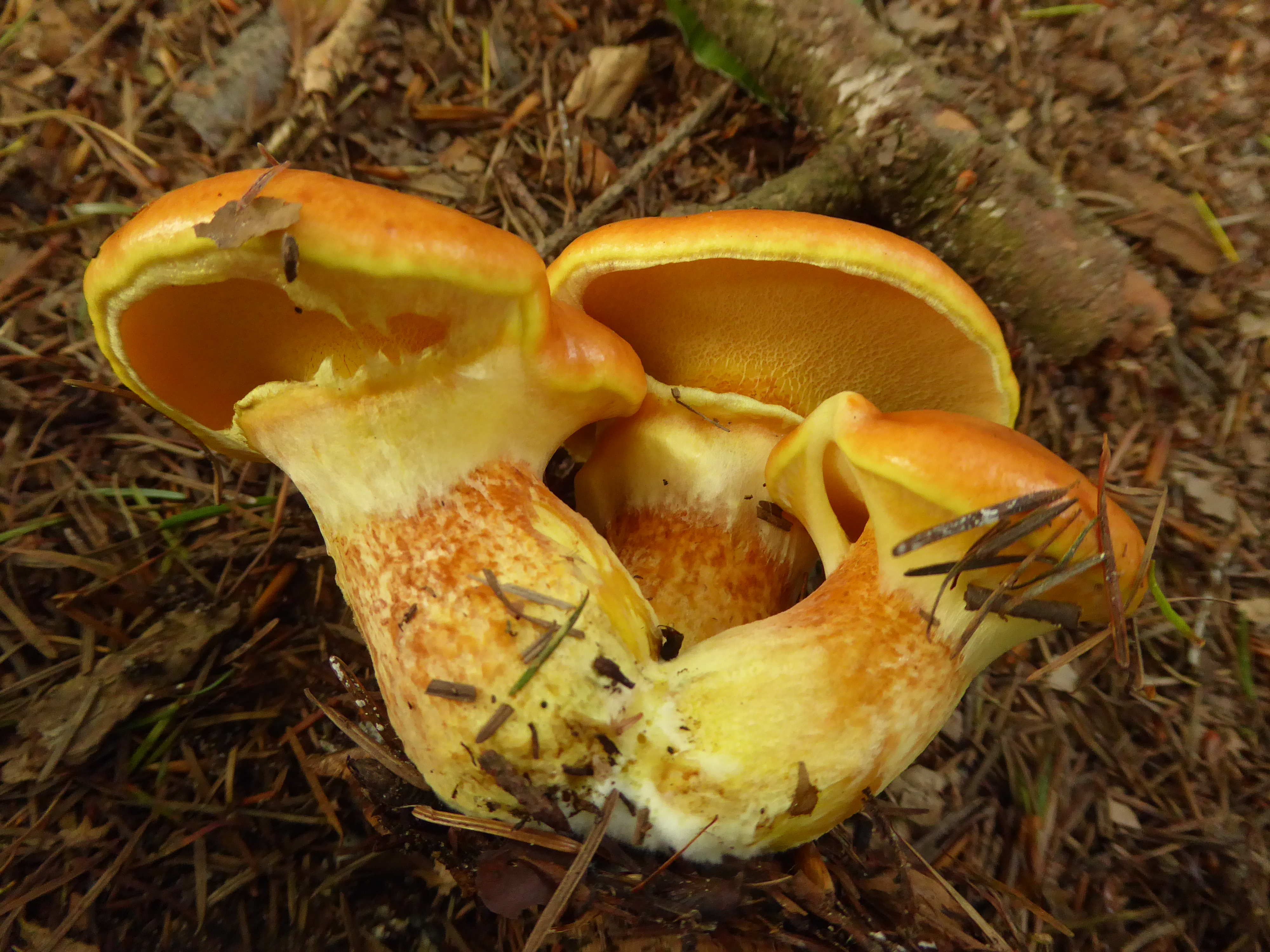
Image from GBIF · CC BY-NC-ND
OverviewAI-generated
*Suillus grevillei* is a species of fungus in the family Suillaceae. It belongs to the kingdom Fungi, phylum Basidiomycota, class Agaricomycetes, and order Boletales. The taxon was described by Singer, with the author citation (Klotzsch) Singer. This mushroom forms mycorrhizal associations and produces an ochre spore print. It is classified as an edible mushroom.
The IUCN Red List assessed the species as Least Concern in 2019. Records of *S. grevillei* have been documented in the United States, France, and New Zealand. The organism has several common names, including boled llarwydd, 厚環乳牛肝菌, Gele ringboleet, and klouzek sličný.
Synthesized by Vinony from 29 facts across 6 sources: Wikidata, GBIF, IUCN Red List, Gbif Occ, iDigBio, Vinony graph. Generated from structured data (not the Wikipedia text) and checked against those facts — may still contain errors.
Species
Least ConcernSPECIES
- KingdomFungi
- PhylumBasidiomycota
- ClassAgaricomycetes
- OrderBoletales
- FamilySuillaceae
Der Gold-Röhrling oder Goldgelbe Lärchen-Röhrling (Suillus grevillei, Syn.: Suillus flavus) ist ein essbarer Pilz aus der Familie der Schmierröhrlingsverwandten. Inhaltsverzeichnis 1 Merkmale 2 Ökologie 3 Verbreitung 4 Bedeutung 5 Quellen 6 Weblinks Merkmale Längs halbierter Fruchtkörper des Gold-Röhrlings Sporen des Gold-Röhrlings im Lichtmikroskop Der Gold-Röhrling bildet in Hut und Stiel gegliederte Fruchtkörper mit zentralem Stiel. Der jung halbkugelige, später polsterförmige- bis flach konvexe, zuletzt flache Hut wird 5–15 cm breit. Er ist gold- bis orangegelb, manchmal orangebräunlich bis rostbraun oder zitronengelb gefärbt. Die Huthaut ist glatt, selten etwas runzlig, bei feuchter Witterung ist sie stark schleimig, der gelbliche Schleim lässt sich in feuchtem Zustand gut abziehen. Bei trockenem Wetter ist die Hutoberfläche lediglich klebrig, die Huthaut lässt sich dann nur schwer abziehen. Die jung gelben, im Alter etwas bräunlichen Röhren sind angewachsen oder laufen etwas am Stiel herab. Die auf Druck bräunenden Poren sind jung leuchtend gelb, pro mm stehen 2–3 Poren. Der Stiel kann 4–10 cm lang und 0,5–2 cm stark werden, oberhalb der Ringzone ist er wie die Poren gefärbt,
via GBIF · IUCN
Museum specimens
- Specimen records
- 852
- With media
- 325
- Family
- Suillaceae
- Collections
- MSC, DBG, DUKE, MIN, HCOA, UT
- Recorded in
- United States, France, New Zealand
Wikidata facts
Show 11 more facts
- Commons category
- Suillus grevillei
- taxon rank
- species
- taxon name
- Suillus grevillei
- Commons gallery
- Suillus grevillei
- mushroom ecological type
- mycorrhiza
- spore print color
- ochre
- edibility
- edible mushroom
- taxon common name
- lehtikuusentatti
- IUCN conservation status
- Least Concern
- taxon author citation
- (Klotzsch) Singer
- short name
- S. grevillei
Sources (8)
via Wikidata · CC0
~3 min read
Encyclopedic overview
Suillus grevillei, commonly known as tamarack jack, Greville's bolete, or larch bolete, is a mycorrhizal mushroom with a tight, brilliantly coloured cap, shiny and wet looking with its mucous slime layer. The hymenium easily separates from the flesh of the cap, with a central stalk that is quite slender. The species has a ring or a tight-fitting annular zone.
Etymology
Excerpted from Wikipedia’s “Suillus grevillei” article, available under the CC BY-SA 4.0 licence.