File:IBM_Blue_Gene_P_supercomputer.jpg · Wikimedia Commons · See Wikimedia Commons
supercomputer
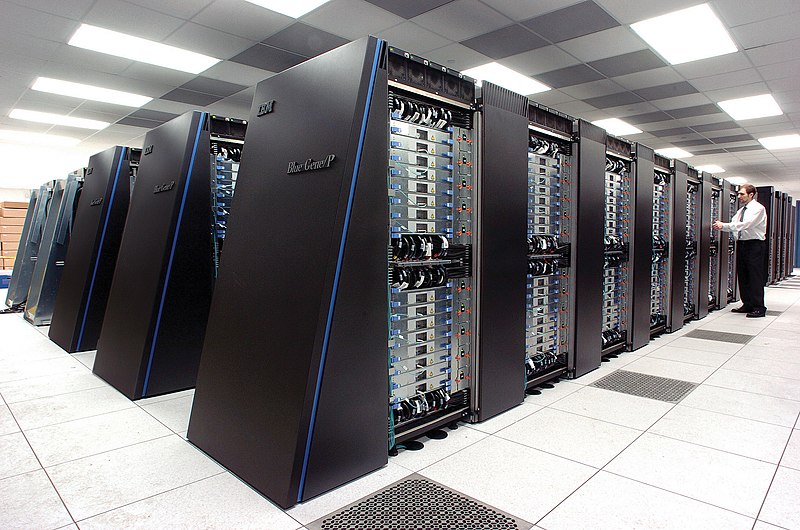
Sign in to savethumb|upright=1.5|The IBM Blue Gene|Blue Gene/P supercomputer "Intrepid" at [[Argonne National Laboratory (pictured 2007) runs 164,000 processor cores using normal data center air conditioning, grouped in 40 racks/cabinets connected by a high-speed 3D torus network.]] A supercomputer is a type of computer with a high level of performance as compared to a general-purpose computer. Supercomputers play an important role in the field of computational science, and are used for a wide range of computationally intensive tasks in various fields including quantum mechanics, weather forecasting, climate
A supercomputer is an extremely powerful computer designed to perform complex calculations far faster than regular computers, using thousands of processor cores working together. These machines are essential for tackling massive computational problems like weather forecasting, climate modeling, and quantum mechanics research that would be impractical or impossible for ordinary computers to handle.
AI-generated from the Wikipedia summary — may contain errors.
Wikidata facts
- Instance of
- class of computers
- Subclass of
- computer
- Image
- Cray 2 Arts et Metiers dsc03940.jpg
- Has use
- high-performance computing
Show 4 more facts
- facet of
- operating system
- Commons category
- Supercomputers
- topic's main category
- Category:Supercomputers
- Commons gallery
- Supercomputer
via Wikidata · CC0
~39 min read
Encyclopedic overview
21 sectionsContents
- History
- Massively parallel designs
- Special purpose supercomputers
- Energy usage and heat management
- Software and system management
- Operating systems
- Software tools and message passing
- Distributed supercomputing
- Opportunistic approaches
- Quasi-opportunistic approaches
- High-performance computing clouds
- Performance measurement
- Capability versus capacity
- Performance metrics
- The TOP500 list
- Applications
- Development and trends
- In fiction
- See also
- References
- External links
thumb|upright=1.5|The IBM Blue Gene|Blue Gene/P supercomputer "Intrepid" at [[Argonne National Laboratory (pictured 2007) runs 164,000 processor cores using normal data center air conditioning, grouped in 40 racks/cabinets connected by a high-speed 3D torus network.]] A supercomputer is a type of computer with a high level of performance as compared to a general-purpose computer. Supercomputers play an important role in the field of computational science, and are used for a wide range of computationally intensive tasks in various fields including quantum mechanics, weather forecasting, climate research, oil and gas exploration, molecular modeling (computing the structures and properties of chemical compounds, biological macromolecules, polymers, and crystals), and physical simulations (such as simulations of aerodynamics, of the early moments of the universe, and of nuclear weapons). They have been essential in the field of cryptanalysis.
The performance of a supercomputer is commonly measured in floating-point operations per second (FLOPS) instead of million instructions per second (MIPS). Since 2022, exascale supercomputers have existed which can perform over 1018 FLOPS. For comparison, a desktop computer has performance in the range of hundreds of gigaFLOPS (1011) to tens of teraFLOPS (1013). Since November 2017, all of the world's fastest 500 supercomputers run on Linux-based operating systems. Additional research is being conducted in the United States, the European Union, Taiwan, Japan, and China to build faster, more powerful and technologically superior exascale supercomputers.
Excerpted from Wikipedia’s “supercomputer” article, available under the CC BY-SA 4.0 licence.
Gallery (42)
Available in 80 languages
- Español
- Français
- Deutsch
- 中文
- 日本語
- Русский
- Português
- Italiano
- العربية
- हिन्दी
- Albanian
- Albanian
- Armenian
- Azerbaijani
- Bahasa Indonesia
- Bangla
- Basque
- Belarusian
Show 61 more
- Bhojpuri
- Bosnian
- Bulgarian
- Burmese
- Catalan
- Central Kurdish
- Croatian
- Czech
- Danish
- Esperanto
- Estonian
- Finnish
- Georgian
- Greek
- Hebrew
- Icelandic
- Kazakh
- Kurdish
- Kyrgyz
- Lao
- Latvian
- Lingua Franca Nova
- Lithuanian
- Lombard
- Malagasy
- Malay
- Malayalam
- Marathi
- Minangkabau
- Mingrelian
- Mirandese
- Mongolian
- Nederlands
- Norwegian
- Occitan
- Polski
- Punjabi
- Quechua
- Romanian
- Serbian
- Serbian (Latin)
- Sicilian
- simple
- Sinhala
- Slovak
- Slovenian
- Svenska
- Swahili
- Tamil
- Telugu
- Tiếng Việt
- Türkçe
- Ukrainian
- Urdu
- Western Panjabi
- Wu Chinese
- zh_yue
- Zulu
- فارسی
- ไทย
- 한국어
via Wikidata sitelinks · CC0