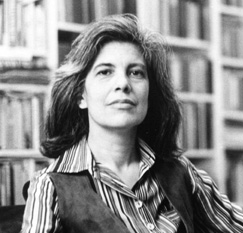
File:Susan_Sontag_1979_©Lynn_Gilbert_(headshot).jpg · Wikimedia Commons · See Wikimedia Commons
Susan Sontag
Sign in to saveAlso known as Susan Rosenblatt, Susan Lee Sontag, Susan Lee Rosenblatt
American writer and filmmaker, professor, and activist (1933–2004)
OverviewAI-generated
Susan Sontag was an American writer, film director, screenwriter, and professor. She was born in New York City in 1933 and died there in 2004. Her notable works include *On Photography* and *Against Interpretation*. She was educated at the University of Paris, Harvard University, the University of Oxford, and the University of Chicago. Sontag worked in the fields of English-language literature, history, and philosophy.
She was a member of the American Academy of Arts and Letters, the American Academy of Arts and Sciences, the Phi Beta Kappa Society, and PEN America. She was also recognized in the Macarthur Fellows collection and the National Book Award collection. Sontag was married to Philip Rieff and had unmarried partners including Annie Leibovitz, María Irene Fornés, Nicole Stéphane, and Joseph Brodsky. She was employed by Sarah Lawrence College. She is buried at Montparnasse Cemetery.
Synthesized by Vinony from 38 facts across 5 sources: Wikidata, Open Library, TMDb, Firecrawl, Vinony collections. Generated from structured data (not the Wikipedia text) and checked against those facts — may still contain errors.
Person · Open Library
- Born
- 16 Jan 1933
- Died
- 28 Dec 2004
- Works
- 197
Top works
- Refusenik!
- On Paul Goodman
- Selected Stories
- AIDS and its metaphors
- The way we live now
via Open Library + Wikidata
Film & TV
New York City, New York, USA
Susan Sontag (January 16, 1933 – December 28, 2004) was an American essayist, literary and cultural theorist, icon, and political activist whose works include On Photography, Against Interpretation, The Way We Live Now, and Regarding the Pain of Others.
Known for
- 150 Miles of Rotting, Rutted, Lumpy, Dilapidated Pavement — Woman Talking2021
- Symphony Of The Invisible — Self (voice)2020
- Helmut Newton: The Bad and the Beautiful — Self (archive footage)2020
- The Illegal Film — Self (archive footage)2019
- Regarding Susan Sontag — Self (archive footage)2014
- Great Thinkers: In Their Own Words — Self (archive footage)2011
- 365 Day Project — Self2007
- Annie Leibovitz: Life Through a Lens — Self (archive footage)2007
- The Great Magician2006
- Parola (su una data)2003
via TMDB
Official website
The Susan Sontag Foundation
susansontag.com →Link to the official site · 1,626 chars · not written by Vinony
Wikidata facts
- Instance of
- human
- Given name
- Susan
- Gender
- female
- Citizenship
- United States
- Place of birth
- New York City
- Place of death
- New York City
- Spouse
- Philip Rieff
- Child
- David Rieff
- Occupation
- opinion journalist
- Educated at
- North Hollywood High School
- Employer
- Sarah Lawrence College
- Languages spoken
- English language
- Participant in
- 1971 Cannes Film Festival
- Field of work
- history
- Genre
- essay
- Official website
- www.susansontag.com
- Image
- Susan Sontag 1979 ©Lynn Gilbert (headshot).jpg
Show 17 more facts
- place of burial
- Montparnasse Cemetery
- Commons category
- Susan Sontag
- cause of death
- myelodysplastic syndrome
- date of birth
- 1933-01-16
- date of death
- 2004-12-28
- unmarried partner
- Joseph Brodsky
- manner of death
- natural causes
- member of
- PEN America
- name in native language
- Susan Sontag
- on focus list of Wikimedia project
- Art+Feminism
- has works in the collection
- National Gallery of Art
- start of work period
- 1959-00-00
- writing language
- English language
- end of work period
- 2004-00-00
- P8168
- VGT
- nominated for
- Lambda Literary Award
- P12674
- 127 Johanna
Sources (12)
via Wikidata · CC0
~36 min read
Encyclopedic overview
Susan Lee Sontag (/ˈsɒntæɡ/; January 16, 1933 – December 28, 2004) was an American writer and critic. She primarily wrote essays, but also published novels; she published her first major work, the essay "Notes on 'Camp' ", in 1964. Her best-known works include the critical works Against Interpretation (1966), On Photography (1977), Illness as Metaphor (1978) and Regarding the Pain of Others (2003), the short story "The Way We Live Now" (1986) and the novels The Volcano Lover (1992) and In America (1999).
Sontag was active in writing and speaking about, or traveling to, areas of conflict, including during the Vietnam War and the Siege of Sarajevo. She wrote extensively about literature, cinema, photography and media, illness, war, human rights, and left-wing politics. Her essays and speeches drew backlash and controversy, and she has been called "one of the most influential critics of her generation".
Excerpted from Wikipedia’s “Susan Sontag” article, available under the CC BY-SA 4.0 licence.
Gallery (6)
Available in 69 languages
- Español
- Français
- Deutsch
- 中文
- 日本語
- Русский
- Português
- Italiano
- العربية
- हिन्दी
- Afrikaans
- Armenian
- Asturian
- azb
- Bahasa Indonesia
- Bangla
- Basque
- be_x_old
Show 50 more
- Belarusian
- Bosnian
- Bulgarian
- Catalan
- Central Kurdish
- Chuvash
- Cornish
- Czech
- Danish
- Egyptian Arabic
- Esperanto
- Estonian
- Finnish
- Galician
- Georgian
- Greek
- Hebrew
- Hungarian
- Icelandic
- Ido
- Irish
- Kazakh
- Latin
- Latvian
- Malagasy
- Malay
- Malayalam
- Nederlands
- Norwegian
- Norwegian Nynorsk
- Occitan
- Polski
- Punjabi
- Romanian
- Serbian
- simple
- skr
- Slovak
- Slovenian
- Svenska
- Türkçe
- Ukrainian
- Urdu
- Volapük
- Welsh
- Western Panjabi
- Wu Chinese
- zh_min_nan
- فارسی
- 한국어
via Wikidata sitelinks · CC0