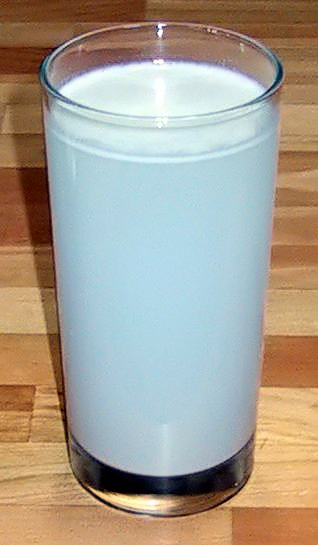
File:WaterAndFlourSuspensionLiquid.jpg · Wikimedia Commons · See Wikimedia Commons
A suspension is a mixture where solid particles are dispersed throughout a liquid or gas, but the particles don't dissolve and will eventually settle to the bottom if left undisturbed. Understanding suspensions matters because many everyday products—like paint, milk, and medicines—are suspensions, and knowing how they behave helps predict whether they'll stay mixed or separate over time.
AI-generated from the Wikipedia summary — may contain errors.
Research
138,854 papers- Culturing Suspension Cancer Cell Lines.Methods in molecular biology (Clifton, N.J.) · 2022Longjohn MN, Phan HD, Christian SLDOI: 10.1007/978-1-0716-2376-3_2
- Vault-suspension.Proceedings of the Royal Society of Medicine · 1949ARTHURE HGDOI: 10.1177/003591574904200602
- Suspension stability of aluminum-based adjuvants.Nanoscale · 2025Liang Z, Gao H, Ren Q et al.DOI: 10.1039/d5nr00699f
- Evaluation of the Simple Suspension Method for Oral Anticancer Drugs.Yakugaku zasshi : Journal of the Pharmaceutical Society of Japan · 2024Abe T, Kusakabe S, Naoi M et al.DOI: 10.1248/yakushi.23-00194
- [Pharmacy compounding of an omeprazole suspension].ReviewJournal de pharmacie de Belgique · 2009Van Der Straeten F, Al-Afandi A, De Paepe K et al.
- Phenytoin suspension.Neurology · 1989Rankine DA, Sadler RMDOI: 10.1212/wnl.39.12.1644
- THEORY OF COARSE SUSPENSION FORMULATION.ReviewJournal of pharmaceutical sciences · 1964HIESTAND ENDOI: 10.1002/jps.2600530102
- Overview of the safety profile of clarithromycin suspension in pediatric patients.The Pediatric infectious disease journal · 1993Craft JC, Siepman NDOI: 10.1097/00006454-199312003-00009
via PubMed
Wikidata facts
- Subclass of
- dispersion
- Has part
- solid
- Image
- Weizenbier-ukko.jpg
Show 3 more facts
- different from
- suspension
- on focus list of Wikimedia project
- Wikipedia:Vital articles/Level/4
- Commons category
- Suspensions
via Wikidata · CC0
~6 min read
Encyclopedic overview
A suspension of flour mixed in a glass of water, showing the Tyndall effect
In chemistry, a suspension is a heterogeneous mixture of a fluid that contains solid particles sufficiently large for sedimentation. The particles may be visible to the naked eye, usually must be larger than one micrometer, and will eventually settle, although the mixture is only classified as a suspension when and while the particles have not settled out.
Excerpted from Wikipedia’s “suspension” article, available under the CC BY-SA 4.0 licence.
Available in 65 languages
- Español
- Français
- Deutsch
- 中文
- 日本語
- Русский
- Português
- Italiano
- العربية
- हिन्दी
- Afrikaans
- Armenian
- Azerbaijani
- Bahasa Indonesia
- Basque
- Belarusian
- Bosnian
- Bulgarian
Show 46 more
- Catalan
- Central Kurdish
- Chechen
- Chuvash
- Croatian
- Czech
- Danish
- Esperanto
- Estonian
- Finnish
- Georgian
- Greek
- Haitian Creole
- Hebrew
- Hungarian
- Irish
- Kazakh
- Lithuanian
- Low German
- Macedonian
- Malay
- Moksha
- Nederlands
- Northern Frisian
- Norwegian
- Polski
- Punjabi
- Romanian
- Serbian
- Serbian (Latin)
- simple
- Slovak
- Slovenian
- Svenska
- Tajik
- Tamil
- Tiếng Việt
- Türkçe
- Ukrainian
- Urdu
- Uzbek
- Wu Chinese
- zh_yue
- فارسی
- ไทย
- 한국어
via Wikidata sitelinks · CC0