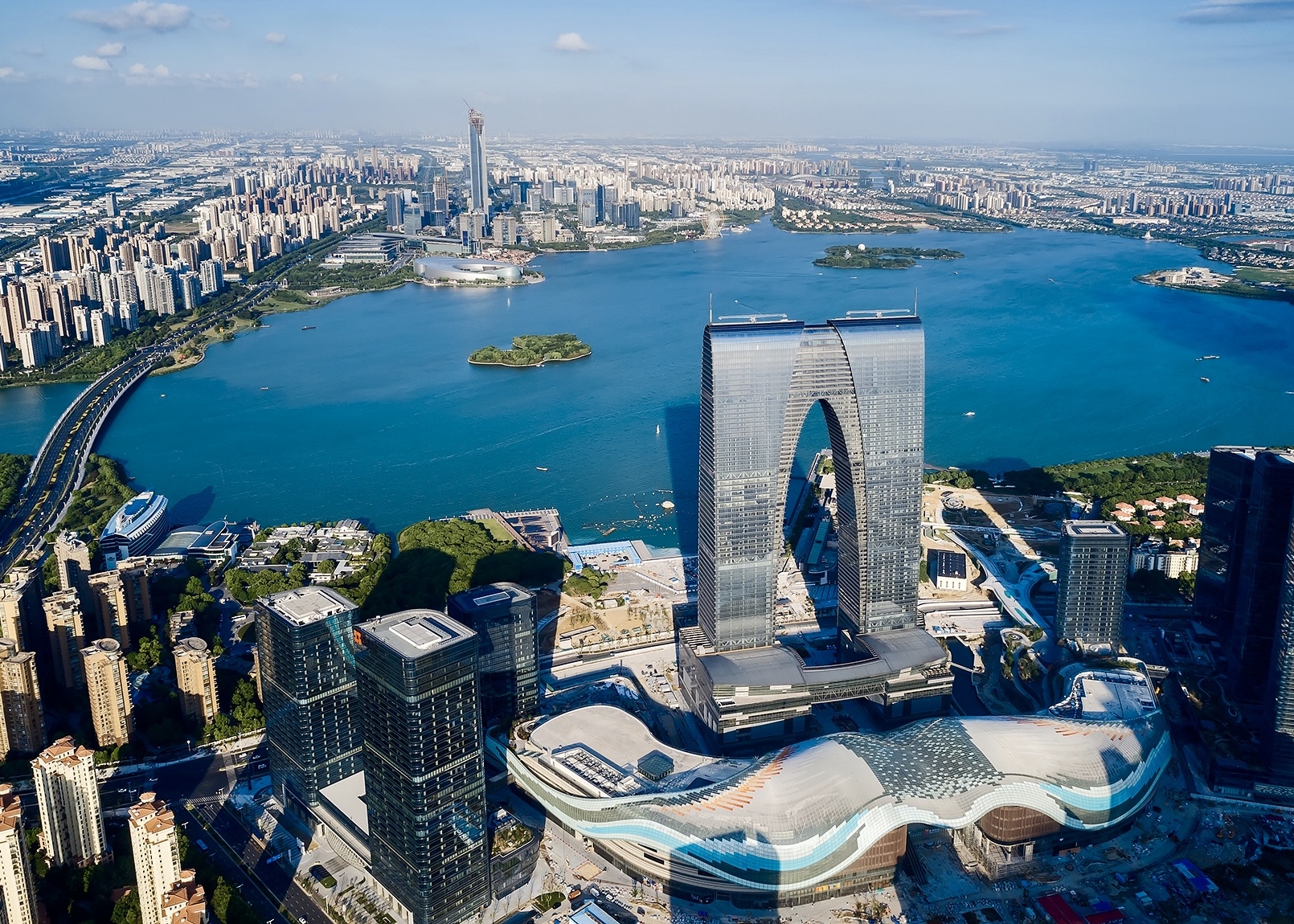
Suzhou
Sign in to saveAlso known as Soochow, Suzhou, Jiangsu, Soochoo, Suchow, Su-chou, Suzhou, China, Wu, Woo
Suzhou is the most populous prefecture-level city in Jiangsu province, China, and was the historic economic, cultural, and scholarly center of China from the Song to Qing dynasty. Suzhou is a major tourist destination and industrial hub of Eastern China, specializing in high-end manufacturing. Renowned as the cradle of Wu culture, Suzhou flourished as a hub of trade, arts, and intellectual life along the Grand Canal, helping shape China's economic and cultural development for centuries. The city is internationally famous for its classical gardens, which harmonize architecture, water, rocks, an
OverviewAI-generated
Suzhou is a prefecture-level city and big city located in Jiangsu, China. It shares borders with Shanghai, Wuxi, Changzhou, and Nantong. The city contains the administrative territorial entities of Gusu District, Huqiu District, Wuzhong District, and Xiangcheng District. Its official name is 苏州市, and it is situated in the UTC+08:00 time zone.
The population of Suzhou is 12,748,262. The city has an elevation above sea level of 5 meters. It is twinned with Venice, Victoria, Ikeda, and Kanazawa. Zhou Naixiang serves as the party chief representative. The local dialing code is 512, and the postal code is 215000.
Synthesized by Vinony from 53 facts across 7 sources: Wikidata, Openweathermap, Open Meteo, OpenStreetMap, GeoNames, Vinony graph, Geo. Generated from structured data (not the Wikipedia text) and checked against those facts — may still contain errors.
In the Vinony graph
The entry is geolocated on the map in adm2nd_region, across 3 mapped points.
Within Vinony's link graph, Suzhou is referenced by 3,042 other articles, and connects out to Wu, list of current and former capitals of subdivisions of China and Yangtze.
Vinony files it under Cities in Jiangsu, Jiangnan and National Civilized City.
Its subject is documented across 87 Wikipedia language editions.
Weather now
cached 14h ago7-day forecast
via Open-Meteo
Place details
- Locality
- 姑苏区
- Region
- 江苏省
- Country
- 中国
- Population
- 6,715,559
- Timezone
- Asia/Shanghai
via OpenStreetMap · GeoNames
Wikipedia views (30d)
29,535 totalvia Wikimedia Pageviews API
Key facts
- Settlement.name
- Suzhou
- Settlement.other_name
- Soochow
- Settlement.native_name
- 苏州市
- Settlement.native_name_lang
- zh-Hans
- Settlement.settlement_type
- Prefecture-level city
- Settlement.image_map1
- Suzhou locator map in Jiangsu.svg
- Settlement.map_caption1
- Location of Suzhou in Jiangsu
- Settlement.pushpin_map
- China
- Settlement.subdivision_type
- Country
- Settlement.subdivision_name
- China
- Settlement.subdivision_type1
- Province
- Settlement.subdivision_name1
- Jiangsu
- Settlement.subdivision_type2
- County-level divisions
- Settlement.subdivision_name2
- 11
- Settlement.seat_type
- Municipal seat
- Settlement.seat
- Gusu District
- Settlement.government_type
- Prefecture-level city
- Settlement.leader_title
- Party Secretary
via Wikipedia infobox
Wikidata facts
- Instance of
- big city
- Part of
- Jiangsu
- Official name
- 苏州市
- Country
- China
- Contains
- Taicang
- Population
- 12748262
- Area
- 8657.32
- Elevation
- 5
- Time zone
- UTC+08:00
- Body of water
- Yangtze
- Shares border with
- Huzhou
- Official website
- www.suzhou.gov.cn
- Image
- 东方之门1.jpg
- Dialing code
- 512
- Licence plate code
- 苏U
Show 10 more facts
- twinned administrative body
- Ayabe
- Commons category
- Suzhou
- topic's main category
- Category:Suzhou
- category for people born here
- Category:People from Suzhou
- category of associated people
- Category:People of Suzhou
- Commons gallery
- Suzhou
- postal code
- 215000
- different from
- Suzhou District
- hashtag
- Suzhou
- P12749
- Alex Ferguson
Sources (7)
via Wikidata · CC0
Travel guide
Understand
thumb|300px|One of the canals Suzhou has always been a major center of Wu culture which developed in the region around Lake Tai; a Suzhou accent in the Wu language is still considered prestigious, even though the language is now often called "Shanghainese". Suzhou was the capital of the Kingdom of Wu in the first millennium BCE, but through most of history Wu has not been an independent state.
The area was settled much earlier, but the city walls that defined what we now know as Suzhou were built in the late 6th century BCE. By 100 CE Suzhou was one of the ten largest cities on Earth, and in the early 19th century it was the world's largest non-capital city. Throughout this history, Suzhou was clearly the most important city of its region; Shanghai was just a walled town near the river mouth and the officials there reported to higher-ranking officials in Suzhou.
Starting in the mid-19th century, Shanghai boomed due to foreign trade; today it is far larger than Suzhou and very much the center of the area. However Suzhou is still a very significant city; the core city has over five million people, and the whole urban area more than ten million. The entire region is prosperous.
Suzhou has been a center of the silk trade and a place of gardens and canals for centuries. It has long been both a center of commerce and a haven for scholars, artists, and skilled craftsmen.
All of that is still the case today, over 700 years later. thumb|300px|Garden of the Master of the Nets In Im…
See
Suzhou has a number of attractions, including at least two that are absolutely world-class: its famous classical Chinese gardens, and the Suzhou Museum designed by a world-renowned architect.
Suzhou's gardens and architecture have had influence worldwide. Suzhou Street in Beijing's Summer Palace is a copy of Suzhou's Shantang Street, and the Chinese Garden Court in New York's Metropolitan Museum is a copy of part of the Master of the Nets garden. Both Vancouver's Sun-Yat-Sen Garden and Portland's Lan Su Chinese Garden were built by craftsmen imported from Suzhou.
Buy
There are also many such stores around the Mystery Temple and along other back streets north of Guanqian Jie, and some near various tourist attractions. Shops in the SIP are like those in Guanqian Jie, most of which are concentrated in a few enormous malls.
As anywhere in China, bargaining is the norm. Since Suzhou is a domestic tourist destination, though, prices will start off at surprisingly reasonable values. As anywhere, help from a knowledgeable local can save you both hassle and money, but you should not accept "help" from unknown locals; that may just mean you get a higher price and the "helper" gets a commission.
As a city famed through the ages for its silk embroidery, Suzhou is one of the best places to pick up silk handicrafts. Suzhou double-sided embroidery, in which the same picture is rendered in great detail on both sides of a silk screen and the knots are tied in the middle, is a traditional Suzhou speciality and is absolutely amazing. The needles used for this work are finer than a human hair.
Much of lower-priced embroidery work sold to tourists is now made using sewing machines which provide embroidery stitches. The fine handwork is still available, and often at better prices in Suzhou than elsewhere, but it is not cheap.
The Embroidery Institute is a lively enterprise producing high quality work which you can see on a tour of the facility. The gift shop has prices a little higher than at the street stalls but they will bargain and the quality is much …
Eat
Suzhou has its own unique, slightly sweet cuisine that tends to have very light and delicate flavors. Locals are very fond of freshwater fish and shellfish. Sweets made from glutinous rice paste are an old tradition here; these will generally baffle most Western palates, but try them anyway. A Suzhou speciality popular with many visitors is Song Shu Gui Yu (松鼠桂鱼 sōng shǔ guì yú), often rendered in English as "Squirrel-Shaped Mandarin Fish": the meat of a large fish is delicately cut into strips, breaded in flour, fried, and served covered with pine nuts and a sweet-and-sour sauce. It looks a little like a squirrel's tail... if you've drunk enough of the local rice wine. Another famous local dish is the slightly sweet braised cold duck (酱鸭 jiàng yā).
Stay safe
Suzhou is a safe place on the whole but there are a few things to watch out for. Pickpocketing is common on crowded buses, and around the north bus station and the train station. Pan-handlers and beggars around the old town can become a real nuisance although they are not dangerous. Watch out for incredibly pushy hawkers operating on Guanqian Jie shopping street - they generally charge ridiculous prices for counterfeit goods.
Taxis are generally safe although it's advisable not to follow touts operating around tourist sights or the train station. Also be aware that pedicab and 3-wheel tuk-tuk drivers are known to overcharge.
Probably the biggest safety risk in Suzhou are the electric scooters. These cheap, plastic, battery powered 2-wheel vehicles swarm around the city like ninjas and are renowned for driving anywhere possible - the wrong side of the road, the pavement, tiny alleyways and across crowded pedestrian crossings. They are almost silent and riders generally don't use headlights at night to save battery power - the only giveaway is their squeaky electric horns. Don't be surprised when you're walking down a busy pavement and one of these pocket-rockets whizzes past at 50 km/h without warning so always keep an eye and an ear out for them, particularly at night and at rush hour when the designated bike lanes become too crowded so the riders take alternate means.
Remember that in China it's legal for car drivers to make a right turn against a red light - albeit they …
Stay healthy
thumb|250px|Breathing may be difficult for some travelers
Some travelers may need to worry about the air quality in Suzhou, although the problem is not as bad as in nearby Shanghai or Nanjing.
As is the case for most of China, the tap water is not recommended for drinking but OK for washing. Filtered and boiled tap water is considered safer for drinking.
As Suzhou is a water town, there is a high presence of mosquitoes in the summer; luckily, repellant can be found in every convenience store, and they don't carry any known diseases in this area, so they're more of an annoyance than a hazard.
Connect
Suzhou has many free Wi-Fi access points as well as pay (¥2.5 per hour) Internet cafes.
Go next
Suzhou has a central position in East China and anywhere in the region is accessible. The other major cities of the area — Shanghai, Nanjing and Hangzhou — are all both economically important and major tourist destinations. Some of the lesser cities may also be of interest: Wuxi is so close that people from either city often shop or dine in the other Yixing is famous for pottery, especially teapots Yangzhou is historically important and Zhengjiang, just across the river, was the girlhood home of Nobel Prize writer Pearl Buck See East China#Go next for some possibilities beyond the region.
Suzhou is close to Lake Tai, which is a major recreational area. Day trips to the lake are possible going straight west from Suzhou or going via towns which are right on the lake, Wuxi to the north or the Suzhou suburb Wujiang to the south. Longer trips are also possible; see the Lake Tai article.
The whole region around Suzhou is flat Yangtze Delta terrain and has water towns, once the market towns for agricultural areas. All have picturesque canals with old houses along them and many bridges, and many are set up to accommodate tourists. Suzhou itself is very much a water town, and some travellers will find that enough. However, smaller places may be more picturesque or better preserved. Many agencies in Suzhou offer tours to some of these — especially to ones within Suzhou such as Zhouzhuang, Tongli and Zhen Ze. All are within an hour's travel of central Suzhou, and the…
Travel guide from Wikivoyage (CC BY-SA 4.0)
~40 min read
Encyclopedic overview
48 sectionsContents
- Names
- History
- Administrative divisions
- Geography
- Topography
- Hydrology
- Climate
- Cityscape and environment
- Classical Gardens of Suzhou
- Temples
- Canals and Historic Districts
- Resorts and natural reserves
- Skyscrapers
- Pan Gate
- Baodai Bridge
- Tiger Hill
- Pagodas
- Museums
- Hospitals
- Demographics
- Economy
- Agriculture
- Traditional handicrafts
- Development zones
- Suzhou Industrial Park
- Suzhou Industrial Park Export Processing Zone
- Suzhou New District
- Sports
- Transportation
- Railway
- Highways
- Water transport
- Air
- Metro
- Tram
- Bus
- Culture
- Notable people
- Education
- Universities and colleges
- High schools
- Postgraduate institutions
- Others
- See also
- Notes
- References
- Works cited
- External sources
Suzhou is the most populous prefecture-level city in Jiangsu province, China, and was the historic economic, cultural, and scholarly center of China from the Song to Qing dynasty. Suzhou is a major tourist destination and industrial hub of Eastern China, specializing in high-end manufacturing. Renowned as the cradle of Wu culture, Suzhou flourished as a hub of trade, arts, and intellectual life along the Grand Canal, helping shape China's economic and cultural development for centuries. The city is internationally famous for its classical gardens, which harmonize architecture, water, rocks, and plants into poetic expressions of nature. Long admired for its silk production, refined cuisine, and lyrical Kunqu opera, Suzhou has been praised in Chinese poetry, along with Hangzhou, as "paradise on earth," a reputation that endures today as the city blends its timeless canals, whitewashed lanes, and scholarly heritage with modern industries. Suzhou is part of the Yangtze Delta megalopolis.
Founded in 514 BC, Suzhou rapidly grew in size by the Eastern Han dynasty, mostly due to emigration from northern China. From the 10th century onwards, it has been an important economic, cultural, and commercial center, as well as the largest non-capital city in the world, until it was overtaken by Shanghai in approximately 1850. Since the reform and opening up began in 1978, Suzhou attained GDP growth rates of about 14% in 35 years. In 2023, Suzhou had 5 million registered residents. Suzhou is the 33rd global city by scientific output according to Nature Index 2025. The city is home to universities, including Soochow University, Suzhou University of Science and Technology, Xi'an Jiaotong–Liverpool University, and Changshu Institute of Technology.
Excerpted from Wikipedia’s “Suzhou” article, available under the CC BY-SA 4.0 licence.
Gallery (42)
On the map
3 mapped locations
Available in 87 languages
- Español
- Français
- Deutsch
- 中文
- 日本語
- Русский
- Português
- Italiano
- العربية
- हिन्दी
- Afrikaans
- Armenian
- Asturian
- azb
- Bahasa Indonesia
- Balinese
- Bangla
- Basque
Show 68 more
- Belarusian
- Breton
- Bulgarian
- Catalan
- cdo
- Cebuano
- Central Kurdish
- Chechen
- Croatian
- Czech
- Danish
- Dzongkha
- Egyptian Arabic
- Esperanto
- Estonian
- Filipino
- Finnish
- Galician
- Georgian
- Greek
- Hakka Chinese
- Hebrew
- Hungarian
- Icelandic
- Irish
- Kikuyu
- Kurdish
- Latin
- Latvian
- Lithuanian
- Macedonian
- Malagasy
- Malay
- Malayalam
- Marathi
- Moksha
- Mongolian
- Nederlands
- Norwegian
- Norwegian Nynorsk
- Ossetic
- Polski
- Punjabi
- Romanian
- Scots
- Serbian
- Serbian (Latin)
- simple
- Sindhi
- Slovenian
- Svenska
- Tamil
- Tiếng Việt
- Türkçe
- Ukrainian
- Urdu
- Uyghur
- Uzbek
- Waray
- Welsh
- Wu Chinese
- Yakut
- zh_classical
- zh_min_nan
- zh_yue
- فارسی
- ไทย
- 한국어
via Wikidata sitelinks · CC0