
Image by HansLinde on Pixabay · Pixabay License
Suzuki Harunobu
Sign in to saveAlso known as Chōeiken Shikojin, Shikojin, Jirobei Hozumi, Jihei, Harunobu, Jihei Hozumi, Suzuki Hozumi, Chōyeiken
Japanese printmaker
OverviewAI-generated
Suzuki Harunobu, whose native name is 鈴木春信, was a Japanese xylographer and illustrator. He was born and died in Edo, Japan, and worked in that location. His spoken and written language was Japanese. He is associated with the ukiyo-e and nishiki-e movements, creating works in the genre art style.
His works are held in the collections of the Minneapolis Institute of Art, the Art Institute of Chicago, The Nelson-Atkins Museum of Art, and the Auckland Art Gallery Toi o Tāmaki. He is recorded as having 36 works.
Synthesized by Vinony from 18 facts across 2 sources: Wikidata, Europeana Sparql. Generated from structured data (not the Wikipedia text) and checked against those facts — may still contain errors.
In the Vinony graph
Within Vinony's link graph, Suzuki Harunobu is referenced by 222 other articles, and connects out to bijin-ga, woodblock printing in Japan and Yanagawa Shigenobu.
It sits within the topics 1720s births, 1770 deaths and 18th-century Japanese artists.
Its subject is documented across 33 Wikipedia language editions.
Wikidata facts
- Instance of
- human
- Gender
- male
- Citizenship
- Japan
- Place of birth
- Edo
- Place of death
- Edo
- Occupation
- xylographer
- Languages spoken
- Japanese
- Genre
- genre art
- Movement
- ukiyo-e
- Work location
- Japan
Show 8 more facts
- Commons category
- Suzuki Harunobu
- Commons Creator page
- Suzuki Harunobu
- name in kana
- すずき はるのぶ
- name in native language
- 鈴木春信
- floruit
- 1829-01-01
- ethnic group
- Japanese people
- date of birth
- 1725-01-01
- date of death
- 1770-07-08
Sources (6)
via Wikidata · CC0
Works in European collections
36 objects attributed to Suzuki Harunobu, held across European museums, libraries & archives · via Europeana
Die Etikette, aus der Serie: Die fünf Tugenden
Die Eifersüchtige
Love Couple, Sheet 17 from the series: The lovely love adventures of the Maneemon
Erfrischender Sturm aus dem Faltfächer, aus der Serie: Acht Ansichten eleganter Gemächer
Junge Frau versteckt Brief vor jungem Mann
Der dritte Monat, aus der Serie: Beliebte Bräuche und unsterbliche Dichter in den vier Jahreszeiten
Heimliches Treffen, Blatt 24 aus der Serie: Die reizenden Liebesabenteuer des Maneemon
Der Fächerverkäufer
Minamoto no Shitagō, from the series 36 great poets
Come under the mosquito net
Der unstete Liebhaber, Blatt 21 aus der Serie: Die reizenden Liebesabenteuer des Maneemon
Junge Dame mit Dienerin im Schnee
Der Abschied
Der Zorn der Berggottheit, Blatt 4 aus der Serie: Die reizenden Liebesabenteuer des Maneemon
The Yamabuki flowers, from the series: 36 great poets
Sommerliche Liebesstunde
Minamoto no Muneyuki Ason, from the series: 36 great poets
Der Doppelselbstmord, Blatt 11 aus der Serie: Die reizenden Liebesabenteuer des Maneemon
Glücksgott Hōtei trägt ein junges Mädchen durch Wasser
Junges Mädchen unter dem Moskitonetz
Untitled
Untitled
Untitled
Untitled
Untitled
Untitled
Untitled
Untitled
Untitled

Untitled
Untitled
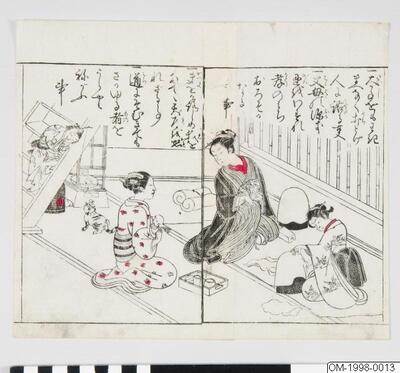
Untitled
Untitled
Untitled
Untitled
Untitled
~10 min read
Encyclopedic overview
Two girls, c. 1750
Suzuki Harunobu (Japanese: 鈴木 春信; c. 1725 – 8 July 1770) was a Japanese designer of woodblock print art in the ukiyo-e style. He was an innovator, the first to produce full-color prints (nishiki-e) in 1765, rendering obsolete the former modes of two- and three-color prints. Harunobu used many special techniques, and depicted a wide variety of subjects, from classical poems to contemporary beauties. Like many artists of his day, Harunobu also produced a number of shunga, or erotic images. During his lifetime and shortly afterwards, many artists imitated his style. A few, such as Harushige, even boasted of their ability to forge the work of the great master. Much about Harunobu's life is unknown.
Excerpted from Wikipedia’s “Suzuki Harunobu” article, available under the CC BY-SA 4.0 licence.