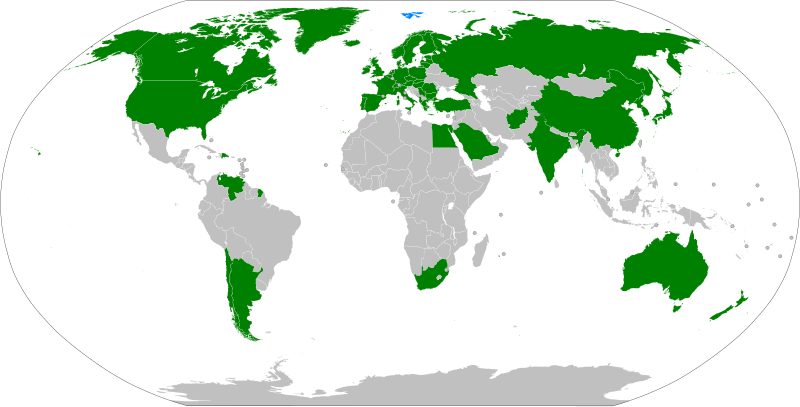
File:Svalbard_signatories.svg · Wikimedia Commons · See Wikimedia Commons
Svalbard Treaty
Sign in to saveAlso known as Spitsbergen Treaty, Treaty relating to Svalbard, Treaty relating to Spitsbergen
treaty recognising Norwegian sovereignty over the Arctic archipelago of Svalbard
In the Vinony graph
Vinony's link graph records 390 inbound references to Svalbard Treaty, and connects out to United States, Turkey and Russia.
It is catalogued under topics including 1920 in Norway, Concession territories and February 1920.
Vinony links it to 40 Wikipedia language editions.
Key facts
- Signed
- 9 February 1920
- Location
- Paris , France
- Effective
- 14 August 1925
- Condition
- Ratification by all the signatory powers
- Parties
- 49 – see list
- Depositary
- Government of the French Republic
- Languages
- French and English
via Wikipedia infobox
Wikidata facts
- Instance of
- treaty
- Country
- Norway
- Main subject
- Svalbard
- Location
- Paris
- Image
- Svalbard signatories.png
- Significant event
- coming into force
Show 5 more facts
- archives at
- Government of Norway
- point in time
- 1920-02-09
- title
- Traité concernant le Svalbard
- depositary
- Government of the French Republic
Sources (1)
via Wikidata · CC0
~8 min read
Encyclopedic overview
The Svalbard Treaty (originally the Spitsbergen Treaty) recognises the sovereignty of Norway over the Arctic archipelago of Svalbard, at the time called Spitsbergen. The exercise of sovereignty is, however, subject to certain stipulations, and not all Norwegian law applies. The treaty restricts military uses of the archipelago, but it is not demilitarized. The signatories were given equal rights to engage in commercial activities (mainly coal mining) on the islands. Norway and Russia have exercised this right.
Uniquely, the archipelago is an entirely visa-free zone under the terms of the Svalbard Treaty.
Excerpted from Wikipedia’s “Svalbard Treaty” article, available under the CC BY-SA 4.0 licence.