Encyclopedia of Life · EOL (see source)
Species
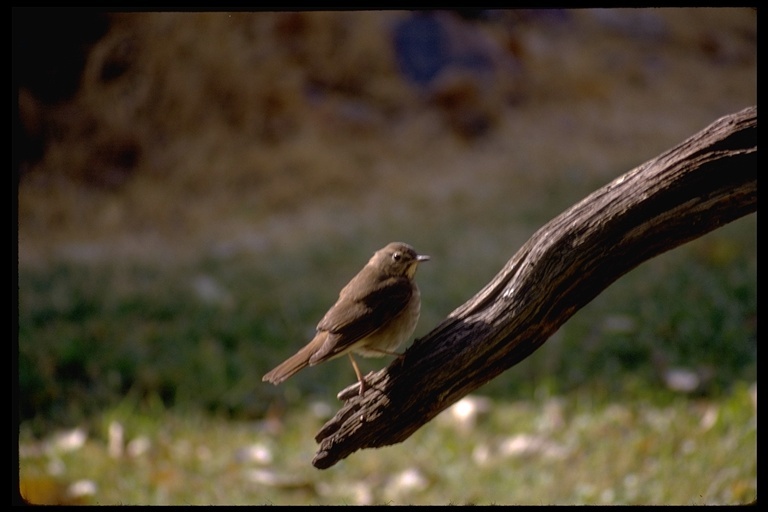
Least ConcernGrayer overall than most of its North American relatives, Swainson’s Thrush (7 inches) is most easily separated from a similar species, the Gray-cheeked Thrush, by its buff-brown cheeks and conspicuous eye-rings. Other field marks include a spotted breast, pink legs, and a medium-length bill. Male and female Swainson’s Thrushes are similar to one another in all seasons. The Swainson’s Thrush breeds in Alaska and across a wide swath of central and southern Canada. Smaller numbers are found south of the Canadian border, particularly along the Pacific coast and at higher elevations in the Appalachians and the Rocky Mountains. Swainson’s Thrush winters in southern Mexico and Central America south to Argentina. In summer, Swainson’s Thrush breeds primarily in evergreen forests dominated by spruce and fir trees. During the winter, this species inhabits wet tropical forests. On migration, Swainson’s Thrush may be found in a variety of habitats with dense undergrowth available for foraging and cover. Many North American birders never travel far south enough to see Swainson’s Thrush in winter. This species is much easier to observe in summer and on migration, although it is more often heard
via IUCN
Wikidata facts
- Instance of
- taxon
- Parent taxon
- Catharus
- Named after
- William Swainson
- Image
- Catharus ustulatus -North Dakota-8a.jpg
Show 10 more facts
- taxon rank
- species
- IUCN conservation status
- Least Concern
- Commons category
- Catharus ustulatus
- taxon name
- Catharus ustulatus
- Commons gallery
- Catharus ustulatus
- taxon common name
- tordo-de-swainson
- sequenced genome URL
- www.ensembl.org/Catharus_ustulatus
- diel cycle
- diurnality
- short name
- C. ustulatus
- taxon range
- Capixaba
via Wikidata · CC0
~6 min read
Encyclopedic overview
Swainson's thrush (Catharus ustulatus), also called olive-backed thrush, russet-backed thrush, and salmonberry bird is a medium-sized thrush. It is a member of genus Catharus and is typical of it in terms of its subdued coloration and beautiful, ascending flute-like voice. Swainson's thrush was named after William Swainson, an English ornithologist.
Etymology
Excerpted from Wikipedia’s “Swainson's Thrush” article, available under the CC BY-SA 4.0 licence.