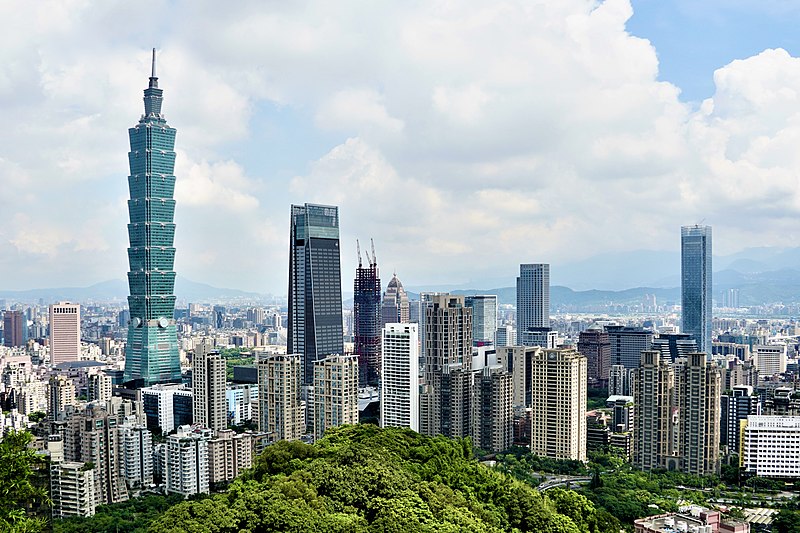
File:Taipei_Skyline_2022.06.29.jpg · Wikimedia Commons · See Wikimedia Commons
Taipei
Sign in to saveAlso known as The City of Azaleas, Taipei City, Taibei, City of Taipei, Tanshoui, Tai Pei
Taipei (; ; Tâi-gí: Tâi-pak), officially Taipei City, is the capital and a special municipality of Taiwan. Located in Northern Taiwan, Taipei City is an enclave of the municipality of New Taipei City that sits about southwest of the northern port city of Keelung. Most of the city rests on the Taipei Basin, an ancient lakebed. The basin is bounded by the relatively narrow valleys of the Keelung and Xindian rivers, which join to form the Tamsui River along the city's western border.
Taipei is the capital and special municipality of Taiwan, located in northern Taiwan as an enclave surrounded by New Taipei City. The city sits on the Taipei Basin, an ancient lakebed surrounded by river valleys, and serves as Taiwan's main political and administrative center.
AI-generated from the Wikipedia summary — may contain errors.
Weather now
7-day forecast
via Open-Meteo
Key facts
- Political division.name
- Taipei
- Political division.other_name
- Taipak, Taipeh, Taihoku
- Political division.settlement_type
- Capital city and Special Municipality
- Political division.image_flag
- Flag of Taipei City.svg
- Political division.image_seal
- Emblem of Taipei City.svg
- Political division.seal_type
- Logo
- Political division.nickname
- The City of Azaleas
- Political division.pushpin_map
- Taiwan#Asia#Pacific Ocean#Earth
- Political division.subdivision_type
- Country
- Political division.established_title
- Settled
- Political division.established_date
- 1709
- Political division.established_title1
- Taipeh Prefecture
- Political division.established_date1
- 1875
- Political division.established_title2
- Renamed Taihoku
- Political division.established_date2
- 17 April 1895
- Political division.established_title3
- Provincial city status
- Political division.established_date3
- 25 October 1945
- Political division.established_title4
- Provisional national capital
via Wikipedia infobox
Wikidata facts
- Official name
- Тайбэй
- Country
- Empire of Japan
- Located in
- Taiwan under Japanese rule
- Contains
- Shilin District
- Continent
- Asia
- Capital
- Xinyi District
- Official language
- Standard Taiwanese Mandarin
- Population
- 2442991
- Area
- 271.7997
- Elevation
- 10
- Time zone
- UTC+08:00
- Body of water
- Keelung River
- Head of government
- Ko Wen-je
- Legislature
- Taipei City Council
- Capital of
- Taiwan
- Shares border with
- New Taipei
- Official website
- www.gov.taipei
- Image
- 20260204 Taipei, Taiwan Skyline.jpg
- Households
- 1081315
- Dialing code
- 02
Show 27 more facts
- category for people born here
- Category:Births in Taipei
- Commons category
- Taipei
- twinned administrative body
- Basseterre
- postal code
- 100
- topic's main category
- Category:Taipei
- Commons gallery
- 臺北市
- category for people who died here
- Category:Deaths in Taipei
- category of associated people
- Category:People from Taipei
- native label
- 台北市
- inception
- 1709-00-00
- owner of
- Tianmu Baseball Stadium
- language used
- Basay
- streaming media URL
- www.youtube.com/watch?v=xCDSGVpWuNI
- P8168
- Heinrich Jung
- enclave within
- New Taipei
- executive body
- Taipei City Government
- office held by head of government
- Mayor of Taipei
- hashtag
- Đài Bắc
- official symbol
- Ficus microcarpa
- located in/on physical feature
- Taipei Basin
- on focus list of Wikimedia project
- Wikipedia:Vital articles/Level/4
- described by source
- Granat Encyclopedic Dictionary
- P12749
- West Virginia
- male population
- 1150846
- female population
- 1292145
- social media followers
- 44800
- Peh-oe-ji
- Tâi-pak-chhī
Sources (10)
via Wikidata · CC0
Travel guide
Understand
thumb|400px|An evening in Taipei from Elephant Mountain in 2017. In 1884, Liu Mingchuan, the Qing dynasty governor of Taiwan, moved the prefectural capital to Taipei. As officials arrived and government buildings were constructed, the city began to transform from a quiet market town. When Taiwan became a province in 1887, Taipei was named its capital and continued to hold that status. Its position in northern Taiwan — closest to Japan — also supported its growth after the island was ceded to Japan in 1895.
During Japan’s fervent modernization campaign, much of Taipei’s traditional Chinese architecture was swept away, including the historic city walls. However, several Qing-era structures, such as the old North Gate, the former Provincial Administration Hall, and a number of temples, survived. The Japanese colonial period also left a lasting mark on the city’s architectural landscape, with prominent landmarks such as the Presidential Palace and National Taiwan University built during this time.
Taipei underwent another dramatic transformation after 1945, when the Kuomintang (KMT) government relocated from mainland China. To accommodate the massive influx of mainland refugees, temporary housing spread rapidly across the city. These were later replaced with utilitarian concrete apartment blocks, which defined Taipei’s urban aesthetic for decades. Many of these buildings still stand, but beginning in the 1980s, Taiwan’s economic boom fueled a new phase of development. Modern ne…
See
Those who take the time to visit and look around will soon find that Taipei is just as vibrant as any other major city, and is full of a certain charm which makes it unique in its own right. Just spend a day wandering around Taipei's streets and you will start finding many surprises.
Buy
It has been said that Los Angeles has no center. In contrast, one could say that Taipei is all center, and as such it has been given the epithet - "the emporium without end." Basically, however, the main shopping area can be divided into two districts: East and West. West Taipei is the old city and is characterized by narrow streets packed with small shops. East Taipei boasts wide tree lined boulevards and the biggest shopping malls are in this area.
Eat
Taipei is a foodie's paradise. Almost every street and alley offers some kind of eatery. Although Taiwanese cuisine is primarily based on the cuisine of southern Fujian, the huge influx of Kuomintang refugees from mainland China after losing the Chinese Civil War means that Taipei is also one of the best places in the world to sample regional cuisines from all over China, with many of these also having been given a unique Taiwanese twist. In addition, Thai, Vietnamese, Japanese, Korean and Italian cuisines are also popular. Basically, East Taipei, especially around Dunhua and Anhe Roads, and also the expat enclave of Tianmu are where to clash chopsticks with the rich and famous, whereas West Taipei offers more smaller, homey restaurants. Convenience stores are open 24/7 and are extremely useful for travelers. You can buy cheap meals, withdraw cash, and buy toiletries.
Drink
The nightlife in Taipei runs from boisterous night markets to equally exuberant clubs and bars, and indeed the city comes alive with glittering lights after the last rays of the sun leave the grey buildings.
Sleep
Taipei offers an important number of various accommodations ranging from basic dorms to 5-star luxury hotels. See the districts articles to read detailed listings.
Tourists sleeping one night in Taipei might want to stay in Zhongzheng, near the Main Train Station, where many budget accommodations can be found. Hostels can be found in the old Taipei area. Hotels around the Ximending area would be convenient for those wanting to eat, shop and party all in one area. Business travelers would probably prefer to stay in Xinyi, the financial district, where many luxury hotels are found. The Grand Hotel in Zhongshan, built back when Chiang Kai-shek decided there wasn't a suitable hotel in which to welcome foreign dignitaries, may appeal to those interested in classical Chinese architecture and history. 10% service fee and 5% VAT are usually not included in the top end hotel rates.
If you're staying a bit more long-term in Taipei, do as some daily commuters do and get cheaper rooms outside city boundaries, in places such as Xindian and Yonghe, which are still somewhat accessible through the Taipei MRT network.
Stay safe
Taipei is one of the safest cities you will ever visit, and violent crime is extremely rare. Most people, including female travellers, will not encounter any problems roaming the streets alone at night. However, while not as rampant as in major European cities, pickpockets operate in crowded areas, so you should be vigilant of your belongings, particularly in night markets. Homeless people tend to congregate near Taipei Main Station. While most of them are harmless and will not bother you, you may want to avoid the area late at night if it makes you feel uncomfortable. Smoking is only allowed in designated areas. Walking while smoking can result in a penalty fee.
Local police are a resource you can turn for help, and many officers speak at least basic English.
Central Weather Administration – In addition to giving a seven-day forecasts for Taiwan(including districts in Taipei), this website also has detailed maps showing the path of an approaching typhoon and up-to-the-minute information of earthquakes, giving their location and magnitude. Emergency numbers: Police: 110 Ambulance, Fire brigade: 119
Go next
Taiwan's excellent rail system makes day trips easy, and there's lots to see around the New Taipei and Keelung.
Tamsui, an old port town northwest of Taipei, is the main scene of the Taiwanese movie-Secret by Jay Chou. It's very popular with tourists. Jiufen is a former gold mining town on the northeast coast and now a popular tourist destination. Banqiao is a town and administrative capital of the other city in the Taipei Metro Area, New Taipei City. Fulong is on the eastern coast of New Taipei City. There you will find a coastal town with an excellent beach. Every July, there is the three day Ho-hai-yan Rock Festival which is a must-see. Yingge is famous for its high concentration of potters and ceramic makers.
It's even possible to travel to anywhere along the west coast of Taiwan all the way to Kaohsiung and back within a day, although at the price of a high-speed rail ticket. The eastern parts are a little harder to get to, and Taroko Gorge warrants more than a night's stay anyway.
Taroko Gorge – Here, the Liwu River cuts through 3,000-foot marble cliffs. The area around the gorge is also designated as Taroko Gorge National Park. Hsinchu is a city with an old heritage and modern science park. Shei-pa National Park spans mountains and rivers and is in Hsinchu County has great hiking trails. Hsinchu County is also home to Leofoo Village Theme Park, Taiwan's most popular amusement park. Sun Moon Lake in Nantou County is a crystal clear lake embedded into lush mountains. …
Travel guide from Wikivoyage (CC BY-SA 4.0)
~34 min read
Encyclopedic overview
51 sectionsContents
- Names
- History
- Early settlers to the Qing dynasty
- Empire of Japan
- Post-WW2 under ROC
- Geography
- Climate
- Air quality
- Cityscape
- Demographics
- Economy
- Culture
- Tourism
- Commemorative sites and museums
- Taipei 101
- Performing arts
- Shopping and recreation
- Temples
- Festivals and events
- Government
- Garbage recycling
- Administrative divisions
- City planning
- Transportation
- Metro
- Rail
- Bus
- Airports
- Ticketing
- Education
- Sports
- Major sporting events
- Youth baseball
- Media
- Television
- Newspapers
- International relations
- Twin towns and sister cities
- United States
- Outside United States
- Partner cities
- Friendship cities
- In popular culture
- Gallery
- See also
- Notes
- Words in native languages
- Other
- References
- Further reading
- External links
Taipei (; ; Tâi-gí: Tâi-pak), officially Taipei City, is the capital and a special municipality of Taiwan. Located in Northern Taiwan, Taipei City is an enclave of the municipality of New Taipei City that sits about southwest of the northern port city of Keelung. Most of the city rests on the Taipei Basin, an ancient lakebed. The basin is bounded by the relatively narrow valleys of the Keelung and Xindian rivers, which join to form the Tamsui River along the city's western border.
The municipality of Taipei is home to an estimated population of 2,494,813 (March 2023), forming the core part of the Taipei–Keelung metropolitan area, also known as "Greater Taipei", which includes the nearby cities of New Taipei and Keelung with a population of 7,047,559, the 40th most-populous urban area in the world—roughly one-third of Taiwanese citizens live in the metro areas. The name "Taipei" can refer either to the whole metropolitan area or just the municipality alone. Taipei has been the political center of the island since 1887, when it first became the seat of Taiwan Province by the Qing dynasty until 1895 and again from 1945 to 1956 by the Republic of China (ROC) government, with an interregnum from 1895 to 1945 as the seat of the Government-General of Taiwan during the Japanese rule. The city has been the national seat of the ROC central government since 1949, and it became the nation's first special municipality (then known as Yuan-controlled municipality) on 1 July 1967, upgrading from provincial city status.
Excerpted from Wikipedia’s “Taipei” article, available under the CC BY-SA 4.0 licence.
Gallery (52)
On the map
3 mapped locations
Available in 169 languages
- Español
- Français
- Deutsch
- 中文
- 日本語
- Русский
- Português
- Italiano
- العربية
- हिन्दी
- abstract
- Achinese
- Afrikaans
- Albanian
- Albanian
- Amharic
- Aragonese
- Armenian
Show 150 more
- Arpitan
- Asturian
- azb
- Azerbaijani
- Bahasa Indonesia
- Balinese
- Bangla
- Bashkir
- Basque
- be_x_old
- Belarusian
- Bikol
- Bosnian
- Breton
- Bulgarian
- Buriat
- Burmese
- Catalan
- cdo
- Cebuano
- Central Kurdish
- Chechen
- Chuvash
- Croatian
- Czech
- Danish
- Egyptian Arabic
- Esperanto
- Estonian
- Faroese
- Fiji Hindi
- Fijian
- Filipino
- Finnish
- Galician
- Gan Chinese
- Georgian
- Greek
- Guarani
- Haitian Creole
- Hakka Chinese
- Hausa
- Hebrew
- Hungarian
- hyw
- Iban
- Icelandic
- Ido
- Iloko
- Interlingua
- Interlingue
- Irish
- Jamaican Creole English
- Javanese
- Kannada
- Kazakh
- Khmer
- Kinyarwanda
- Kyrgyz
- Ladino
- Lao
- Latin
- Latvian
- Ligurian
- Limburgish
- Lithuanian
- lld
- Lombard
- Luxembourgish
- Macedonian
- Malagasy
- Malay
- Malayalam
- Maltese
- Marathi
- Mazanderani
- Minangkabau
- Mingrelian
- Mirandese
- Mongolian
- Nederlands
- Nepali
- Newari
- Northern Frisian
- Norwegian
- Norwegian Nynorsk
- Novial
- Occitan
- Ossetic
- Pampanga
- Papiamento
- Pashto
- Piedmontese
- Polski
- Punjabi
- pwn
- Quechua
- Romanian
- Rusyn
- Santali
- Sardinian
- Scots
- Scottish Gaelic
- Serbian
- Serbian (Latin)
- Shona
- Sicilian
- Silesian
- simple
- Sindhi
- Sinhala
- Slovak
- Slovenian
- Svenska
- Swahili
- Tajik
- Talysh
- Tamil
- Tatar
- tay
- Tibetan
- Tiếng Việt
- Tok Pisin
- Toki Pona
- Türkçe
- Udmurt
- Ukrainian
- Urdu
- Uyghur
- Uzbek
- Venetian
- Veps
- Volapük
- Waray
- Welsh
- Western Frisian
- Western Panjabi
- Wu Chinese
- Yakut
- Yiddish
- Yoruba
- Zaza
- Zeelandic
- zh_classical
- zh_min_nan
- zh_yue
- Zhuang
- فارسی
- ไทย
- 한국어
via Wikidata sitelinks · CC0