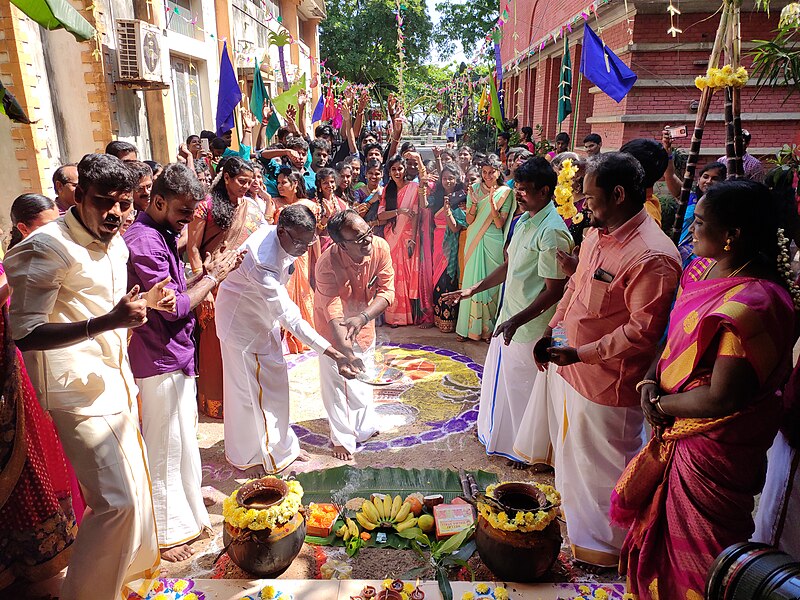
File:Pongal_Festival.jpg · Wikimedia Commons · See Wikimedia Commons
Tamil
Sign in to saveAlso known as Tamils, Tamil people, Damulian, Tamal, Tamalsan, Tambul, Tamilans, Tamilian
The Tamils ( ), also known by their demonym Tamilar, are a Dravidian ethnic group who natively speak the Tamil language and trace their ancestry mainly to the southern part of the Indian subcontinent. Tamil is one of the longest-surviving languages, with over two thousand years of written history, dating back to the Sangam period (between 300 BCE and 300 CE). Tamils constitute about 5.7% of the Indian population and form the majority in the South Indian state of Tamil Nadu and the union territory of Puducherry. They also form significant proportions of the populations in Sri Lanka (15.3%), Mal
Tamil refers to a Dravidian ethnic group native to southern India who speak the Tamil language, which has survived for over two thousand years with a documented written history dating back to around 300 BCE. Tamils make up about 5.7% of India's population and are the majority group in the South Indian state of Tamil Nadu and the union territory of Puducherry, while also forming significant populations in other regions including Sri Lanka.
AI-generated from the Wikipedia summary — may contain errors.
Key facts
- Ethnic group.group
- Tamils
- Ethnic group.native_name_lang
- ta
- Ethnic group.population
- (Native Tamil speakers, est.2024) center|frameless|280x280px
- Ethnic group.image
- Pongal Festival.jpg
- Ethnic group.caption
- Tamils celebrating Pongal festival
- Ethnic group.region1
- India
- Ethnic group.pop1
- 69,026,881 (2011)
- Ethnic group.region2
- Sri Lanka
- Ethnic group.pop2
- 3,108,770 (2012)
- Ethnic group.region3
- Malaysia
- Ethnic group.pop3
- 1,800,000 (2016)
- Ethnic group.region4
- South Africa
- Ethnic group.pop4
- ~600,000 (2013)
- Ethnic group.region5
- United States
- Ethnic group.pop5
- 238,699+ (2017)
- Ethnic group.region6
- Canada
- Ethnic group.pop6
- 237,890 (2021)
- Ethnic group.region7
- Singapore
via Wikipedia infobox
Wikidata facts
- Instance of
- ethnic group
- Subclass of
- Dravidian people
- Languages spoken
- Tamil
- Native language
- Tamil
- Religion
- Islam
- Country
- Sri Lanka
- Location
- Medan
Show 3 more facts
- Commons category
- Tamils
- topic's main category
- Category:Tamil
- studied by
- Tamilology
Sources (2)
via Wikidata · CC0
~52 min read
Encyclopedic overview
42 sectionsContents
- Etymology
- History
- In India
- Pre-historic period (before 4th century BCE)
- Sangam period (3rd century BCE–3rd century CE)
- Medieval era (4th–13th century CE)
- Vijayanagar and Nayak period (14th–17th century CE)
- Later conflicts and European colonization (17th to 20th century CE)
- Post Indian Independence (1947–present)
- In Sri Lanka
- Pre-Anuradhapura period (before fifth century CE)
- Anuradhapura period (4th century BCE to 10th century CE)
- Polonnaruwa and Jaffna kingdom (11th–15th century CE)
- Later conflicts and European colonization (16th–20th century CE)
- Post Sri Lankan independence (1948–present)
- Geographic distribution
- India
- Sri Lanka
- Tamil diaspora
- Culture
- Language
- Literature
- Art and architecture
- Architecture
- Sculpture and paintings
- Music
- Performance arts
- Martial arts
- Modern arts
- Clothing
- Calendar
- Food and hospitality
- Medicine
- Festivals
- Sports
- Religion
- Notable people
- See also
- Notes
- References
- Bibliography
- External links
The Tamils ( ), also known by their demonym Tamilar, are a Dravidian ethnic group who natively speak the Tamil language and trace their ancestry mainly to the southern part of the Indian subcontinent. Tamil is one of the longest-surviving languages, with over two thousand years of written history, dating back to the Sangam period (between 300 BCE and 300 CE). Tamils constitute about 5.7% of the Indian population and form the majority in the South Indian state of Tamil Nadu and the union territory of Puducherry. They also form significant proportions of the populations in Sri Lanka (15.3%), Malaysia (7%) and Singapore (5%). Tamils have migrated world-wide since the 19th century CE and a significant population exists in South Africa, Mauritius, Fiji, as well as other regions such as the Southeast Asia, Middle East, Caribbean and parts of the Western World.
Archaeological evidence from Tamil Nadu indicates a continuous history of human occupation for more than 3,800 years. In the Sangam period, Tamilakam was ruled by the Three Crowned Kings of the Cheras, Cholas and Pandyas. Smaller Velir kings and chieftains ruled certain territories and maintained relationship with the larger kingdoms. Urbanisation and mercantile activity developed along the coasts during the later Sangam period with the Tamils influencing the regional trade in the Indian Ocean region. Artifacts obtained from excavations indicate the presence of early trade relations with the Romans. The major kingdoms to rule the region later were the Pallavas (3rd–9th century CE), and the Vijayanagara Empire (14th–17th century CE).
Excerpted from Wikipedia’s “Tamil” article, available under the CC BY-SA 4.0 licence.
Gallery (52)
Available in 75 languages
- Español
- Français
- Deutsch
- 中文
- 日本語
- Русский
- Português
- Italiano
- العربية
- हिन्दी
- Afrikaans
- Armenian
- azb
- Azerbaijani
- Bahasa Indonesia
- Bangla
- Basque
- Belarusian
Show 56 more
- Bulgarian
- Catalan
- Chuvash
- Croatian
- Czech
- Danish
- Egyptian Arabic
- Esperanto
- Finnish
- Georgian
- Greek
- Gujarati
- Hebrew
- Hungarian
- Icelandic
- Javanese
- Kazakh
- kge
- Kurdish
- Kyrgyz
- Latvian
- Lithuanian
- Malagasy
- Malay
- Malayalam
- Marathi
- Minangkabau
- Nederlands
- Nepali
- Norwegian
- Norwegian Nynorsk
- Polski
- Punjabi
- Serbian
- Serbian (Latin)
- simple
- Sinhala
- skr
- Slovak
- Svenska
- Tamil
- Telugu
- Tiếng Việt
- Toki Pona
- Türkçe
- Ukrainian
- Urdu
- Uzbek
- Western Frisian
- Western Panjabi
- Wu Chinese
- Yakut
- zh_min_nan
- فارسی
- ไทย
- 한국어
via Wikidata sitelinks · CC0