
Sri Lanka
Sign in to saveAlso known as Democratic Socialist Republic of Sri Lanka, Ceylon, Taprobane, Serendib, Ceylan, lk, Lanka, Sri, sri
Sri Lanka, officially the Democratic Socialist Republic of Sri Lanka, formerly known as Ceylon, is an island country in South Asia. It is located in the Indian Ocean, southwest of the Bay of Bengal, and is separated from India by the Gulf of Mannar and the Palk Strait. Sri Lanka shares a maritime border with the Maldives to the southwest and India to the northwest, and lies across the Bay of Bengal from Bangladesh and Myanmar to the northeast and the Andaman and Nicobar Islands of India to the east. Its capital is Sri Jayawardenepura Kotte, while Colombo is its largest city and the political, financial and cultural centre. Sri Lanka's population is 22 million; with the Sinhalese people, who speak the Sinhala language, forming the vast majority—while Tamil is spoken by the large Tamil minority. Other long-established ethnic groups include the Moors, Indian Tamils, Burghers, Malays, Chinese, and Vedda.
OverviewAI-generated
Sri Lanka, officially the Democratic Socialist Republic of Sri Lanka, is located in Southern Asia. Its capital is Sri Jayawardenepura Kotte. The country covers an area of 65610 and has a population of 21763170. It was established on 1972-05-22, replacing the Dominion of Ceylon. Historically, it has been part of the Portuguese Empire, British Empire, and Dutch Empire. The native labels for the nation are ශ්රී ලංකා ප්රජාතාන්ත්රික සමාජවාදී ජනරජය, இலங்கை சனநாயக சோசலிசக் குடியரசு, and ශ්රී ලංකාව.
The official languages are Sinhala and Tamil, and the currency is the Sri Lankan rupee. The legislative body is the Parliament of Sri Lanka, with the head of government holding the office of Prime Minister of Sri Lanka or President of Sri Lanka. Public holidays include Independence Day. The emergency phone number is 119, and the licence plate code is CL. The top-level domains are .lk, .இலங்கை, and .ලංකා. The flag is 🇱🇰.
Synthesized by Vinony from 68 facts across 9 sources: Wikidata, Open Meteo, Openweathermap, World Bank, OpenStreetMap, REST Countries, PubMed, Vinony graph, Geo. Generated from structured data (not the Wikipedia text) and checked against those facts — may still contain errors.
Weather now
cached 17h ago7-day forecast
via Open-Meteo
Country

- Capital
- Sri Jayawardenepura Kotte
- Population
- 21,763,170
- Region
- Asia · Southern Asia
- Demonym
- Sri Lankan
- Currencies
- LKR (Rs රු)
- Languages
- Sinhala, Tamil
- Calling code
- +94
- Drives on
- Left
- Gini
- 39.3 (2016)
- FIFA code
- SRI
- TLD
- .lk, .இலங்கை, .ලංකා
- Timezones
- UTC+05:30
via REST Countries
Indicators · World Bank
- GDP
- $99B(2024)
- Population
- 21,916,000(2024)
- Life expectancy
- 77.7 yrs(2024)
- Unemployment
- 4 %(2025)
- Urban population
- 20.3 %(2024)
- Internet users
- 54.6 %(2024)
- Forest area
- 34 %(2023)
- Renewable energy
- 48.8 %(2021)
via World Bank Open Data · CC BY 4.0
Wikipedia views (30d)
242,980 totalvia Wikimedia Pageviews API
Research
22,252 papers- Thalassemia in Sri Lanka.ReviewHemoglobin · 2022Premawardhena AP, Madushanka HDPDOI: 10.1080/03630269.2022.2025826
- Anemia in Sri Lanka: A Literature Review.ReviewHemoglobin · 2022Amarasingha AADS, Silva HJRL, Perera PS et al.DOI: 10.1080/03630269.2022.2096460
- Sri Lanka's health crisis.BMJ (Clinical research ed.) · 2022Bandara S, Alwis IDOI: 10.1136/bmj-2022-073475
- Cancer services in Sri Lanka: current status and future directions.ReviewJournal of the Egyptian National Cancer Institute · 2021Jayarajah U, Abeygunasekera AMDOI: 10.1186/s43046-021-00070-8
- Pharmacogenomics in Sri Lanka: a comprehensive systematic review of the research landscape and clinical implications.Pharmacogenomics · 2024Ranasinghe P, Jeyapragasam H, Liyanage S et al.DOI: 10.1080/14622416.2024.2421743
- Sri Lanka.Department of State publication. Background notes series · 1985United States. Department of State. Bureau of Public Affairs
- Global Dialysis Perspective: Sri Lanka.Kidney360 · 2022Wijewickrama ES, Herath NDOI: 10.34067/KID.0001592022
- Sri Lanka has been a success story for WHO's engagement in global public health.The Ceylon medical journal · 2023Singh ADOI: 10.4038/cmj.v68iSI1.9786
via PubMed
Wikidata facts
- Instance of
- country
- Has part
- history of Sri Lanka
- Official name
- la République socialiste démocratique de Sri Lanka
- Demonym
- Šrilančanka
- Religion
- Christianity
- Country
- Dutch Empire
- Contains
- North Central Province
- Continent
- Asia
- Capital
- Colombo
- Official language
- Tamil
- Currency
- Sri Lankan rupee
- Population
- 22037000
- Area
- 65610
- Body of water
- Indian Ocean
- Head of government
- Harini Amarasuriya
- Head of state
- Anura Kumara Dissanayake
- Form of government
- republic
- Legislature
- Parliament of Sri Lanka
- Anthem
- Sri Lanka Matha
- Shares border with
- India
- Highest point
- Pidurutalagala
- Official website
- www.gov.lk/index.php
- Image
- Topography Sri Lanka.jpg
- Life expectancy
- 77
Show 72 more facts
- Nominal GDP
- 74403578363
- Unemployment rate
- 5
- Calling code
- +94
- Licence plate code
- CL
- Electrical plug type
- BS 1363
- Mains voltage
- 230
- Motto
- Rhyfeddod Asia yw Ffresni Sri Lanca
- Coat of arms
- Emblem of Sri Lanka
- topic's main Wikimedia portal
- Portal:Sri Lanka
- Unicode character
- 🇱🇰
- category of associated people
- Category:Sri Lankan people
- geography of topic
- Geography of Sri Lanka
- office held by head of government
- President of Sri Lanka
- native label
- ශ්රී ලංකාව
- public holiday
- Independence Day
- diplomatic relation
- North Korea
- inception
- 1972-05-22
- Commons gallery
- Sri Lanka
- trunk prefix
- 0
- history of topic
- history of Sri Lanka
- replaces
- Dominion of Ceylon
- mobile country code
- 413
- total fertility rate
- 2
- maritime identification digits
- 417
- marriageable age
- 18
- topic's main category
- Category:Sri Lanka
- member of
- World Health Organization
- railway traffic side
- left
- located in/on physical feature
- South Asia
- category for films shot at this location
- Category:Films shot in Sri Lanka
- category for people who died here
- Category:Deaths in Sri Lanka
- office held by head of state
- President of Sri Lanka
- Commons category
- Sri Lanka
- top-level Internet domain
- .lk
- retirement age
- 55
- category for people born here
- Category:Births in Sri Lanka
- water as percent of area
- 1.3
- number of out-of-school children
- 436411
- driving side
- left
- lowest point
- Indian Ocean
- IPA transcription
- sɾiːˈlɑŋkɑ
- language used
- Tamil
- central bank
- Central Bank of Sri Lanka
- literacy rate
- 91.9
- GS1 country code
- 479
- culture
- culture of Sri Lanka
- VAT rate
- 17
- described by source
- Pauly–Wissowa
- BTI Status Index
- 6.04
- BTI Governance Index
- 4.8
- economy of topic
- economy of Sri Lanka
- demographics of topic
- demographics of Sri Lanka
- Democracy Index
- 6.14
- Human Development Index
- 0.782
- hashtag
- sri-lanka
- on focus list of Wikimedia project
- Wikipedia:Vital articles/Level/4
- Happy Planet Index score
- 46.8
- Gini coefficient
- 39.3
- Inequality-adjusted Human Development Index
- 0.676
- suicide rate
- 12.9
- female population
- 11429000
- male population
- 10727000
- P12749
- Bruce Springsteen
- birth rate
- 13.781
- death rate
- 7.287
- rural population
- 17960843
- urban population
- 4220157
- P8168
- Bridge near Kemer
- most populous urban area
- Colombo
- Commonwealth Sport country code
- SRI
- name
- Tích Lan
Sources (15)
via Wikidata · CC0
Travel guide
Get in
thumb|375px|A map showing the visa requirements of Sri Lanka, with countries in gold having visa on arrival with an Electronic Travel Authorization
Get around
thumb|A red public bus and a blue private bus as seen from the back of a train near Jaffna Sri Lanka has a strong public transport network linking nearly all tourist destinations, making independent travel very easy. Roads can be terrifying due to local driving traditions — see #Stay safe. Together with occasional massive crowds (especially on holidays), often lacking luggage space, buses may not seem like the most appealing way of travel for some. Yet, they offer great opportunities for interaction with locals, are cheap, plentiful and have different price points (express/local, public/private). Harassment of women travelling alone was frequent in the past, but Sri Lanka seems to have grown up since then.
See
thumb|Ruwanwelisaya stupa in Anuradhapura Admission fees for foreigners to many of the tourist sites are up to ten times those for locals. And nowadays even the remotest Buddha statue or waterfall charges Rs 300 or more.
Temple of the sacred tooth relic (Dhaladha Maligawa) is a historical structure built around the 16th century to treasure the sacred tooth relic of Lord Buddha. It was built as a palace for the kings of Sri Lanka. which was later turned into a temple. This structure has been reconstructed many time after demolition, including by a terrorist attack during the 1983-2009 civil war.
Some popular sights in Sri Lanka are:
Lagoons such as Mannar and Jaffna, alongside marshes in these areas. Beautiful English-style villages in Nuwara Eliya. There are many tea estates and Hakgala gardens too. The beaches of Unawatuna, Galle, Weligama, Bentota and northern areas are well known, but there are many quieter beaches like Dikwella, Kalpitiya or SK Town. The unexplored Sri Lanka in Jaffna and the islands in the Northern Province (such as Neduntheevu AKA Delft). The ancient cities of Anuradhapura and Polonnaruwa (not temples) Chilaw sandpits (great for bird watching) Pinnawala elephant orphanage The rainforests of Peak Wilderness Sanctuary, Knuckles Mountain Range and Sinharaja Forest Reserve.
With a recorded history of more than 2,500 years, Sri Lanka has a rich cultural and natural heritage and its World Heritage Sites are among the absolute highlights in the country. Wi…
Eat
thumb|Kiribath, rice cooked in coconut milk thumb|Kottu Roti with chicken thumb|Hoppers
Sri Lanka and South Indian food share a lot in common, and many local restaurants describe their menus as Sri Lankan & South Indian. There are several uniquely Sri Lankan dishes, though, such as the different types of hopper, devilled meat and/or fish, cuttlefish, etc., and the common fiery addition to any curry, pol sambol made of grated coconut, red chilli powder and lime juice.
The variety of Sri Lankan food is not very wide. Most places sell the same stuff, fried snacks, the same baked goods, kottu, roti, curry, and from time to time you will find a dosa place. Otherwise, there are Chinese and Western restaurants.
Sri Lankan food is generally spicy; you can always ask for less spicy options if you prefer, but it will still be spicy. Sri Lankans eat with their right hands; every eatery can provide cutlery if you can't eat otherwise. But try the Sri Lankan way (tips of fingers only); it's harder than it looks but strangely liberating.
Food is generally very cheap, with a cheap meal costing about US$1. The most expensive tourist-orientated places seldom charge more than US$10. The staple food of Sri Lankans is rice and curry (Rs 300–500), which is a massive mound of rice surrounded by various curries and delicacies. If you want to eat a cheap lunch you can follow the locals and try crowds at any of the numerous small restaurants, confusingly called 'Hotels'. These normally sell a rice…
Drink
In Sri Lanka, tap water is not safe to drink. Bottled water is cheap (1 litre for Rs. 150 in January 2025) and available everywhere. The more trustworthy brands have the SLS (Sri Lanka Standard Institute) label on the bottle, so look for it.
Fresh milk spoils easily, due to the climate, and so is often very expensive. Powdered or UHT milk is often substituted.
Thambili, the juice from king coconut, is very refreshing. It's sold at the side of streets throughout the island, the coconut is cut open in front of you and it's cheaper than bottled drinks at about Rs. 30 each. The standard international soft drinks are available everywhere. Also ubiquitous are soft drinks from the local producer, Elephant House, which makes a wide range of products - try the ginger beer and cream soda.
The most common local beer is Lion Lager: big bottles in restaurants and bars go for around Rs. 1000 in 2025. If you like dark beer, try Lion Stout. It has a smooth, dense body, chocolatey finish, and high alcohol content! Other brews include Three Coins, which is brewed by the Mt Lavinia hotel chain, allegedly to a Belgian recipe.
The traditional spirit is Arrack, which costs about Rs 4000 a bottle, and is often drunk with club soda. The quality can vary depending on how much you want to pay. A widely recommended brand is "Old Reserve" which is worth the premium price. Other locally-produced spirits include Ascot Dry Gin, which is fairly good and costs Rs. 5,670 a bottle (2025). Local rum goes f…
Sleep
Accommodation in Sri Lanka has been transformed. What would be recognised as the modern tourist industry began in the 1960s with traditional beach hotels built on the west coast which were aimed primarily at the package holiday crowd and traditional travel operators. But the past decade has brought a major change, with the growth of villas, boutique hotels, and independent properties offering a huge array of choice.
Stay healthy
Vaccinations are recommended for Hepatitis A+B and Tetanus. Typhus vaccination is also recommended for travellers heading outside of tourist areas especially in the wet season. The CDC also recommends vaccination against Japanese encephalitis. Dengue fever: During the rainy season use mosquito repellent. When head and joint aches occur see a doctor. There are two vaccines available: Dengvaxia and Qdenga. Chikungunya disease: this mosquito-borne viral infection has been reported by travellers in Galle as recently as October 2025. Its symptoms are painful and long-lasting. Wear DEET-based insect repellent and cover your skin where possible. Malaria: since 2016 Sri Lanka is declared malaria free zone by WHO Yellow fever: Sri Lanka, like the rest of Asia is free from yellow fever, but a vaccination certificate is required from travellers over 1 year of age coming from infected areas. Aggressive dogs are a problem in Sri Lanka — stray dogs can be found virtually anywhere in this country. While during the day they are too exhausted to pose a threat, at night they can become a serious issue — best to carry a stick at night for protection if you walk through badly light neigbourhood. Getting a Rabies vaccination could make sense, especially if you stay longer. Visitors should not drink tap water. Stick to bottled water for drinking and tooth-brushing. Although snake bites are extremely rare among tourists (comparable to being struck by lightning), anyone bitten should seek prompt med…
Respect
thumb|Buddha statues at the Gangarama Temple in Colombo
There are several customs that, especially for Western travellers, will take a bit of getting used to.
It is customary to remove shoes and wear respectful attire (i.e., no miniskirts, tank tops, short pants) when visiting temples. It is also the custom to remove shoes before entering a home, though this is not as strictly followed as in places such as Japan. Never touch or pat Buddhist monks, including younger monks and children who practice at a temple. Do not display tattoos that depict the Buddha. They can be regarded as highly insulting in Sri Lanka, even if acceptable in other Buddhist regions. Arrest and deportation are realistic scenarios, although this last happened in 2014. Do not turn your back to a Buddha statue while within a reasonable distance. This includes posing for photos, where you should not make arm or body contact with the statue. It is advisable to photograph a Buddha statue with all persons facing towards it (as observing it), rather than posing alongside. Public nudity is illegal in Sri Lanka – nude or topless sunbathing and skinny dipping should be avoided, except in the private beach resorts which allow it. Although much latitude is given to tourists, it is more polite to use your right hand when handing money and small objects, etc. Of course you can use both hands for something big or heavy. Be respectful to monks/elderly/disabled. There's no particular etiquette, but do what you'd normally…
Travel guide from Wikivoyage (CC BY-SA 4.0)
~40 min read
Encyclopedic overview
Flag
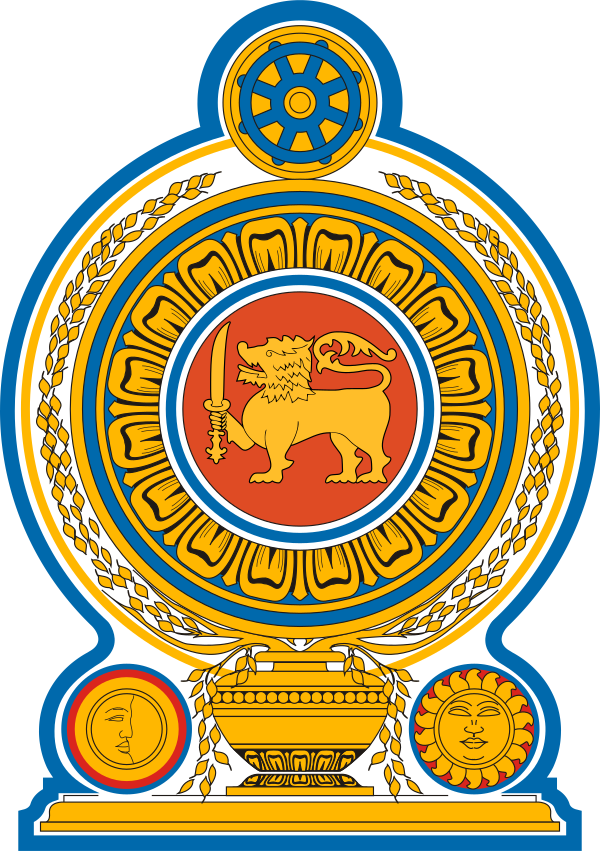
Emblem
Excerpted from Wikipedia’s “Sri Lanka” article, available under the CC BY-SA 4.0 licence.
Gallery (16)
On the map
2 mapped locations
Available in 247 languages
- Español
- Français
- Deutsch
- 中文
- 日本語
- Русский
- Português
- Italiano
- العربية
- हिन्दी
- Abkhazian
- abstract
- Achinese
- Afrikaans
- Albanian
- Albanian
- Amharic
- ami
Show 228 more
- Angika
- Aragonese
- Armenian
- Arpitan
- Assamese
- Asturian
- Awadhi
- azb
- Azerbaijani
- Bahasa Indonesia
- Balinese
- Bangla
- Bashkir
- Basque
- bat_smg
- Bavarian
- be_x_old
- Belarusian
- Betawi
- Bhojpuri
- Bikol
- Bishnupriya
- blk
- Bosnian
- Breton
- Buginese
- Bulgarian
- Buriat
- Burmese
- Catalan
- cbk_zam
- cdo
- Cebuano
- Central Dusun
- Central Kurdish
- Chechen
- Chuvash
- Cornish
- Corsican
- Crimean Tatar
- Croatian
- Czech
- dag
- Danish
- Divehi
- dty
- Dzongkha
- Egyptian Arabic
- Esperanto
- Estonian
- Extremaduran
- Faroese
- Fiji Hindi
- Filipino
- Finnish
- fiu_vro
- Fula
- Gagauz
- Galician
- gcr
- Georgian
- Gilaki
- Goan Konkani
- Gothic
- Greek
- Guarani
- Gujarati
- Haitian Creole
- Hakka Chinese
- Hausa
- Hawaiian
- Hebrew
- Hungarian
- Icelandic
- Ido
- Iloko
- Inari Sami
- Interlingua
- Interlingue
- Irish
- Jamaican Creole English
- Javanese
- Kabyle
- Kannada
- Kara-Kalpak
- Karachay-Balkar
- Kashmiri
- Kashubian
- Kazakh
- kbp
- kge
- Khmer
- Kikuyu
- Kinyarwanda
- Komi
- Kongo
- Kurdish
- Kyrgyz
- Ladino
- Lao
- Latin
- Latvian
- Lezghian
- Ligurian
- Limburgish
- Lingala
- Lingua Franca Nova
- Lithuanian
- lld
- Lombard
- Low German
- Lower Sorbian
- Luxembourgish
- Macedonian
- Maithili
- Malagasy
- Malay
- Malayalam
- Maltese
- Manipuri
- Manx
- Māori
- map_bms
- Marathi
- Mari
- Mazanderani
- Minangkabau
- Mingrelian
- Mongolian
- Moroccan Arabic
- Navajo
- Nederlands
- Nepali
- Newari
- Northern Frisian
- Northern Sami
- Northern Sotho
- Norwegian
- Norwegian Nynorsk
- Novial
- Obolo
- Occitan
- Odia
- Old English
- olo
- Oromo
- Ossetic
- Pampanga
- Papiamento
- Pashto
- Picard
- Piedmontese
- Polski
- Punjabi
- Quechua
- Romanian
- Rusyn
- Samoan
- Sanskrit
- Santali
- Sardinian
- Scots
- Scottish Gaelic
- Serbian
- Serbian (Latin)
- Shan
- Shona
- Sicilian
- Silesian
- simple
- Sindhi
- Sinhala
- Slovak
- Slovenian
- Somali
- Standard Moroccan Tamazight
- Sundanese
- Svenska
- Swahili
- Swati
- syl
- szy
- Tajik
- Talysh
- Tamil
- Taroko
- Tatar
- tay
- Telugu
- Tetum
- Tibetan
- Tiếng Việt
- Tok Pisin
- Toki Pona
- Tongan
- Tulu
- Tumbuka
- Türkçe
- Turkmen
- Udmurt
- Ukrainian
- Upper Sorbian
- Urdu
- Uyghur
- Uzbek
- Venetian
- Veps
- Volapük
- Waray
- Welsh
- West Flemish
- Western Frisian
- Western Panjabi
- Wolof
- Wu Chinese
- Yakut
- Yiddish
- Yoruba
- Zaza
- Zeelandic
- zh_classical
- zh_min_nan
- zh_yue
- Zhuang
- Zulu
- فارسی
- ไทย
- 한국어
via Wikidata sitelinks · CC0