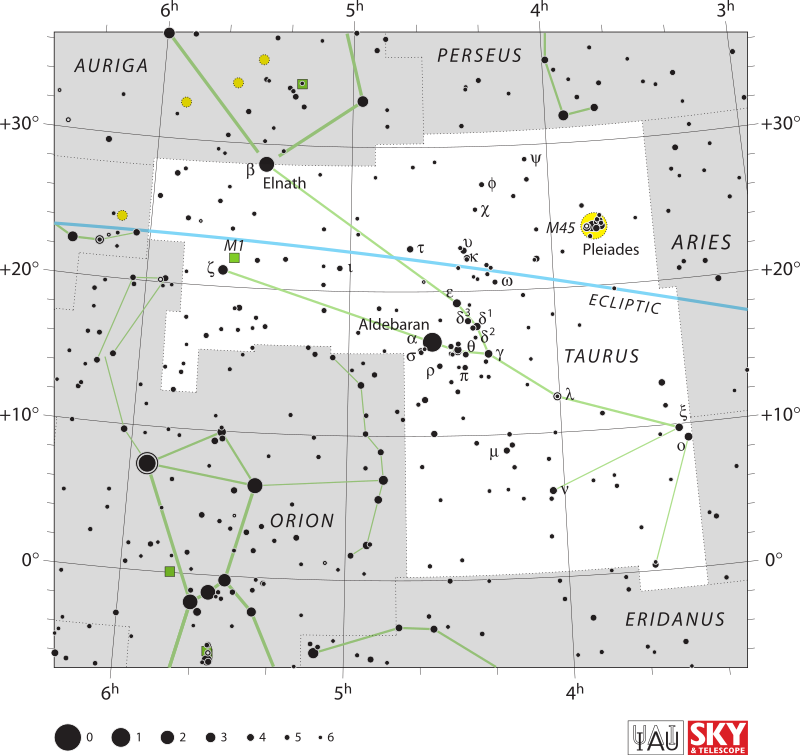
File:Taurus_IAU.svg · Wikimedia Commons · See Wikimedia Commons
Taurus
Sign in to saveAlso known as Tau, Tauri, The Bull
zodiac constellation straddling the celestial equator
Taurus is a constellation of stars located along the celestial equator in the night sky. It is one of the twelve constellations of the zodiac, which has historical significance in astronomy and astrology as a reference point for tracking celestial objects and seasonal changes.
AI-generated from the Wikipedia summary — may contain errors.
Wikidata facts
- Instance of
- zodiacal constellation
- Named after
- bull
- Official name
- Taurus
- Area
- 797
- Shares border with
- Eridanus
- Image
- TaurusCC.jpg
Show 9 more facts
- Commons gallery
- Taurus (constellation)
- topic has template
- Template:Stars of Taurus
- notation
- ♉
- Commons category
- Taurus (constellation)
- topic's main category
- Category:Taurus (constellation)
- described by source
- Encyclopædia Britannica 11th edition
- short name
- Tau
- on focus list of Wikimedia project
- Wikipedia:Vital articles/Level/4
- different from
- torus
via Wikidata · CC0
~16 min read
Encyclopedic overview
Taurus (Latin, 'Bull') is one of the constellations of the zodiac and is located in the northern celestial hemisphere. Taurus is a large and prominent constellation in the Northern Hemisphere's winter sky. It is one of the oldest constellations, dating back to the Early Bronze Age at least, when it marked the location of the Sun during the spring equinox. Its importance to the agricultural calendar influenced various bull figures in the mythologies of Ancient Sumer, Akkad, Assyria, Babylon, Egypt, Greece, and Rome. Its traditional astrological symbol is (♉︎), which resembles a bull's head.
A number of features exist that are of interest to astronomers. Taurus hosts two of the nearest open clusters to Earth, the Pleiades and the Hyades, both of which are visible to the naked eye. At first magnitude, the red giant Aldebaran is the brightest star in the constellation. In the northeast part of Taurus is Messier 1, more commonly known as the Crab Nebula, a supernova remnant containing the Crab Pulsar. One of the closest regions of active star formation, the Taurus-Auriga complex, crosses into the northern part of the constellation. The variable star T Tauri is the prototype of a class of pre-main-sequence stars.
Excerpted from Wikipedia’s “Taurus” article, available under the CC BY-SA 4.0 licence.
Gallery (8)
Available in 104 languages
- Español
- Français
- Deutsch
- 中文
- 日本語
- Русский
- Português
- Italiano
- العربية
- हिन्दी
- Afrikaans
- Albanian
- Aragonese
- Armenian
- Asturian
- Azerbaijani
- Bahasa Indonesia
- Bangla
Show 85 more
- Bashkir
- Basque
- Batak Toba
- be_x_old
- Belarusian
- Bikol
- Bosnian
- Breton
- Bulgarian
- Burmese
- Catalan
- cdo
- Cornish
- Corsican
- Croatian
- Czech
- Danish
- Egyptian Arabic
- Esperanto
- Estonian
- Finnish
- Galician
- Georgian
- Greek
- Hakka Chinese
- Hebrew
- Hungarian
- hyw
- Icelandic
- Ido
- Igbo
- Interlingua
- Irish
- Javanese
- Kannada
- Kashmiri
- Kazakh
- Kurdish
- Latin
- Latvian
- Limburgish
- Lithuanian
- Low German
- Luxembourgish
- Macedonian
- Malagasy
- Malay
- Malayalam
- Manx
- Mari
- Mazanderani
- nah
- Nederlands
- Northern Frisian
- Norwegian
- Norwegian Nynorsk
- Occitan
- Ossetic
- Picard
- Polski
- Punjabi
- Romanian
- Serbian
- Serbian (Latin)
- simple
- Slovak
- Slovenian
- Svenska
- Swahili
- Tamil
- Tatar
- Tiếng Việt
- Türkçe
- Ukrainian
- Urdu
- Waray
- Welsh
- Wu Chinese
- Yakut
- Zaza
- zh_min_nan
- zh_yue
- فارسی
- ไทย
- 한국어
via Wikidata sitelinks · CC0