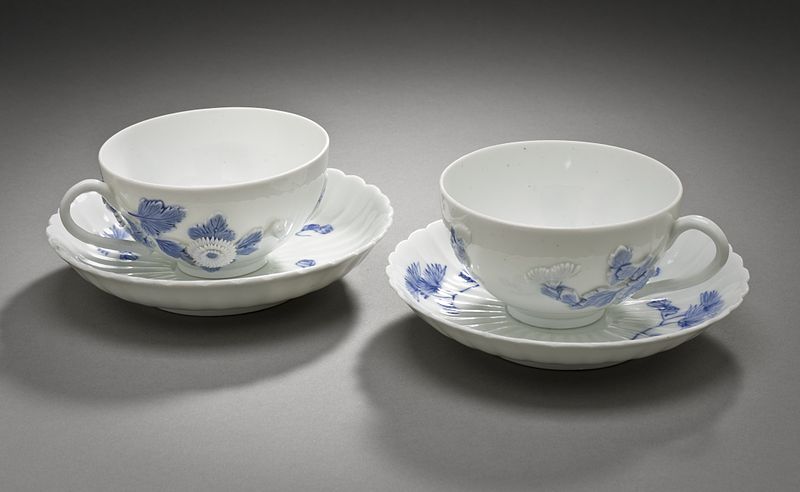
File:Five_Piece_Tea_Service_with_Chrysanthemum_Design_LACMA_M.2006.132.10a-i.jpg · Wikimedia Commons · See Wikimedia Commons
taza de té
Sign in to savethumb|right|Teacups on matching saucers thumb|right|A tea bowl without a handle (grip)|handle A teacup is a cup for drinking tea. It generally has a small handle that may be grasped with the thumb and one or two fingers. It is typically made of a ceramic material and is often part of a set which is composed of a cup and a matching saucer or a trio that includes a small cake or sandwich plate. These may be part of a tea set combined with a teapot, cream jug, covered sugar bowl, and slop bowl. Teacups are often wider and shorter than coffee cups. Cups for morning tea are conventionally larger t
A teacup is a small ceramic cup designed for drinking tea, typically featuring a handle and often sold as part of a matching set with a saucer or plate. Teacups matter because they reflect cultural traditions around tea drinking and are often valued as decorative objects and components of formal tea service.
AI-generated from the Wikipedia summary — may contain errors.
Wikidata facts
- Subclass of
- teaware
- Image
- Five Piece Tea Service with Chrysanthemum Design LACMA M.2006.132.10a-i.jpg
- Said to be same as
- cup
Show 3 more facts
- Commons category
- Cups
- contains
- tea
- described by source
- Bible Encyclopedia of Archimandrite Nicephorus
Sources (3)
via Wikidata · CC0
Article · Español
La jícara es un recipiente de arcilla o bien elaborado a partir del fruto del jícaro. En su definición más antigua aparece como "vasija pequeña de loza" empleada para tomar chocolate. El DRAE da como segunda definición "vasija pequeña de madera", fabricada artesanalmente con la corteza del fruto de la güira, y utilizada como la española de loza. Su uso es muy común en el estado de Tabasco, la península de Yucatán y otros estados del sureste de México y Centroamérica. Se considera americanismo azteca, del náhuatl xicalli, pocillo o vasija hecha con la corteza del fruto de la calabaza o de la güira, que pudo evolucionar como jícara. Se atesta su uso por primera vez en la lengua castellana en el año 1560 en Crónica de la Nueva España.
Abstract from DBpedia / Wikipedia · CC BY-SA