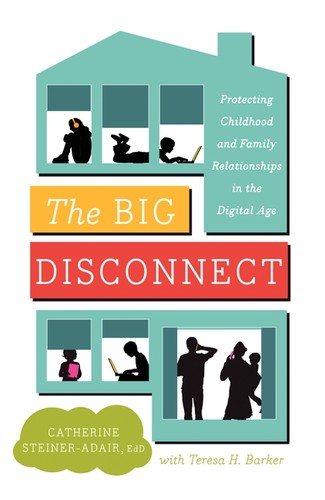
Cover via Open Library · Open Library
The Disconnected
Sign in to saveAlso known as Tutunamayanlar
Tutunamayanlar () is the first novel of Oğuz Atay, one of the most prominent Turkish authors of the twentieth century. It was written in 1970-71 and published in 1972. Although it was never reprinted in his lifetime and was controversial among critics, it has become a best-seller since a new edition came out in 1984.
Book · Open Library
- Author
- Catherine Steiner-Adair
- First published
- 2013
- Editions
- 3
- Subjects
- Internet and families, Technology and children, Computers and families, Parenting, Digital media, Social aspects, SOCIAL SCIENCE, General
via Open Library
Described at
Atay: The Disconnected | The Modern Novel
themodernnovel.org →The story starts with Turgut Özben, a Turkish engineer. He has sent a copy of the manuscript to the unnamed narrator, saying it should be published, in which he recounts the story of his dear friend, Selim Işık (not to be confused with the real Selim Işık, who plays for a Turkish thrash metal band!) Selim Işık had, apparently, committed suicide and Turgut wants to find out why. The book is essentially Turgut’s attempts to find about about Selim’s life and what might have driven him to kill himself. Essentially, he tracks down various people who knew Selim and who can fill in the gaps. Turgut was, he thought, good friends with Selim. They met at university, where both were studying engineering. In fact, he meets him and Kenan, another engineer, whom he becomes friendly with, with the two playing a numbers game instead of listening to the lecture. As in any good modernist novel, game-playing will play a role in this book. We gradually learn about Turgut. He is married to Nermin and they have two daughters. He is fascinated by the use of old words of Arabic and Persian origin in Turkish, many of which have been rejected in modern Turkish, following the Atatürk reforms. (Those who try to remove them from modern Turkish are later mocked in the novel.) We also follow his relationship with Selim. They seem to be good friends and do indeed play games. For example, Selim invents an imaginary biography for Turgut. One of the issues they discuss is something that is key to this novel, namely the history of Turkey and, in particular, the Turkish contribution to the modern world. They claim, for example that it was a Turk who invented photography. Turgut gradually discovers, to his surprise, that Selim seemingly had a lot of close friends of whose existence Turgut was completely unaware. Much of the book involves tracking down these friends and speaking to them. Inevitably, they all have their own quirks and their own special relationship with Selim. The first is Süleyman Kargı. He gives the first clue to Selim’s suicide, saying that Selim could not bear to be alone. Indeed, there are plenty of things he does not like, including horses, lightning, sea and false teeth. Selim had written a collection of strange songs, mixing in Turkish, English and French. Selim hoped that these had been destroyed but Süleyman had kept them and we are given them. They are often about the Turks’ place in history and about pre-urban history. Süleyman also mentions the Bilig-Tenuz, an ancient encyclopedia written on stones which had been discovered in 1917 and dates from 2014 years ago. The entry goes onto to show that they are not communal, have haphazard feeding habits, cannot protect themselves, lose fights, are forbidden to hunt but still do, and are religious. Given that Selim more than once refers to himself as one of The Disconnected , it is clear that, while the Disconnected are a seemingly different species, they are, of course, humans who do not fit in, as is apparently the case with Selim. Süleyman goes on to give us a detailed exegesis of Selim’s songs, most of which is thoroughly playful. For example we learn about the great philosopher Hegel. No, not that one but another one, a butcher who is called Hegel and decides that, as his name is the same as the great philosopher, he should be a philosopher, too. It does not work out well. We also learn about the great Ziya Özdevrimsel, who lives in Childharoldeshire, Ohio and who is responsible for trafic light reforms. His story does not work out well, either. Turgut meets other people. There is Melin the violnist, a somewhat rough and ready man who says that Selim works for the Secret Service and that maybe he is not dead but in a country with poor communications. Turgut drags him round the brothels. He goes to Selim’s house and meets his mother who clearly does not understand. He looks through all the books and items in Selim’s room, looking for…what? he does not know. He does read his diary,
Excerpt from a page describing this subject · 10,940 chars · not written by Vinony
Wikidata facts
- Instance of
- literary work
- Author
- Oğuz Atay
- Country of origin
- Turkey
Show 6 more facts
- publication date
- 1971-00-00
- language of work or name
- Turkish
- form of creative work
- novel
- described at URL
- www.netinceleme.com/2020/10/oguz-atay-tutunamayanlar-roman.html
- title
- Tutunamayanlar
- place of publication
- Istanbul
Sources (2)
via Wikidata · CC0
~1 min read
Encyclopedic overview
1 sectionsContents
- References
Tutunamayanlar () is the first novel of Oğuz Atay, one of the most prominent Turkish authors of the twentieth century. It was written in 1970-71 and published in 1972. Although it was never reprinted in his lifetime and was controversial among critics, it has become a best-seller since a new edition came out in 1984.
Tutunamayanlar has been described as “probably the most eminent novel of twentieth-century Turkish literature”. This reference is due to a UNESCO survey, which goes on: “it poses an earnest challenge to even the most skilled translator with its kaleidoscope of colloquialisms and sheer size.” It has been translated into Dutch, as Het leven in stukken ("Life in pieces"), and into German, as Die Haltlosen (usually "unstable", "unsupported", but here a literal translation of the Turkish). An English translation by Sevin Seydi, as The Disconnected, was published by Olric Press in 2017 ().
Excerpted from Wikipedia’s “The Disconnected” article, available under the CC BY-SA 4.0 licence.