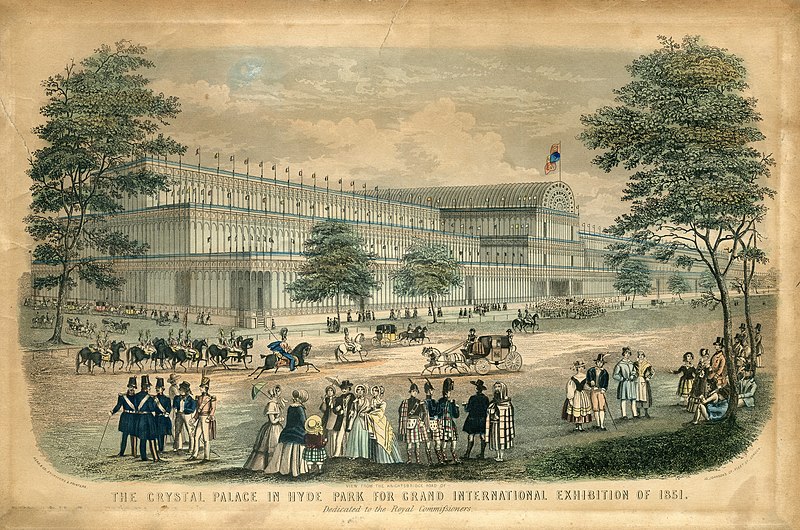
The Great Exhibition
Also known as Great Exhibition, Great Exhibition of the Works of Industry of All Nations, The Great Exhibition of the Works of Industry of All Nations, First World's Fair
1st World's Fair in 1851 in London, England
Key facts
- Bie class
- Universal exposition
- Category
- Historical Expo
- Name
- 1851 London
- Building s
- The Crystal Palace
- Area
- 10.4 ha (26 acres)
- Invention s
- Telegraph , vulcanised rubber
- Visitors
- 6,039,722
- Country
- United Kingdom of Great Britain
- City
- London
- Venue
- Hyde Park, London
- Opening
- ( 1851-05-01 ) ( 1851-10-15 ) May 1 – October 15, 1851 , (5 months and 2 weeks)
- Closure
- 15 October 1851 ( 1851-10-15 )
- Next
Article
The Great Exhibition of the Works of Industry of All Nations, also known as the Great Exhibition or the Crystal Palace Exhibition (in reference to the temporary structure in which it was held), was an international exhibition that took place in Hyde Park, London, from 1 May to 15 October 1851. It was the first in a series of world's fairs, exhibitions of culture and industry that became popular in the 19th century. The event was organised by Henry Cole and Albert, Prince Consort of Victoria, Queen of the United Kingdom.
Famous people of the time attended the Great Exhibition, including Charles Darwin, Karl Marx, C.H.Spurgeon, Michael Faraday (who assisted with the planning and judging of exhibits), Samuel Colt, John Mercer, members of the Orléanist royal family and the writers Charlotte Brontë, Charles Dickens, Lewis Carroll, George Eliot, Alfred Tennyson, and William Makepeace Thackeray. The future Arts and Crafts proponent William Morris, then a teenager, later said he refused to attend the Exhibition on the grounds of taste. Exhibits showcased include the first public flush toilets invented by George Jennings.