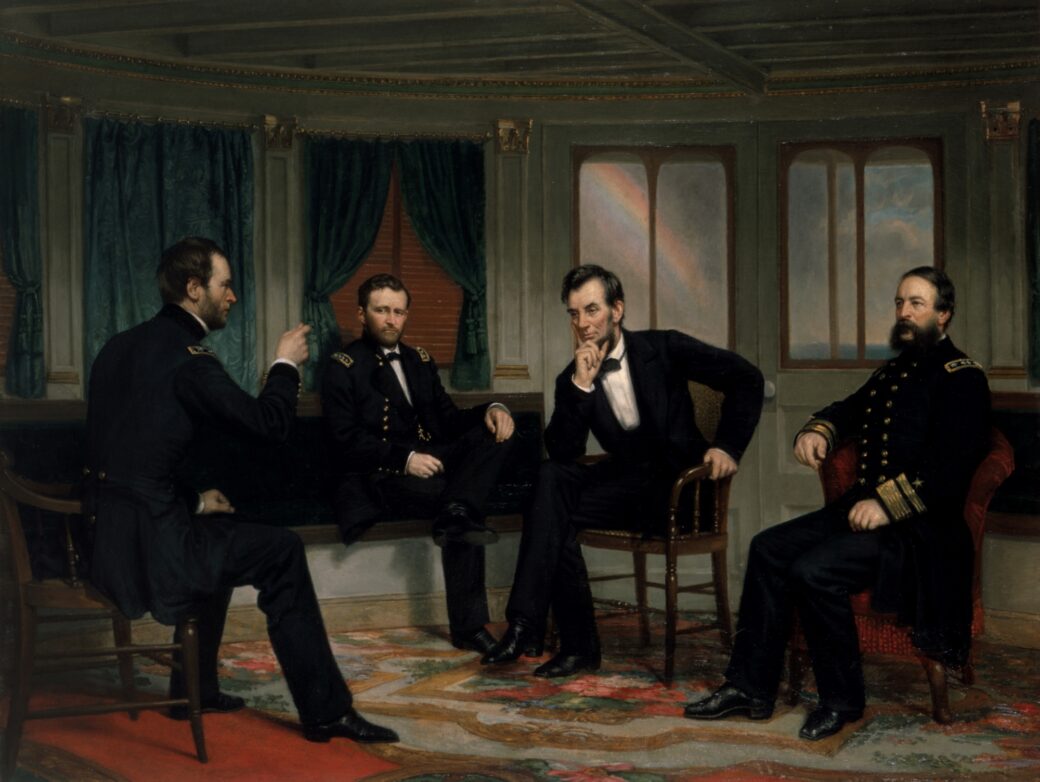
The Peacemakers
Sign in to save1868 painting by George P.A. Healy
Described at
Treasures of the White House: The Peacemakers - White House Historical Association
947.2558.1The title is the only clue to the import of this solemn painting, a prelude to the end of the Civil War. Seated in the after cabin of the Union steame...
whitehousehistory.org →The title is the only clue to the import of this solemn painting, a prelude to the end of the Civil War. Seated in the after cabin of the Union steamer River Queen are Maj. Gen. William T. Sherman, Lt. Gen. Ulysses S. Grant, President Abraham Lincoln, and Rear Adm. David D. Porter. Less than a week before the fall of Petersburg, Virginia, the four men met to discuss the nature of the peace terms to follow. The events leading up to the scene recorded in The Peacemakers are these. Following his march through Georgia, Sherman with his army had turned to the Carolinas and, on March 19, 1865, had taken Goldsboro, North Carolina. Petersburg, the last defense of Richmond, where Gen. Robert E. Lee had gathered his forces, had been under siege by Grant's army for nine months. The end of the Civil War was at last imaginable. Since Porter, in charge of the Union fleet on the James River, was also in City Point, he joined the others. On March 27 and again on the 28th, the four gathered aboard the steamer. The first meeting was, according to Sherman, "a good, long, social visit." During the second meeting their conversation, although wide-ranging, turned often to the conclusion of the peace. Only Sherman and Porter left written accounts, and some have suggested that they exaggerated Lincoln's desire for peace, as Porter put it, "on almost any terms" in order to justify Sherman's later, controversial liberal surrender terms to Gen. Joseph Johnston. But Lincoln's generous intentions had been memorably formulated in his Second Inaugural Address, just three weeks before: "With malice toward none; with charity for all." Following the meeting shown in The Peacemakers and preceding the end of the war by one week, Petersburg fell on the night of April 2 after the long siege. Grant and Lincoln entered the city the next day. On his return to the Union base at City Point, Lincoln told Porter: "Thank God I have lived to see this. It seems to me that I have been dreaming a horrid dream for four years, and now the nightmare is gone. I want to see Richmond." Together they sailed upriver to the defenseless capital of the Confederacy. There Lincoln, less than a fortnight before his assassination, walked the streets amid a swelling throng of emancipated black people. The Peacemakers documents in measured accents this turning point of American history. Its somber figures–less actors than audience–await the denouement, the Confederate surrender at Appomattox Court House, Virginia. Source: William Kloss, et. al., Art in the White House, New York: Abrams, 1992. It seems unlikely that the United States would form a long-lasting friendship with Great Britain after declaring independence in 1776, but these two nations once deeply embroiled in arguments over sovereignty grew to be close allies. This tight friendship didn't come without significant obstacles. Several decades after stunning revolutionary success over the Crown, British soldiers again descended on American soil, setting Although the White House was completed 25 years after the founding of the United States, Presidential and White House history are deeply connected to the American story. Several Founding Fathers went on to become president; Independence Day has been celebrated at the White House since Thomas Jefferson himself was in office; and America's Centennial and Bicentennial were both marked at the
Excerpt from a page describing this subject · 8,664 chars · not written by Vinony
Wikidata facts
- Instance of
- painting
- Genre
- portrait
- Country of origin
- United States
- Main subject
- group of humans
- Depicts
- rainbow
- Material used
- canvas
- Creator
- George Peter Alexander Healy
- Collection
- Oval Office
- Image
- The Peacemakers 1868.jpg
- Height
- 119.7
- Width
- 159.1
Show 7 more facts
- inception
- 1868-01-01
- title
- The Peacemakers
- inventory number
- 947.2558.1
- native label
- The Peacemakers
- Commons category
- The Peacemakers
- copyright status
- public domain
Sources (2)
via Wikidata · CC0
Available in 9 languages
via Wikidata sitelinks · CC0