File:Poster_-_Quiet_Man,_The_01.jpg · Wikimedia Commons · See Wikimedia Commons
OverviewAI-generated
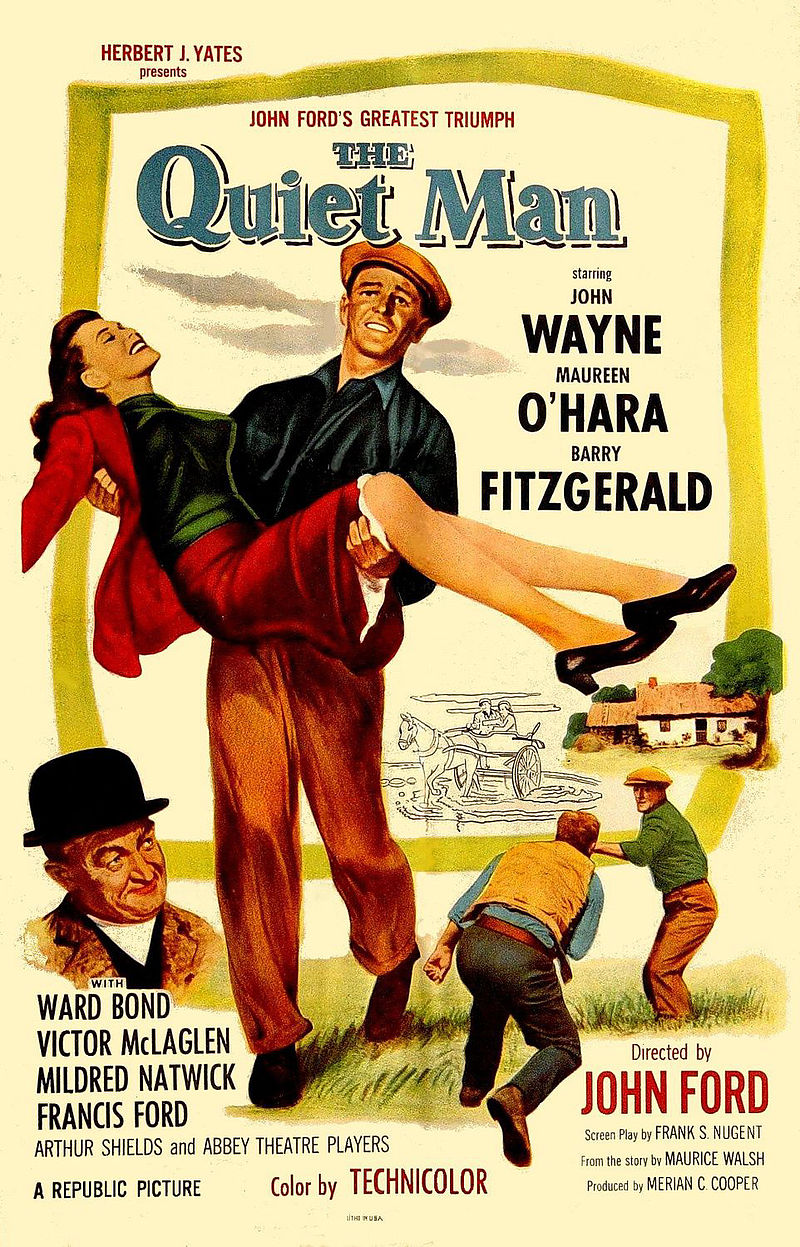
The Quiet Man is a 1952 American romantic comedy and drama film directed by John Ford. The screenplay was written by Richard Llewellyn, Frank S. Nugent, and John Ford, with production handled by Merian C. Cooper and Ford. The cast includes John Wayne, Maureen O'Hara, Barry Fitzgerald, and Victor McLaglen. Ward Bond serves as the narrator, while Victor Young composed the music and Jack Murray edited the film. The story follows an American man who returns to his birth village in Ireland, where he encounters love and conflict.
Filming took place in Cong, Ashford Castle, County Mayo, Clifden, and Connemara, with the narrative set in the Republic of Ireland. The film has a runtime of 129 minutes and was distributed by Republic Pictures and Netflix. It received the Academy Award for Best Director, the National Board of Review Award for Best Film, and a spot on the National Board of Review: Top Ten Films list. Additionally, it was nominated for the Academy Award for Best Picture, Best Writing, Adapted Screenplay, and Best Supporting Actor.
Synthesized by Vinony from 47 facts across 5 sources: Wikidata, TMDb, OMDb, IMDb, Vinony graph. Generated from structured data (not the Wikipedia text) and checked against those facts — may still contain errors.
Film · TMDB
7.3An American man returns to the village of his birth in Ireland, where he finds love and conflict.
Cast
- John Wayne as Sean Thornton
- Maureen O'Hara as Mary Kate Danaher
- Victor McLaglen as Squire 'Red' Will Danaher
- Barry Fitzgerald as Michaleen Oge Flynn
- Ward Bond as Father Peter Lonergan
- Mildred Natwick as The Widow Sarah Tillane
Themes
- countryside
- fight
- brother
- widow
- boxer
- beer
- love
- rural area
- cottage
- train
This product uses the TMDB API but is not endorsed or certified by TMDB.
Ratings
IMDb
7.7/10
44,635 votes
Rotten Tomatoes
91%
Metacritic
85/100
- Year
- 1952
- Runtime
- 129 min
- Genres
- Comedy, Drama, Romance
- Rated
- Approved
- Awards
- Won 2 Oscars. 15 wins & 10 nominations total
via OMDb · IMDb
Key facts
- Directed by
- John Ford
- Screenplay by
- Frank S. Nugent
- Based on
- ”The Quiet Man”, 1933 story in Saturday Evening Post , by Maurice Walsh
- Produced by
- John Ford Merian C. Cooper
- Starring
- John Wayne Maureen O'Hara Barry Fitzgerald Ward Bond Victor McLaglen Mildred Natwick Francis Ford Arthur Shields Abbey Theatre Players
- Cinematography
- Winton C. Hoch
- Edited by
- Jack Murray
- Music by
- Victor Young
- Production companies
- Republic Pictures Argosy Pictures
- Distributed by
- Republic Pictures
- Release dates
- June 6, 1952 ( 1952-06-06 ) (London and Dublin) August 21, 1952 ( 1952-08-21 ) (New York City) September 14, 1952 ( 1952-09-14 ) (United States)
- Running time
- 129 minutes
- Country
- United States
- Languages
- English, Irish
- Budget
- $1.75 million or $1,698,254
- Box office
- $3.8 million (rentals)
via Wikipedia infobox
Wikidata facts
- Instance of
- film
- Part of
- National Film Registry
- Country of origin
- United States
- Original language
- English language
- Director
- John Ford
- Screenwriter
- John Ford
- Cast member
- Frank O'Connor
- Composer
- Victor Young
- Producer
- John Ford
- Cinematographer
- Winton Hoch
- Filming location
- Ashford Castle, County Mayo
- Duration
- 129
- FilmAffinity ID
- 856214
- Distribution format
- video on demand
- Sport
- boxing
Show 13 more facts
- Commons category
- The Quiet Man
- publication date
- 1953-05-01
- title
- The Quiet Man
- nominated for
- Academy Award for Best Sound
- film editor
- Jack Murray
- narrator
- Ward Bond
- distributed by
- Netflix
- after a work by
- Maurice Walsh
- different from
- The Quiet Man
- assessment
- Bechdel test
- review score
- 85/100
- capital cost
- 1750000
- box office
- 7600000
Sources (15)
via Wikidata · CC0
~17 min read
Encyclopedic overview
Sean Thornton (John Wayne) and Squire Danaher (Victor McLaglen) aggressively shake hands, testing each other's strength. The Quiet Man is a 1952 American romantic comedy drama film directed and produced by John Ford, and starring John Wayne, Maureen O'Hara, Victor McLaglen, Barry Fitzgerald, Arthur Shields and Ward Bond. The screenplay by Frank S. Nugent was loosely based on a 1933 Saturday Evening Post short story of the same name by Irish author Maurice Walsh, later published as part of a collection titled The Green Rushes. The film features Winton Hoch's lush photography of the Irish countryside and a long, climactic, semi-comic fist fight.
The film was an official selection of the 1952 Venice Film Festival. John Ford won the Academy Award for Best Director, his record fourth, and Winton Hoch won for Best Cinematography. In 2013, the film was selected for preservation in the United States National Film Registry by the Library of Congress as being "culturally, historically, or aesthetically significant".
Excerpted from Wikipedia’s “The Quiet Man” article, available under the CC BY-SA 4.0 licence.