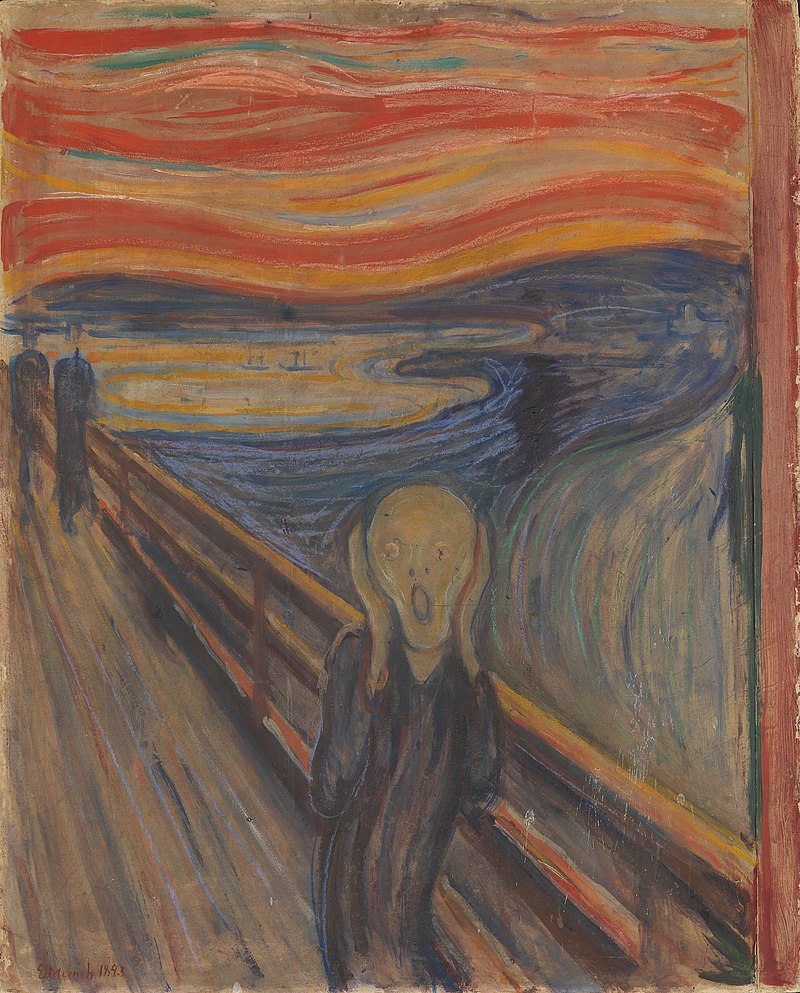
File:Edvard_Munch,_1893,_The_Scream,_oil,_tempera_and_pastel_on_cardboard,_91_x_73_cm,_National_Gallery_of_Norway.jpg · Wikimedia Commons · See Wikimedia Commons
"The Scream" is a series of paintings created by Norwegian artist Edvard Munch that depicts a figure on a bridge clutching their face in what appears to be anguish or despair. The work has become one of the most recognizable images in modern art, widely interpreted as capturing feelings of anxiety and existential dread that resonated with audiences across the world.
AI-generated from the Wikipedia summary — may contain errors.
Wikidata facts
- Depicts
- screaming
- Movement
- Expressionism
- Creator
- Edvard Munch
- Location
- National Gallery of Norway
- Image
- Edvard Munch, 1893, The Scream, oil, tempera and pastel on cardboard, 91 x 73 cm, National Gallery of Norway.jpg
- Height
- 91
- Width
- 73.5
- Has parts of class
- painting
Show 5 more facts
- title
- L'urlo
- Commons category
- The Scream by Edvard Munch
- inception
- 1893-00-00
- native label
- "Skrik"
- on focus list of Wikimedia project
- Wikipedia:Vital articles/Level/4
via Wikidata · CC0
~17 min read
Encyclopedic overview
The Scream is an art composition created by Norwegian artist Edvard Munch in 1893. The Norwegian name of the piece is Skrik ('Scream'), and the German title under which it was first exhibited is Der Schrei der Natur ('The Scream of Nature'). The agonized face in the painting has become one of the most iconic images in art, seen as representing a profound experience of existential dread related to the human condition. Munch's work, including The Scream, had a formative influence on the Expressionist movement.
Munch recalled that he had been out for a walk at sunset when suddenly the setting sun's light turned the clouds "a blood red". He sensed an "infinite scream passing through nature". Scholars have located the spot along a fjord path overlooking Oslo and have suggested various explanations for the unnaturally orange sky, ranging from the effects of a volcanic eruption to a psychological reaction by Munch to his sister's commitment at a nearby lunatic asylum.
Excerpted from Wikipedia’s “The Scream” article, available under the CC BY-SA 4.0 licence.
Gallery (12)
Available in 76 languages
- Español
- Français
- Deutsch
- 中文
- 日本語
- Русский
- Português
- Italiano
- العربية
- Afrikaans
- Albanian
- Aragonese
- Armenian
- Asturian
- Azerbaijani
- Bahasa Indonesia
- Banjar
- Basque
Show 57 more
- be_x_old
- Belarusian
- Bosnian
- Breton
- Bulgarian
- Catalan
- Central Kurdish
- Cornish
- Croatian
- Czech
- Danish
- Egyptian Arabic
- Esperanto
- Estonian
- Faroese
- Filipino
- Finnish
- Galician
- Greek
- Haitian Creole
- Hebrew
- Hungarian
- Icelandic
- Kotava
- Latvian
- Lithuanian
- Malay
- Malayalam
- Maltese
- Nederlands
- Norwegian
- Norwegian Nynorsk
- Occitan
- Polski
- Punjabi
- Romanian
- Serbian
- Serbian (Latin)
- simple
- Slovak
- Slovenian
- Svenska
- Tamil
- Tatar
- Tiếng Việt
- Türkçe
- Ukrainian
- Uzbek
- Venetian
- Waray
- Welsh
- Wu Chinese
- zh_min_nan
- zh_yue
- فارسی
- ไทย
- 한국어
via Wikidata sitelinks · CC0