The Yellow Christ
Sign in to saveAlso known as The Yellow Christ by Paul Gauguin, The Yellow Christ Paul Gauguin, The Yellow Christ (Paul Gauguin)
painting by Paul Gauguin
Described at
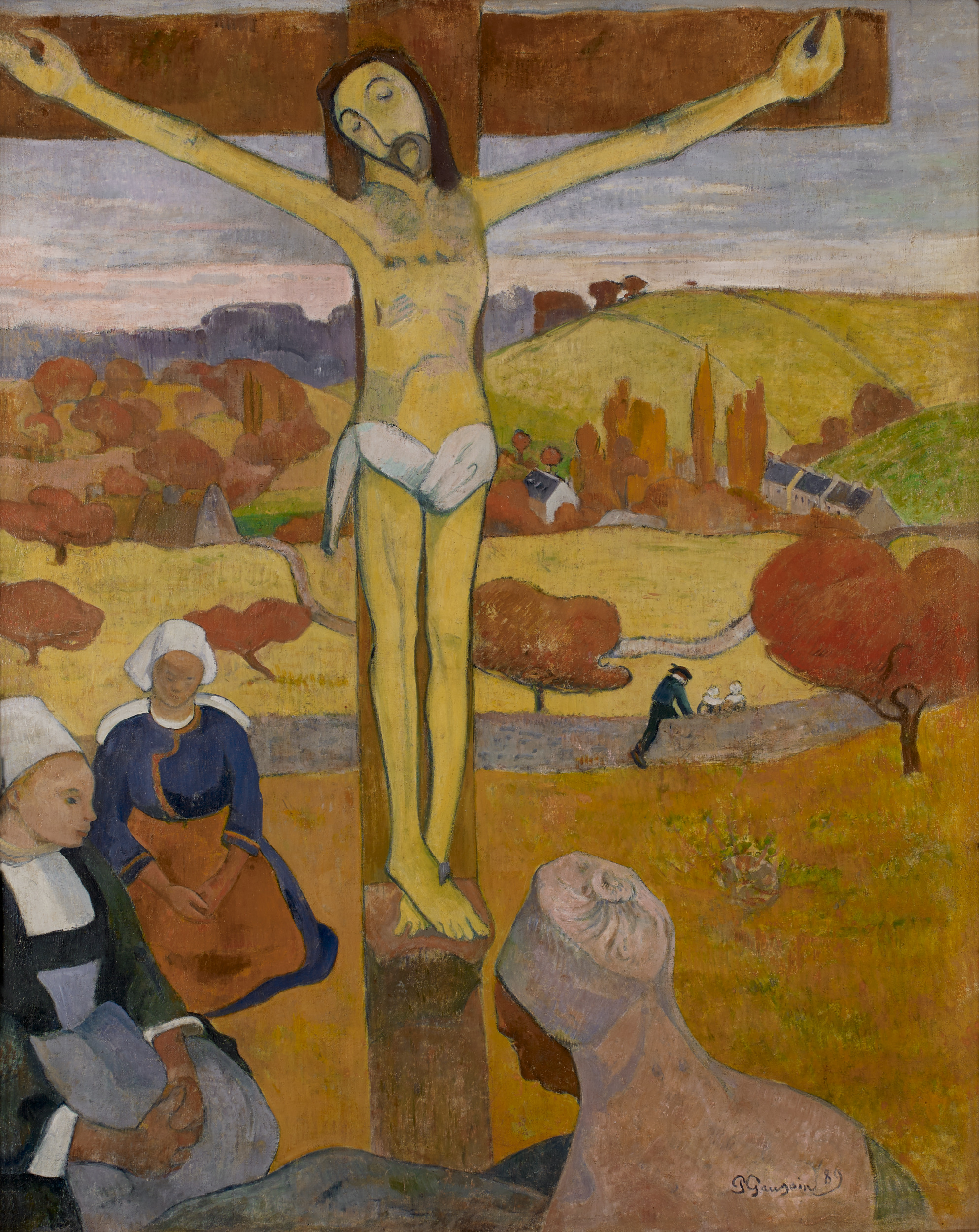
Le Christ jaune (The Yellow Christ) | Buffalo AKG Art Museum
The Symbolists, who emerged during the 1880s, were weary of modern society and sought escape from reality. They began to express their dreams and visions through vivid colors, forms, and compositions. As part of this pursuit, Paul Gauguin left Paris altogether in the late 1880s. During the summer of 1886, he visited the small village of Pont-Aven in Brittany, France, and became fascinated with its history, folklore, and rituals. It was there that Gauguin painted numerous scenes, including “The Yellow Christ.” The central figure of this painting is based on a seventeenth-century painted wooden crucifix that hangs in the nearby Trémalo Chapel. Gauguin painted Christ in a cloying yellow against a dark brown cross in a vibrant fall landscape. Gauguin said he chose the color yellow to convey how he felt about the isolated life and piety of the peasants, several of whom are pictured here dressed in their distinctive regional costume and kneeling at the foot of the cross during the evening hour of Angelus—a Catholic prayer recited daily at 6 am, noon, and 6 pm. In Brittany, the autumn harvest possessed deep spiritual significance, as grain was believed to undergo a process parallel to the religious cycle of Christian life—birth, life, death, and rebirth. The simplicity and primitive directness of the region’s peasants greatly appealed to Gauguin, who made his famous protest against Western sophistication by exiling himself to the South Seas not long after completing this painting. Brittany was Gauguin’s first step away from Paris, and his works completed during this time mark a major stylistic departure from Impressionism.
buffaloakg.org →Image downloads are for educational use only. For all other purposes, please see our Obtaining and Using Images page. Image downloads are for educational use only. For all other purposes, please see our Obtaining and Using Images page. Image downloads are for educational use only. For all other purposes, please see our Obtaining and Using Images page. the artist; Emile Schuffenecker [1851-1934], Paris; Gustave Fayet [1865-1925], Igny, France; 1928, Paul Rosenberg, Paris; 1940, confiscated by the German Army during WWII. From ERR card: Taken in at Germany embassy, November 1940, transferred to Louvre (used as a CP before things were centralized at the JdP). At Jeu de Paume by 5.9.1941. "VERBLEIB: Slg.H.G. 24.7.42" [means "Leave behind; signed H[erman] G[oering], July 24, 1942."] Sent by Rochlitz for Goering from Paris to Baden-Baden in June 1944. 1945 or 1946, returned to Paul Rosenberg; July 22, 1946, purchased from Paul Rosenberg, New York by the Albright Art Gallery, Buffalo The Symbolists, who emerged during the 1880s, were weary of modern society and sought escape from reality. They began to express their dreams and visions through vivid colors, forms, and compositions. As part of this pursuit, Paul Gauguin left Paris altogether in the late 1880s. During the summer of 1886, he visited the small village of Pont-Aven in Brittany, France, and became fascinated with its history, folklore, and rituals. It was there that Gauguin painted numerous scenes, including The Yellow Christ . The central figure of this painting is based on a seventeenth-century painted wooden crucifix that hangs in the nearby Trémalo Chapel. Gauguin painted Christ in a cloying yellow against a dark brown cross in a vibrant fall landscape. Gauguin said he chose the color yellow to convey how he felt about the isolated life and piety of the peasants, several of whom are pictured here dressed in their distinctive regional costume and kneeling at the foot of the cross during the evening hour of Angelus—a Catholic prayer recited daily at 6 am, noon, and 6 pm. In Brittany, the autumn harvest possessed deep spiritual significance, as grain was believed to undergo a process parallel to the religious cycle of Christian life—birth, life, death, and rebirth. The simplicity and primitive directness of the region’s peasants greatly appealed to Gauguin, who made his famous protest against Western sophistication by exiling himself to the South Seas not long after completing this painting. Brittany was Gauguin’s first step away from Paris, and his works completed during this time mark a major stylistic departure from Impressionism. Humble and Human: Treasures from the Albright-Knox Art Gallery and the Detroit Institute of Arts: An Exhibition in Honor of Ralph C. Wilson, Jr.
Excerpt from a page describing this subject · 15,599 chars · not written by Vinony
Wikidata facts
- Instance of
- painting
- Religion
- Christianity
- Owned by
- Paul Rosenberg
- Genre
- religious art
- Country of origin
- French Third Republic
- Based on
- crucifixion
- Main subject
- crucifixion of Jesus
- Depicts
- crucifixion of Jesus
- Movement
- Pont-Aven School
- Material used
- canvas
- Creator
- Paul Gauguin
- Collection
- Buffalo AKG Art Museum
- Location
- Buffalo AKG Art Museum
- Image
- Paul Gauguin - Le Christ jaune (1889).jpg
- Height
- 92.07
- Width
- 73.34
- Significant event
- restitution of Nazi-looted art
Show 8 more facts
- catalog code
- 151
- inception
- 1889-01-01
- inventory number
- 1946:4
- described at URL
- buffaloakg.org/artworks/19464-le-christ-jaune-yellow-christ
- title
- The Yellow Christ
- Commons category
- Le Christ jaune (Paul Gauguin)
- copyright status
- public domain
- depicts Iconclass notation
- 11Q21
via Wikidata · CC0