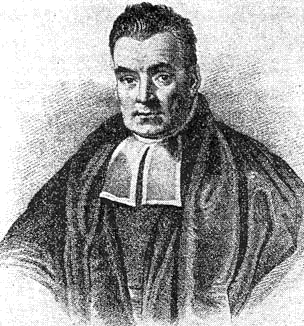
File:Thomas_Bayes.gif · Wikimedia Commons · See Wikimedia Commons
Thomas Bayes
Sign in to saveBritish mathematician and Presbyterian minister (1702-1761)
OverviewAI-generated
Thomas Bayes was a male mathematician, statistician, cleric, and philosopher who worked in the fields of probability theory and mathematics. He was educated at the University of Edinburgh and held the position of Christian minister. Bayes was a member of the Royal Society and received the award of Fellow of the Royal Society. His notable work includes Bayes' theorem.
Born in London, Bayes was of English ethnicity and held citizenship in the United Kingdom and the Kingdom of Great Britain. He practiced Presbyterianism and spoke English. He died on April 7, 1761, in Royal Tunbridge Wells and was buried at Bunhill Fields Burial Ground. His written works include *An essay towards solving a problem in the doctrine of chances* and *Divine benevolence*.
Synthesized by Vinony from 24 facts across 3 sources: Wikidata, Open Library, Vinony collections. Generated from structured data (not the Wikipedia text) and checked against those facts — may still contain errors.
Person · Open Library
- Died
- 1761
- Works
- 8
Top works
- Divine Benevolence : Or, an Attempt to Prove That the Principal End of the Divine Providence and Government Is the Happiness of His Creatures
- Versuch Zur lösung Eines Problems der Wahrscheinlichkeitsrechnung
- An Introduction To The Doctrine Of Fluxions
- An essay towards solving a problem in the doctrine of chances
- Divine benevolence
via Open Library + Wikidata
Key facts
- Born
- c. 1701, London , England
- Died
- 7 April 1761 (1761-04-07) (aged 59), Royal Tunbridge Wells , England
- Alma mater
- University of Edinburgh
- Known for
- Bayesian statistics , Bayes' theorem , Conditional probability , Inverse probability , Bayes prior , Bayes factor , Bayesian inference , See full list
- Fields
- Probability
via Wikipedia infobox
Wikidata facts
- Instance of
- human
- Given name
- Thomas
- Gender
- male
- Citizenship
- Kingdom of Great Britain
- Place of birth
- London
- Place of death
- Royal Tunbridge Wells
- Occupation
- philosopher
- Position held
- Christian minister
- Educated at
- University of Edinburgh
- Languages spoken
- English language
- Religion
- Presbyterianism
- Notable work
- Bayes' theorem
- Field of work
- mathematics
- Image
- Thomas Bayes.gif
Show 10 more facts
- member of
- Royal Society
- date of death
- 1761-04-17
- date of birth
- 1701-00-00
- Commons gallery
- Thomas Bayes
- Commons category
- Thomas Bayes
- place of burial
- Bunhill Fields Burial Ground
- name in native language
- Thomas Bayes
- ethnic group
- English people
- maintained by WikiProject
- WikiProject Mathematics
- P8168
- Orsodacne cerasi
Sources (3)
via Wikidata · CC0
~10 min read
Encyclopedic overview
Thomas Bayes (/beɪz/ BAYZ; c. 1701 – 7 April 1761) was an English statistician, philosopher and Presbyterian minister who is known for formulating a specific case of the theorem that bears his name: Bayes' theorem.
Bayes never published what would become his most famous accomplishment; his notes were edited and published posthumously by Richard Price.
Excerpted from Wikipedia’s “Thomas Bayes” article, available under the CC BY-SA 4.0 licence.