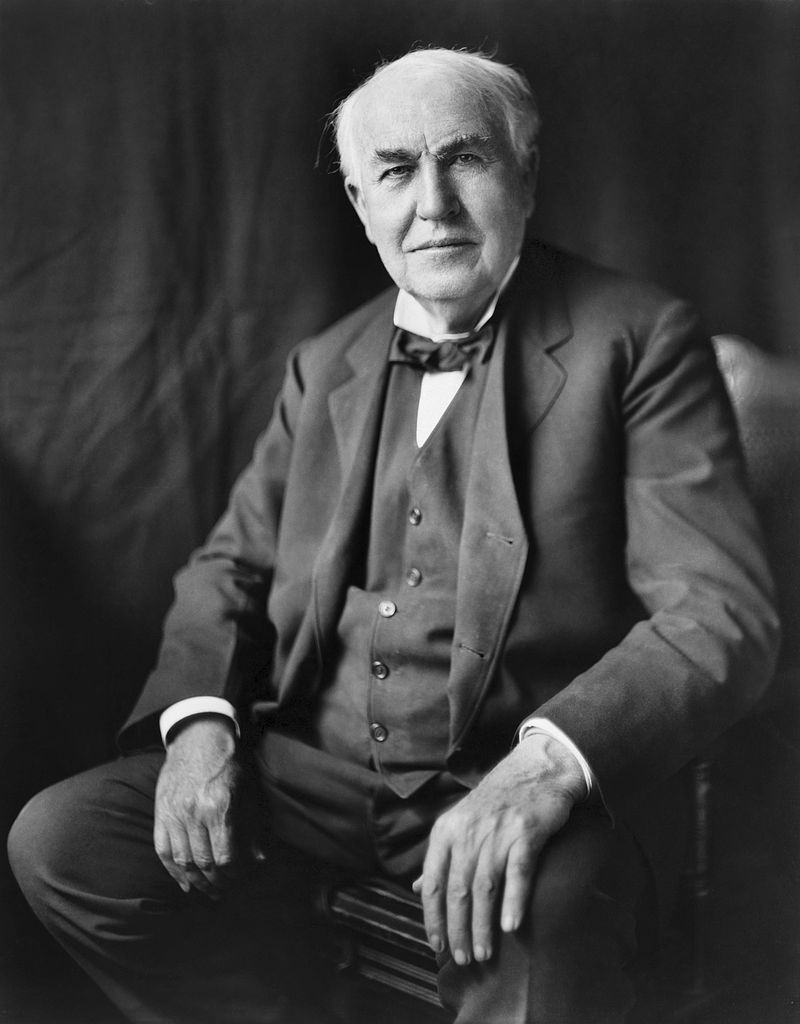
File:Thomas_Edison2.jpg · Wikimedia Commons · See Wikimedia Commons
Thomas Edison
Sign in to saveAmerican inventor and businessman (1847–1931)
OverviewAI-generated
Thomas Alva Edison was an American engineer, inventor, entrepreneur, and businessperson. He was educated at Cooper Union and worked for General Electric. His notable works include the incandescent light bulb and the phonograph. He owned Edison Studios and Edison Records.
Edison was born in Milan, Ohio, in 1847 and died in West Orange in 1931 from type 2 diabetes. He held deist beliefs. He received the Congressional Gold Medal, the Commander of the Legion of Honour, the Grammy Trustees Award, and the Benjamin Franklin Medal. He was also nominated for the Nobel Prize in Physics.
He was a member of the National Academy of Sciences, the Royal Swedish Academy of Sciences, the American Philosophical Society, and the Academy of Sciences of the USSR. His archives are held at Rutgers University. He is recognized in the Hollywood Walk Of Fame collection, the National Inventors Hall Of Fame collection, and the Congressional Gold Medal collection.
Synthesized by Vinony from 37 facts across 4 sources: Wikidata, TMDb, VIAF, Vinony collections. Generated from structured data (not the Wikipedia text) and checked against those facts — may still contain errors.
Film & TV
Milan, Ohio, USA
Thomas Alva Edison (February 11, 1847 – October 18, 1931) was an American inventor and businessman who has been described as America's greatest inventor. He developed many devices in fields such as electric power generation, mass communication, sound recording, and motion pictures. These inventions, which include the phonograph, the motion picture camera, and the long-lasting, practical electric…
Known for
- History 101 — Self (archive footage)2020
- Making Waves: The Art of Cinematic Sound — Self (voice) (archive footage)2019
- The Inventor: Out for Blood in Silicon Valley — Self (archive footage)2019
- Edison — Himself (archive footage)2015
- The Extraordinary Voyage — Self - Filmmaker (archive footage)2011
- Murnau, Borzage and Fox — Self (archive footage) (uncredited)2008
- Edison: The Invention of the Movies — Himself (archive footage)2005
- Naqoyqatsi — Self (archive footage) (uncredited)2002
- Star Power: The Creation Of United Artists — Self (archive footage)1998
- The Shadow of Hate: A History of Intolerance in America — Self (archive footage)1995
via TMDB
Authority record · VIAF
- Lifespan
- 1847–1931
- Nationality
- US
- Role / Field
- Scientists, Motion picture producers and directors, Inventors, Inventor, Businesspeople, Science
- Language
- eng
- Gender
- Male
Recorded by 33 libraries
via VIAF · OCLC
Wikidata facts
- Instance of
- human
- Given name
- Alva
- Gender
- male
- Citizenship
- United States
- Place of birth
- Milan
- Place of death
- West Orange
- Occupation
- film producer
- Educated at
- Cooper Union
- Languages spoken
- English language
- Native language
- English language
- Religion
- deism
- Notable work
- phonograph
- Field of work
- screenwriting
- Image
- Thomas Edison2-crop.jpg
Show 20 more facts
- Commons category
- Thomas Edison
- date of birth
- 1847-02-11
- date of death
- 1931-10-18
- topic's main category
- Category:Thomas Edison
- member of
- Academy of Sciences of the USSR
- Commons Creator page
- Thomas Alva Edison
- Commons gallery
- Thomas Alva Edison
- nominated for
- Nobel Prize in Physics
- on focus list of Wikimedia project
- Wikipedia:Vital articles/Level/4
- owner of
- Edison Records
- different from
- Thomas Addison
- birth name
- Thomas Alva Edison
- cause of death
- type 2 diabetes
- name in native language
- Thomas Alva Edison
- place of burial
- Thomas Edison National Historical Park
- ethnic group
- Americans
- manner of death
- natural causes
- writing language
- English language
- start of work period
- 1877-00-00
- relative
- Lewis Miller
Sources (11)
via Wikidata · CC0
~40 min read
Encyclopedic overview
Thomas Alva Edison (February 11, 1847 – October 18, 1931) was an American inventor and businessman. He developed many devices in fields such as electric power generation, sound recording, and motion pictures. These inventions, which include the phonograph, the motion picture camera, and early versions of the electric light bulb, have had a widespread impact on the modern industrialized world. He was one of the first inventors to apply the principles of organized science and teamwork to the process of invention, working with many researchers and employees. He established the first industrial research laboratory.
Edison was raised in the American Midwest. Early in his career he worked as a telegraph operator, which inspired some of his earliest inventions. In 1876, he established his first laboratory facility in Menlo Park, New Jersey, where many of his early inventions were developed. He went into business and became wealthy. Edison used his fortune to further his passion for invention. This was realized in experimental mining operations, the first film studio, and 1,093 US patents.
Excerpted from Wikipedia’s “Thomas Edison” article, available under the CC BY-SA 4.0 licence.
Gallery (13)
Available in 192 languages
- Español
- Français
- Deutsch
- 中文
- 日本語
- Русский
- Português
- Italiano
- العربية
- हिन्दी
- abstract
- Afrikaans
- Albanian
- Albanian
- Amharic
- Angika
- Aragonese
- Armenian
Show 173 more
- Arpitan
- Assamese
- Asturian
- Awadhi
- Aymara
- azb
- Azerbaijani
- Bahasa Indonesia
- Bangla
- Banjar
- Bashkir
- Basque
- bat_smg
- Bavarian
- be_x_old
- Belarusian
- Bikol
- Bislama
- Bosnian
- Breton
- btm
- Bulgarian
- Buriat
- Burmese
- Catalan
- cdo
- Cebuano
- Central Dusun
- Central Kurdish
- Chechen
- Chuvash
- Colognian
- Cornish
- Corsican
- Croatian
- Czech
- Danish
- dty
- Egyptian Arabic
- Esperanto
- Estonian
- Faroese
- Fiji Hindi
- Filipino
- Finnish
- fiu_vro
- Galician
- Gan Chinese
- gcr
- Georgian
- Goan Konkani
- Gorontalo
- Greek
- Guarani
- Gujarati
- Haitian Creole
- Hakka Chinese
- Hausa
- Hebrew
- Hungarian
- Icelandic
- Ido
- Iloko
- Interlingua
- Irish
- Jamaican Creole English
- Javanese
- Kabyle
- Kannada
- Kanuri
- Kara-Kalpak
- Karachay-Balkar
- Kashmiri
- Kazakh
- kbp
- Kikuyu
- Kurdish
- Kyrgyz
- Lao
- Latin
- Latvian
- Ligurian
- Limburgish
- Lingua Franca Nova
- Lithuanian
- Lombard
- Low German
- Luxembourgish
- Macedonian
- Madurese
- Maithili
- Malagasy
- Malay
- Malayalam
- Maltese
- map_bms
- Marathi
- Mazanderani
- Minangkabau
- Mingrelian
- Mirandese
- Mongolian
- Moroccan Arabic
- Nederlands
- Nepali
- Newari
- Northern Frisian
- Norwegian
- Norwegian Nynorsk
- Novial
- Obolo
- Occitan
- Odia
- olo
- Pampanga
- Pashto
- Piedmontese
- Polski
- Punjabi
- Quechua
- rki
- roa_rup
- Romanian
- Rusyn
- Samoan
- Sanskrit
- Santali
- Scots
- Scottish Gaelic
- Serbian
- Serbian (Latin)
- Sicilian
- simple
- Sindhi
- Sinhala
- Slovak
- Slovenian
- Somali
- Standard Moroccan Tamazight
- Sundanese
- Svenska
- Swahili
- szy
- Tajik
- Tamil
- Tatar
- Telugu
- Tiếng Việt
- Türkçe
- Turkmen
- Ukrainian
- Urdu
- Uyghur
- Uzbek
- Venetian
- Veps
- Volapük
- Waray
- Welsh
- Western Frisian
- Western Panjabi
- Wu Chinese
- Xhosa
- Yakut
- Yiddish
- Yoruba
- Zaza
- Zeelandic
- zh_min_nan
- zh_yue
- فارسی
- ไทย
- 한국어
via Wikidata sitelinks · CC0