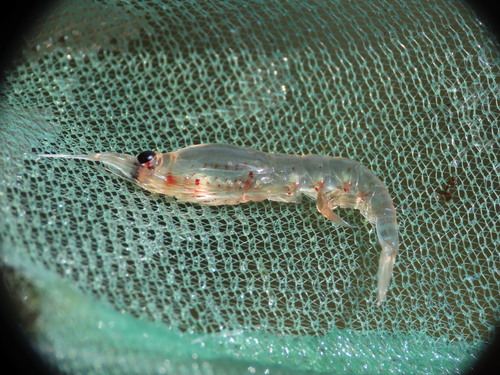
(c) Louis-Philippe Bateman, some rights reserved (CC BY-NC), uploaded by Louis-Philippe Bateman · cc-by-nc
Thysanoessa
Sign in to saveThysanoessa is a genus of the krill that play critical roles in the marine food web. They're abundant in Arctic and Antarctic areas, feeding on zooplankton and detritus to obtain energy. Thysanoessa are responsible for the transportation of carbon and nutrients from surface waters to deeper trophic levels. This genus serves as prey for various fish and provide energy to marine ecosystems as they are at a low trophic level. Most travel through vertical migration, meaning they travel up and down in the water column, providing food for predators at the surface during the night, and at deeper leve
Species
チサノエッサ
GENUS
- KingdomAnimalia
- PhylumArthropoda
- ClassMalacostraca
- OrderEuphausiacea
- FamilyEuphausiidae
via GBIF
Museum specimens
- Specimen records
- 39
- With media
- 7
- Family
- Euphausiidae
- Collections
- USNM, CAS, UAM, CMN, YPM, NHMUK
- Recorded in
- Japan, United States, Canada, United Kingdom, Australia
Wikidata facts
- Instance of
- taxon
- Parent taxon
- Euphausiidae
- Image
- Thysanoessa inermis.jpg
Show 4 more facts
- Commons category
- Thysanoessa
- taxon name
- Thysanoessa
- taxon rank
- genus
- topic's main category
- Category:Thysanoessa
Sources (1)
via Wikidata · CC0
~4 min read
Encyclopedic overview
8 sectionsContents
- Growth & development
- Anatomy
- Feeding
- Habitat
- Species
- References
- Further reading
- External links
Thysanoessa is a genus of the krill that play critical roles in the marine food web. They're abundant in Arctic and Antarctic areas, feeding on zooplankton and detritus to obtain energy. Thysanoessa are responsible for the transportation of carbon and nutrients from surface waters to deeper trophic levels. This genus serves as prey for various fish and provide energy to marine ecosystems as they are at a low trophic level. Most travel through vertical migration, meaning they travel up and down in the water column, providing food for predators at the surface during the night, and at deeper levels during the day.
==Growth & development== Longevity in this genus varies depending on the specie. The average lifespan for the Thysanoessa is between three and four years. The development and growth of this organism takes place during winter to autumn. Thysanoessa are broadcast spawners, meaning that the males will physically put their sperm onto the female's body so that the eggs become fertilized as the female releases them. Once released and in the water, the eggs are dispersed and on their own, ready to hatch in the nauplius stage. Female krill lay over 10,000 eggs, sometimes seasonally, resulting in large populations. The Thysanoessa larvae are slender and their carapace is short in early stages. As the body expands, the cephalothorax becomes transparent.
Excerpted from Wikipedia’s “Thysanoessa” article, available under the CC BY-SA 4.0 licence.
Gallery (6)
Available in 14 languages
- Français
- Русский
- Português
- العربية
- Bahasa Indonesia
- Cebuano
- Egyptian Arabic
- Hungarian
- Nederlands
- Polski
- Svenska
- Türkçe
- Waray
via Wikidata sitelinks · CC0