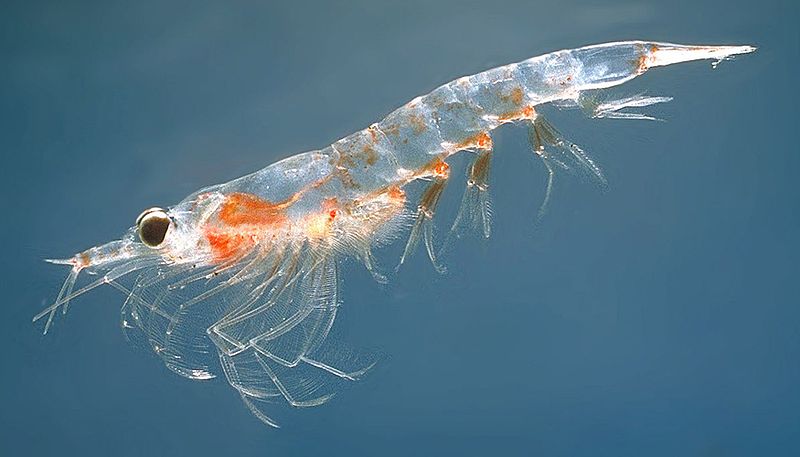
File:Meganyctiphanes_norvegica2.jpg · Wikimedia Commons · See Wikimedia Commons
Euphausiacea
Sign in to saveAlso known as krill
Krill (Euphausiids) (: krill) are small and exclusively marine crustaceans of the order Euphausiacea, found in all of the world's oceans. The name "krill" comes from the Norwegian word '''', meaning "small fry of fish", which is also often attributed to species of fish.
OverviewAI-generated
Euphausiacea is an order of marine organisms within the class Malacostraca and phylum Arthropoda. The taxon, also known as krill or euphausiaceans, falls under the parent taxon Eucarida. Its scientific name was established by Dana in 1852, and it holds an accepted status in taxonomic records. These organisms primarily feed on phytoplankton and zooplankton.
Records of Euphausiacea have been documented in the United States, British West Indies, Mexico, French Polynesia, and Turks And Caicos Islands. Specimens are held by institutions including SIO, YPM, CAS, IBUNAM, and USNM. The order is the subject of 827 PubMed articles and has 498,899 occurrence records in the GBIF database.
Synthesized by Vinony from 36 facts across 7 sources: Wikidata, GBIF, PubMed, Gbif Occ, iDigBio, WoRMS, Vinony graph. Generated from structured data (not the Wikipedia text) and checked against those facts — may still contain errors.
Species
euphausiaceans
Euphausiacea
ORDER
- KingdomAnimalia
- PhylumArthropoda
- ClassMalacostraca
- OrderEuphausiacea
磷蝦是一種类似蝦的海洋無脊椎動物,生物學上屬於磷蝦目(Euphausiacea)。磷虾這種小型的甲殼亞門浮游動物是鬚鯨、蝠鱝、鯨鯊、鋸齒海豹及海豹的食物,也是一些海鳥的主要食物。是接近食物鏈最底部的關鍵物種(keystone species),不過仍不算最底部,因為牠們會進食浮游植物(phytoplankton)和一些比牠們更小的浮游動物(zooplankton)。在南冰洋的南極磷蝦可製造逾5亿公噸的生物質能,約為人類的兩倍,每年有逾一半的南極磷蝦被鯨、海豹、企鵝、魷魚和魚吃掉,而没被吃掉的那些则會再繼續繁殖下一代,以维持种群总数。大部分的磷蝦物種每天會在海面和海底之间垂直遷徙一段很長的路線,因此它们的獵食者也會跟着在夜間上海面,日間則潛至海底。 商業性磷蝦捕獲集中在南冰洋與日本周邊海域,全球捕獲量每年約15-20万公噸,其中大部分來自南冰洋的斯科舍海。磷蝦可作水產養殖和水族箱的飼料。是日本與俄羅斯人的食品,在日本又稱沖醬蝦(オキアミ)。
via GBIF
Museum specimens
- Specimen records
- 585
- With media
- 89
- Collections
- SIO, YPM, CAS, IBUNAM, USNM
- Recorded in
- United States, British West Indies, Mexico, French Polynesia, Turks And Caicos Islands, Antarctica
Research
827 papers- Antarctic marine life under pressure.Science (New York, N.Y.) · 2022Meyer B, Kawaguchi SDOI: 10.1126/science.adf3606
- Euphausiacea diversity in a trans-oceanic transect through the South Atlantic Ocean: the first Atlantic record of Thysanopoda astylata Brinton, 1975.Anais da Academia Brasileira de Ciencias · 2019Muxagata E, Barbosa CN, Agostini VODOI: 10.1590/0001-3765201920180034
- The eyestalk photophore of Northern krill Meganyctiphanes norvegica (M. Sars) (Euphausiacea) re-investigated: Innervation by specialized ommatidia of the compound eye.Arthropod structure & development · 2024Krieger J, Fregin T, Harzsch SDOI: 10.1016/j.asd.2024.101393
- Preface.Advances in marine biology · 2010Tarling GADOI: 10.1016/B978-0-12-381308-4.00018-2
- Krill oil. Monograph.ReviewAlternative medicine review : a journal of clinical therapeutic · 2010
- The complete mitochondrial genome sequence of Euphausia pacifica (Malacostraca: Euphausiacea) reveals a novel gene order and unusual tandem repeats.Genome · 2011Shen X, Wang H, Wang M et al.DOI: 10.1139/g11-053
- Naupliar and Metanaupliar Development of Thysanoessa raschii (Malacostraca, Euphausiacea) from Godthåbsfjord, Greenland, with a Reinstatement of the Ancestral Status of the Free-Living Nauplius in Malacostracan Evolution.PloS one · 2015Akther H, Agersted MD, Olesen JDOI: 10.1371/journal.pone.0141955
- Limb articulation in caridoid crustaceans revisited - new evidence from Euphausiacea (Malacostraca).Arthropod structure & development · 2008Haupt C, Richter SDOI: 10.1016/j.asd.2007.09.005
via PubMed
Wikidata facts
Show 9 more facts
- taxon name
- Euphausiacea
- Commons category
- Euphausiacea
- taxon rank
- order
- topic's main category
- Category:Euphausiacea
- Commons gallery
- Krill
- taxon common name
- krill
- different from
- krill
- on focus list of Wikimedia project
- Wikipedia:Vital articles/Level/4
- main food source
- zooplankton
Sources (2)
via Wikidata · CC0
~29 min read
Encyclopedic overview
24 sectionsContents
- Taxonomy
- Phylogeny
- Timeline
- Distribution
- Anatomy and morphology
- Ecology
- Feeding
- Predation
- Plastics
- Life history and behavior
- Reproduction
- Moulting
- Lifespan
- Swarming
- Vertical migration
- Biogeochemical cycles
- Human uses
- Harvesting history
- Human consumption
- Bio-inspired robotics
- See also
- References
- Further reading
- External links
Krill (Euphausiids) (: krill) are small and exclusively marine crustaceans of the order Euphausiacea, found in all of the world's oceans. The name "krill" comes from the Norwegian word '', meaning "small fry of fish", which is also often attributed to species of fish.
Krill are considered an important trophic level connection near the bottom of the food chain. They feed on phytoplankton and, to a lesser extent, zooplankton, and are also the main source of food for many larger animals. In the Southern Ocean, one species, the Antarctic krill, makes up an estimated biomass of around 379 million tonnes (418 million tons), making it among the species with the largest total biomass. Over half of this biomass is eaten by whales, seals, penguins, seabirds, squid, and fish each year. Most krill species display large daily vertical migrations, providing food for predators near the surface at night and in deeper waters during the day.
Excerpted from Wikipedia’s “Euphausiacea” article, available under the CC BY-SA 4.0 licence.
Gallery (38)
Available in 72 languages
- Español
- Français
- Deutsch
- 中文
- 日本語
- Русский
- Português
- Italiano
- العربية
- हिन्दी
- Afrikaans
- Asturian
- azb
- Bahasa Indonesia
- Balinese
- Basque
- Belarusian
- Bikol
Show 53 more
- Bosnian
- Breton
- Bulgarian
- Burmese
- Catalan
- Cebuano
- Croatian
- Czech
- Danish
- Egyptian Arabic
- Esperanto
- Filipino
- Finnish
- Galician
- Georgian
- Greek
- Hebrew
- Hungarian
- Icelandic
- Inupiaq
- Irish
- Javanese
- Kazakh
- Latin
- Latvian
- Lingua Franca Nova
- Lithuanian
- Malay
- Malayalam
- Navajo
- Nederlands
- Norwegian
- Norwegian Nynorsk
- Occitan
- Pashto
- Polski
- Romanian
- Serbian
- Serbian (Latin)
- simple
- Slovak
- Slovenian
- Svenska
- Tamil
- Tiếng Việt
- Türkçe
- Ukrainian
- Waray
- Wu Chinese
- zh_yue
- فارسی
- ไทย
- 한국어
via Wikidata sitelinks · CC0