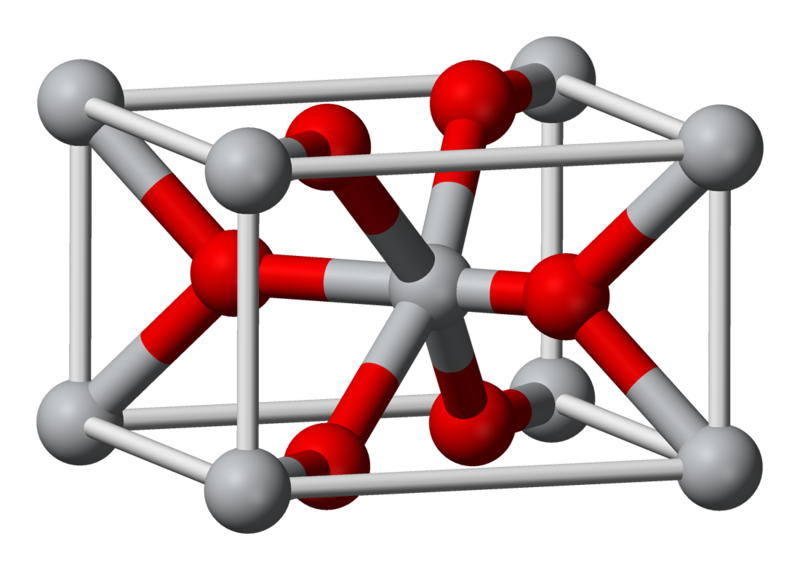
File:Rutile-unit-cell-3D-balls.png · Wikimedia Commons · See Wikimedia Commons
Titan(IV)-oxid
Sign in to saveAlso known as rutile, titanium oxide, titanium peroxide, [TiO2], TiO2, titania, E171, E-171
chemische Verbindung, Weißpigment
OverviewAI-generated
Titanium dioxide is a chemical compound with the formula TiO₂. Its IUPAC name is dioxotitanium, and it has a molecular mass of 79.938. The substance possesses a density of 4.26 and a melting point of 3362. It reaches a boiling point of 5432 and decomposes at 2900. The vapor pressure is listed as 0, while the ionization energy is 9.54.
In terms of safety, the immediately dangerous to life or health concentration is 5000. The time-weighted average exposure limit is set at 15, with a ceiling exposure limit of 0. The compound has two hydrogen bond acceptors and no hydrogen bond donors. It is referenced by 1,033 other encyclopedia articles.
Synthesized by Vinony from 27 facts across 4 sources: Wikidata, PubChem, PubMed, Vinony graph. Generated from structured data (not the Wikipedia text) and checked against those facts — may still contain errors.
Chemical data
- Formula
- O2Ti
- Molecular weight
- 79.866 g/mol
- IUPAC name
- dioxotitanium
- SMILES
- O=[Ti]=O
- InChIKey
- GWEVSGVZZGPLCZ-UHFFFAOYSA-N
- Polar surface area
- 34.1 Ų
- H-bond donors
- 0
- H-bond acceptors
- 2
- Formal charge
- 0
via PubChem
Drug data · ChEMBL
- Max clinical phase
- Approved
- Molecule type
- Small molecule
- First approval
- 2006
- Admin. routes
- topical
- Indications
- metabolic syndrome, urticaria, sunburn, skin cancer
via ChEMBL · EBI
Research
24,867 papers- Titanium Dioxide: Structure, Impact, and Toxicity.ReviewInternational journal of environmental research and public health · 2022Racovita ADDOI: 10.3390/ijerph19095681
- Titanium dioxide nanoparticles as multifunctional surface-active materials for smart/active nanocomposite packaging films.ReviewAdvances in colloid and interface science · 2022Alizadeh Sani M, Maleki M, Eghbaljoo-Gharehgheshlaghi H et al.DOI: 10.1016/j.cis.2021.102593
- Hepatotoxicity of titanium dioxide nanoparticles.ReviewJournal of applied toxicology : JAT · 2025Khan J, Kim ND, Bromhead C et al.DOI: 10.1002/jat.4626
- Titanium dioxide.ReviewIARC monographs on the evaluation of carcinogenic risks to humans · 1989
- Applications of Titanium Dioxide Nanostructure in Stomatology.ReviewMolecules (Basel, Switzerland) · 2022Liu S, Chen X, Yu M et al.DOI: 10.3390/molecules27123881
- Titanium dioxide nanoparticles: revealing the mechanisms underlying hepatotoxicity and effects in the gut microbiota.ReviewArchives of toxicology · 2023Ma Y, Yu N, Lu H et al.DOI: 10.1007/s00204-023-03536-x
- Titanium dioxide nanotubes as drug carriers for infection control and osteogenesis of bone implants.ReviewDrug delivery and translational research · 2021Wang K, Jin H, Song Q et al.DOI: 10.1007/s13346-021-00980-z
- Titanium dioxide nanoparticle genotoxicity: A review of recent in vivo and in vitro studies.ReviewToxicology and industrial health · 2020Wani MR, Shadab GDOI: 10.1177/0748233720936835
via PubMed
Wikidata facts
- Subclass of
- titanium oxide
- Has part
- titanium
- Mass
- 79.938
- Image
- Titanium(IV) oxide.jpg
- Has use
- sunscreen
Show 15 more facts
- melting point
- 3362
- Commons category
- Titanium dioxide
- canonical SMILES
- O=[Ti]=O
- NIOSH Pocket Guide ID
- 0617
- density
- 4.26
- immediately dangerous to life or health
- 5000
- boiling point
- 4532
- vapor pressure
- 0
- time-weighted average exposure limit
- 15
- ceiling exposure limit
- 0
- chemical formula
- TiO₂
- on focus list of Wikimedia project
- Wikipedia:Vital articles/Level/4
- legal status (medicine)
- boxed warning
- ionization energy
- 9.54
- decomposition point
- 2900
via Wikidata · CC0
Article · Deutsch
Titan(IV)-oxid (Titandioxid) ist das IV-wertige Oxid des Titans. Neben diesem polymorphen Oxid gibt es eine Reihe an nichtstöchiometrischen Suboxiden des Titans, sogenannte Magneli-Phasen sowie das Titan(III)-oxid und Titan(II)-oxid. Titandioxid hat als Weißpigment ein weites Einsatzgebiet, daher werden weltweit pro Jahr vier bis fünf Millionen Tonnen produziert. Die Haupteinsatzgebiete liegen im Bereich der Beschichtungen wie Lacke und Anstriche, gefolgt von Kunststoffeinfärbungen und Laminatpapieren. Farbige Produkte enthalten in der Regel auch Weißpigmente, um ein hohes Deckvermögen zu erreichen. Die Verwendung von Titandioxid als Lebensmittelzusatzstoff ist umstritten, da Gesundheitsrisiken nicht ausgeschlossen werden können. Mit Wirkung zum 7. August 2022 ist die Anwendung von Titandioxid in Lebensmitteln im EWR nicht mehr zulässig.Die Schweiz wird dies ähnlich regulieren und hat ein Verbot per 15. März 2022 beschlossen, jedoch mit einer Übergangsfrist von sechs Monaten.
Abstract from DBpedia / Wikipedia · CC BY-SA
Gallery (13)
Available in 64 languages
- Español
- Français
- Deutsch
- 中文
- 日本語
- Русский
- Português
- Italiano
- العربية
- हिन्दी
- Afrikaans
- Armenian
- azb
- Azerbaijani
- Bahasa Indonesia
- Basque
- Belarusian
- Bosnian
Show 45 more
- Bulgarian
- Catalan
- Central Kurdish
- Chuvash
- Croatian
- Czech
- Danish
- Esperanto
- Estonian
- Finnish
- Greek
- Hebrew
- Hungarian
- Icelandic
- Javanese
- Kyrgyz
- Latvian
- Lithuanian
- Macedonian
- Malagasy
- Malay
- Malayalam
- Nederlands
- Norwegian
- Norwegian Nynorsk
- Polski
- Romanian
- Serbian
- Serbian (Latin)
- simple
- Sinhala
- Slovak
- Slovenian
- Svenska
- Tamil
- Tiếng Việt
- Türkçe
- Ukrainian
- Urdu
- Uzbek
- Waray
- Wu Chinese
- zh_yue
- فارسی
- 한국어
via Wikidata sitelinks · CC0