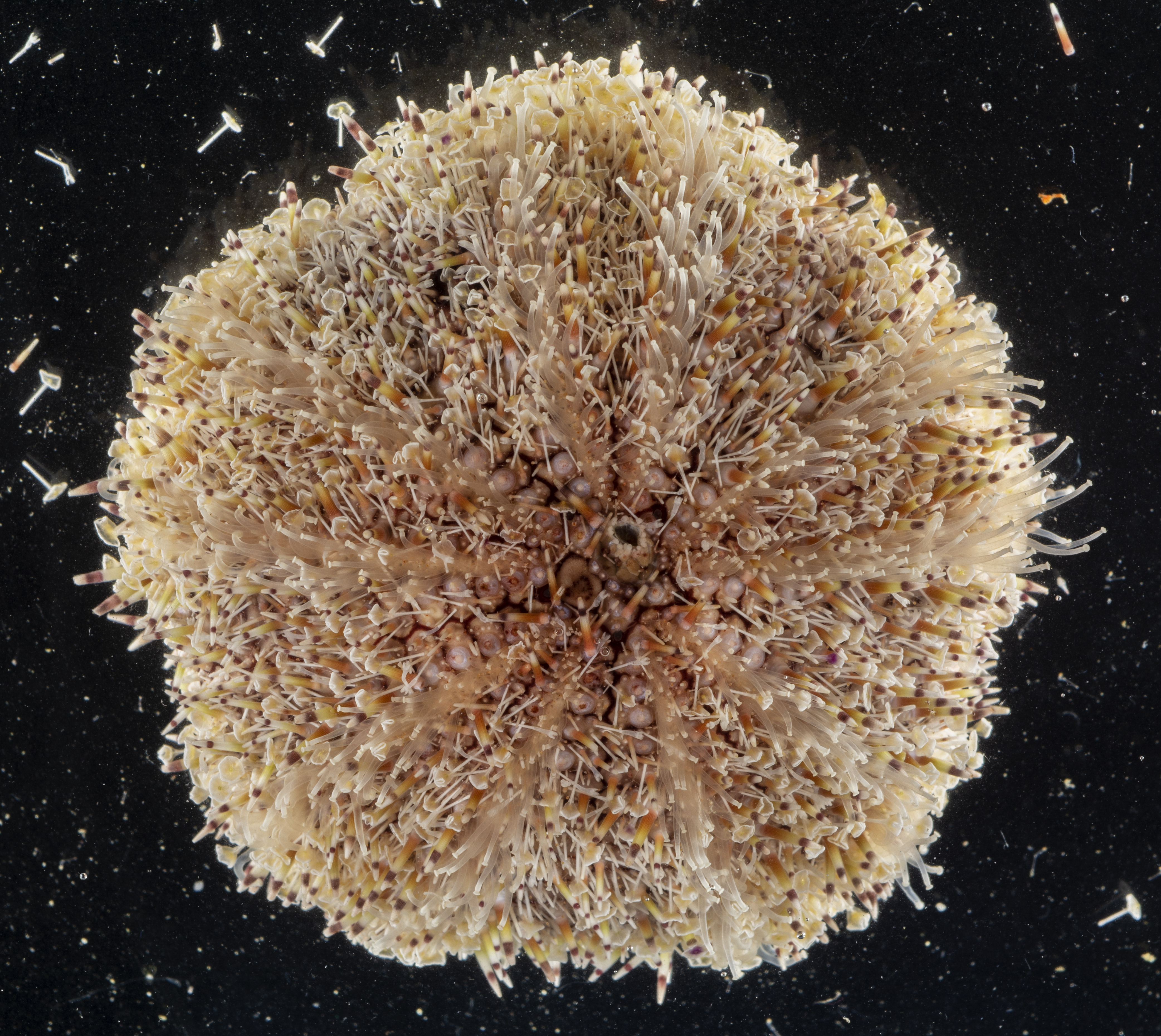
Specimen image via iDigBio · BY-NC
Toxopneustes
Sign in to saveToxopneustes is a genus of sea urchins from the tropical Indo-Pacific. It contains four species. They are known to possess medically significant venom to humans on their pedicellariae (tiny claw-like structures). They are sometimes collectively known as flower urchins, after the most widespread and most commonly encountered species in the genus, the flower urchin (Toxopneustes pileolus). ==Species== Species included in the genus are the following: {| class="wikitable" |- ! Image !! Scientific name !! Description !! Distribution |- |120px ||Toxopneustes elegans Döderlein, 1885|| Can be distin
Species
ラッパウニ属
GENUS
- KingdomAnimalia
- PhylumEchinodermata
- ClassEchinoidea
- OrderCamarodonta
- FamilyToxopneustidae
via GBIF
Museum specimens
- Specimen records
- 68
- With media
- 8
- Family
- Toxopneustidae
- Collections
- CAS, YPM, MZLU, UF, MNHN, SAMA
- Recorded in
- Ecuador, Philippines, Seychelles, United States, Tanzania, Oman, Papua New Guinea, French Polynesia
Wikidata facts
- Instance of
- taxon
- Parent taxon
- Toxopneustidae
- Image
- Toxopneustes pileolus (Sea urchin).jpg
Show 3 more facts
- taxon name
- Toxopneustes
- taxon rank
- genus
- Commons category
- Toxopneustes
Sources (1)
via Wikidata · CC0
~2 min read
Encyclopedic overview
3 sectionsContents
- Species
- Gallery
- References
Toxopneustes is a genus of sea urchins from the tropical Indo-Pacific. It contains four species. They are known to possess medically significant venom to humans on their pedicellariae (tiny claw-like structures). They are sometimes collectively known as flower urchins, after the most widespread and most commonly encountered species in the genus, the flower urchin (Toxopneustes pileolus). ==Species== Species included in the genus are the following: {| class="wikitable" |- ! Image !! Scientific name !! Description !! Distribution |- |120px ||Toxopneustes elegans Döderlein, 1885|| Can be distinguished by the presence of a distinctive dark stripe just below the tips of their spines. || Restricted to waters around Japan. |- |120px ||Toxopneustes maculatus (Lamarck, 1816) ||Can be distinguished by bright violet coloration on the bottom and in a band around the middle of their tests. ||Very rare species found in the Indo-West Pacific. Known only from specimens from Réunion, Christmas Island, and the Palmyra Atoll. |- |120px ||Toxopneustes pileolus (Lamarck, 1816)|| Can be distinguished by variegated red, grey, green, or purple coloration of their tests. ||Common and widespread in the Indo-West Pacific, from East Africa to the Cook Islands. |- |120px ||Toxopneustes roseus (A. Agassiz, 1863) ||Can be distinguished by the uniform coloration of their tests of pink, brown, or purple. ||Restricted to the East Pacific, along the coasts of California, Mexico, Central America, and part of South America (including the Galapagos Islands). |- |}
==Gallery==
Excerpted from Wikipedia’s “Toxopneustes” article, available under the CC BY-SA 4.0 licence.