
File:Lobo_marino_(Zalophus_californianus_wollebaeki),_Punta_Pitt,_isla_de_San_Cristóbal,_islas_Galápagos,_Ecuador,_2015-07-24,_DD_11.JPG · Wikimedia Commons · See Wikimedia Commons
Galapagos Islands
Sign in to saveAlso known as Galapagos, Inchanted Islands, Enchanted Islands, the Galapagos, the Galapagoses, Galapagoses, Insular Region, Insular Region of Ecuador
Archipelago in the Pacific Ocean, part of Ecuador since 1832
OverviewAI-generated
The Galápagos Islands are an isolated archipelago discovered on March 10, 1535. They cover an area of 7880 and have a population of 25000. The islands are recognized in the UNESCO World Heritage collection and are designated as a UNESCO Biosphere Reserve.
Each year, the destination receives 267688 visitors. The subject is referenced by 2,608 other encyclopedia articles. Official information is available through the websites galapagos.today, marcaecuador.com, and galapagoscharterson.com. Additional descriptions can be found at placemania.sk and unesco.org.
Synthesized by Vinony from 16 facts across 4 sources: Wikidata, Firecrawl, Vinony collections, Vinony graph. Generated from structured data (not the Wikipedia text) and checked against those facts — may still contain errors.
Described at
Galapágy: miesto, kde sa zrodil kľúč k evolúcii života - Ekvádor - PlaceMania
Izolované ostrovy, ktoré zmenili chápanie života. Darwin, evolúcia a Galapágy tak, ako ich stále môžeš vidieť dnes.
placemania.sk →Link to a page describing this subject · 25,109 chars · not written by Vinony
Wikidata facts
- Instance of
- tourist attraction
- Has part
- Baltra Island
- Named after
- Chelonoidis nigra nigra
- Country
- Ecuador
- Located in
- Galápagos Province
- Capital
- Puerto Baquerizo Moreno
- Population
- 25000
- Area
- 7880
- Body of water
- Pacific Ocean
- Highest point
- Volcán Wolf
- Official website
- galapagoscharterson.com
- Image
- Galápagos Islands ESA23188644.jpeg
Show 13 more facts
- Commons category
- Galápagos Islands
- topic's main category
- Category:Galápagos Islands
- Commons gallery
- Galapagos
- UNESCO Biosphere Reserve URL
- www.unesco.org/mabdb/br/brdir/directory/biores.asp?code=ECU+01&mode=all
- member of
- Man and the Biosphere Programme
- coextensive with
- Galápagos Province
- native label
- Islas Galápagos
- on focus list of Wikimedia project
- Wikipedia:Vital articles/Level/4
- time of discovery or invention
- 1535-03-10
- topic has template
- Template:Galápagos Islands
- described at URL
- www.placemania.sk/svetova-zaujimavost/galapagy-miesto-kde-sa-zrodil-kluc-k-evolucii-zivota
- P12749
- Byki
- visitors per year
- 267688
via Wikidata · CC0
~40 min read
Encyclopedic overview
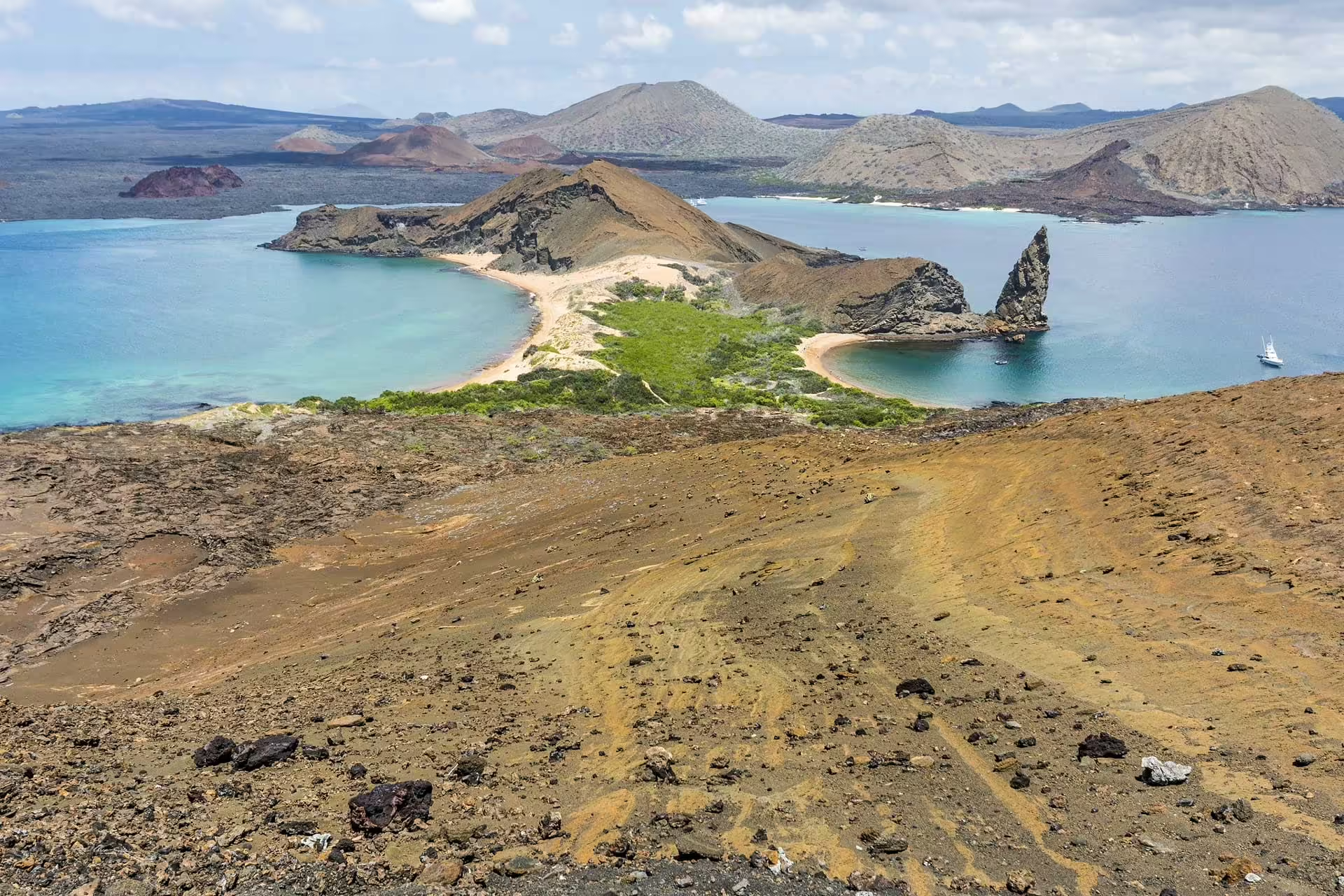
Location of the Galápagos Islands relative to continental Ecuador The Galápagos Islands (Spanish: Islas Galápagos) are an archipelago of volcanic islands in the Eastern Pacific, located around the equator, 485 nautical miles (898 km; 558 mi) west of the mainland of South America. They form the Galápagos Province of the Republic of Ecuador, with a population of slightly over 33,000 in 2020. The province is divided into the cantons of San Cristóbal, Santa Cruz, and Isabela, the three most populated islands in the chain. The Galápagos are famous for their large number of endemic species, which were studied by Charles Darwin in the 1830s and inspired his theory of evolution by means of natural selection. All of these islands are protected as part of Ecuador's Galápagos National Park and Marine Reserve.
There is no firm evidence that Polynesians or the Indigenous peoples of South America reached the islands before their accidental discovery by Bishop Tomás de Berlanga in 1535. If some visitors did arrive, poor access to fresh water on the islands seems to have limited settlement. The Spanish Empire similarly ignored the islands, although during the Golden Age of Piracy various pirates used the Galápagos as a base for raiding Spanish shipping along the Peruvian coast. The goats and black and brown rats introduced during this period greatly damaged the existing ecosystems of several islands. British sailors were chiefly responsible for exploring and mapping the area. Darwin's voyage on HMS Beagle was part of an extensive British survey of the coasts of South America. Ecuador, which won its independence from Spain in 1822 and left Gran Colombia in 1830, formally occupied and claimed the islands on 12 February 1832 while the voyage was ongoing. José de Villamil, the founder of the Ecuadorian Navy, led the push to colonize and settle the islands, gradually supplanting the English names of the major islands with Spanish ones. The United States built the islands' first airport as a base to protect the western approaches of the Panama Canal in the 1930s. After World War II, its facilities were transferred to Ecuador. With the growing importance of ecotourism to the local economy, the airport modernized in the 2010s, using recycled materials for any expansion and shifting entirely to renewable energy sources to handle its roughly 300,000 visitors each year.
Excerpted from Wikipedia’s “Galapagos Islands” article, available under the CC BY-SA 4.0 licence.
Gallery (12)
On the map
Available in 114 languages
- Español
- Français
- Deutsch
- 中文
- 日本語
- Русский
- Português
- Italiano
- العربية
- हिन्दी
- Afrikaans
- Albanian
- Aragonese
- Armenian
- Asturian
- Azerbaijani
- Bahasa Indonesia
- Bangla
Show 95 more
- Bashkir
- Basque
- Belarusian
- Bosnian
- Breton
- Bulgarian
- Burmese
- Catalan
- Cebuano
- Central Kurdish
- Croatian
- Czech
- Danish
- Divehi
- Esperanto
- Estonian
- Faroese
- Fiji Hindi
- Filipino
- Finnish
- Galician
- Georgian
- Greek
- Hebrew
- Hungarian
- Icelandic
- Ido
- Irish
- Javanese
- Kannada
- Kazakh
- Khmer
- Kyrgyz
- Latin
- Latvian
- Limburgish
- Lingua Franca Nova
- Lithuanian
- Low German
- Luxembourgish
- Macedonian
- Malagasy
- Malay
- Malayalam
- Maltese
- Māori
- Marathi
- Minangkabau
- Mongolian
- nds_nl
- Nederlands
- Nepali
- Northern Frisian
- Norwegian
- Norwegian Nynorsk
- Occitan
- Old English
- Papiamento
- Polski
- Punjabi
- Quechua
- Romanian
- Saterland Frisian
- Serbian
- Serbian (Latin)
- Sicilian
- simple
- Sinhala
- Slovak
- Slovenian
- Svenska
- Swahili
- szy
- Tajik
- Tamil
- Tatar
- Tiếng Việt
- Toki Pona
- Türkçe
- Ukrainian
- Urdu
- Uyghur
- Uzbek
- Waray
- Welsh
- Western Frisian
- Western Mari
- Western Panjabi
- Wu Chinese
- Yiddish
- zh_min_nan
- zh_yue
- فارسی
- ไทย
- 한국어
via Wikidata sitelinks · CC0