File:Trajan's_Column_HD.jpg · Wikimedia Commons · See Wikimedia Commons
Trajan's Column
Sign in to saveAlso known as Trajan’s Column
ancient Roman victory column, a landmark of Rome, Italy
Trajan's Column is an ancient Roman monument in Rome that was built to celebrate military victories and commemorate the emperor Trajan. It remains an important historical landmark because it features detailed carved scenes that provide valuable insights into Roman military campaigns and daily life during that era.
AI-generated from the Wikipedia summary — may contain errors.
Wikidata facts
- Instance of
- archaeological site
- Named after
- Trajan
- Country
- Italy
- Located in
- Rome
- Genre
- public art
- Material used
- marble
- Location
- Trajan's Forum
- Official website
- www.stoa.org/trajan
- Image
- Trajan column (Rome) September 2015-2.jpg
Show 14 more facts
- Commons category
- Trajan's Column
- Commons Institution page
- Trajan's Column
- Commons gallery
- Columna Traiana
- commemorates
- Trajan's Dacian Wars
- native label
- Columna Traiana
- architect
- Apollodorus of Damascus
- inception
- 0113-01-01
- culture
- culture of ancient Rome
- commissioned by
- Trajan
- title
- Trajan’s Column
- time period
- culture of ancient Rome
- different from
- The Column
- name
- Colonne Trajane
- IIIF manifest URL
- gn.biblhertz.it/fotothek/api/iiif/3/werk/obj08030127/manifest
via Wikidata · CC0
~29 min read
Encyclopedic overview
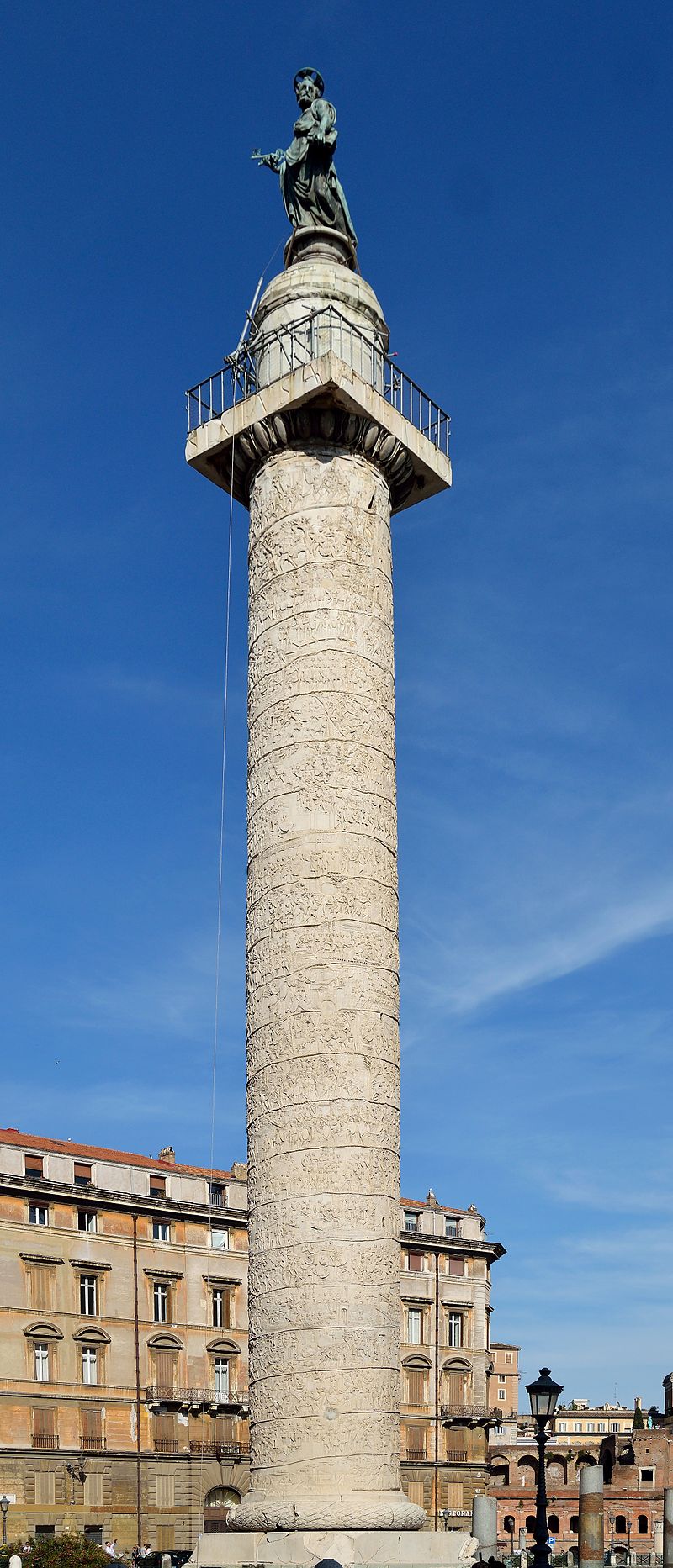
Trajan's Column (Italian: Colonna Traiana, Latin: Columna Traiani) is a Roman triumphal column in Rome, Italy, that commemorates Roman emperor Trajan's victory in the Dacian Wars. It was probably constructed under the supervision of the architect Apollodorus of Damascus at the order of the Roman Senate. It is located in Trajan's Forum, north of the Roman Forum. Completed and dedicated on 12 May 113 AD, the freestanding column is most famous for its spiral bas relief, which depicts the wars between the Romans and Dacians (101–102 and 105–106). Its design has inspired numerous victory columns, both ancient and modern.
The structure is about 30 metres (98 feet) in height, 35 metres (115 feet) including its large pedestal. The shaft is made from a series of 20 colossal Carrara marble drums, each weighing about 32 tons, with a diameter of 3.7 metres (12.1 feet). The 190-metre (620-foot) frieze winds around the shaft 23 times. Inside the shaft, a spiral staircase of 185 steps provides access to a viewing deck at the top. The capital block of Trajan's Column weighs 53.3 tons, and had to be lifted to a height of about 34 metres (112 feet). Ancient coins indicate preliminary plans to top the column with a statue of a bird, probably an eagle. After construction, a statue of Trajan was put in place; this disappeared in the Middle Ages. On December 4, 1587, the top was crowned by Pope Sixtus V with a bronze figure of Saint Peter, which remains.
Excerpted from Wikipedia’s “Trajan's Column” article, available under the CC BY-SA 4.0 licence.