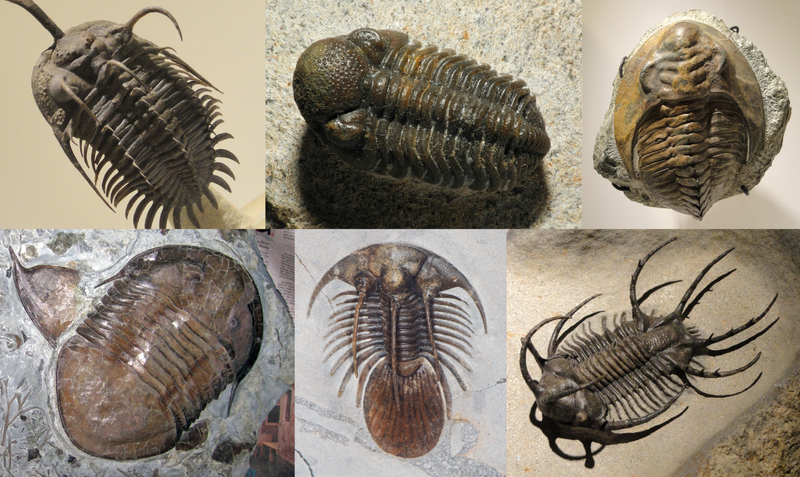
File:Trilobita_Diversity.png · Wikimedia Commons · See Wikimedia Commons
Trilobita
Sign in to saveAlso known as trilobites
Trilobites (; meaning "three-lobed entities") are extinct marine arthropods that form the class Trilobita. One of the earliest groups of arthropods to appear in the fossil record, trilobites were among the most successful of all early animals, existing in oceans for almost 270million years, with over 22,000 species having been described. Because trilobites had wide diversity and an easily fossilized mineralised exoskeleton made of calcite, they left an extensive fossil record. The study of their fossils has facilitated important contributions to biostratigraphy, paleontology, evolutionary biol
Trilobites are extinct marine arthropods that lived in Earth's oceans for nearly 270 million years and are among the earliest and most successful arthropod groups in the fossil record, with over 22,000 species identified. They matter scientifically because their hard, calcite exoskeletons fossilized well and left an extensive fossil record that has made them invaluable for studying biostratigraphy, paleontology, and evolutionary biology.
AI-generated from the Wikipedia summary — may contain errors.
Wikidata facts
- Parent taxon
- Trilobitomorpha
- Image
- Koneprusia brutoni.jpg
Show 10 more facts
- temporal range end
- Changhsingian
- topic's main category
- Category:Trilobites
- taxon rank
- class
- temporal range start
- Cambrian Stage 3
- taxon name
- Trilobita
- Commons category
- Trilobita
- described by source
- Explanatory Dictionary of the Living Great Russian Language
- start time
- 521000000-
- end time
- 251900000-
- means of locomotion
- rolling
via Wikidata · CC0
~61 min read
Encyclopedic overview
41 sectionsContents
- Evolution
- Trilobite relatives
- Fossil record of early trilobites
- Divergence and extinction
- Evolutionary trends
- Cambrian
- Ordovician
- Silurian and Devonian
- Carboniferous and Permian
- Final extinction
- Fossil distribution
- Importance
- Taxonomy
- Morphology
- Terminology
- Cephalon
- Facial sutures
- Dorsal sutures
- Ventral sutures
- Rostrum
- Hypostome
- Thorax
- Volvation
- Pygidium
- Prosopon (surface sculpture)
- Spines
- Soft body parts
- Appendages
- Digestive tract and diet
- Internal organs
- Musculature
- Sensory organs
- Antennae
- Eyes
- Sensory pits
- Development
- History of usage and research
- See also
- References
- Bibliography
- External links
Trilobites (; meaning "three-lobed entities") are extinct marine arthropods that form the class Trilobita. One of the earliest groups of arthropods to appear in the fossil record, trilobites were among the most successful of all early animals, existing in oceans for almost 270million years, with over 22,000 species having been described. Because trilobites had wide diversity and an easily fossilized mineralised exoskeleton made of calcite, they left an extensive fossil record. The study of their fossils has facilitated important contributions to biostratigraphy, paleontology, evolutionary biology, and plate tectonics. Trilobites are placed within the clade Artiopoda, which includes many organisms that are morphologically similar to trilobites, but are largely unmineralised. The relationship of Artiopoda to other arthropods is uncertain.
Trilobites evolved into many ecological niches; some moved over the seabed as predators, scavengers, or filter feeders, and some swam, feeding on plankton. Some even crawled onto land. Most lifestyles expected of modern marine arthropods are seen in trilobites, with the possible exception of parasitism (where scientific debate continues). Some trilobites (particularly the family Olenidae) are even thought to have evolved a symbiotic relationship with sulfur-eating bacteria from which they derived food. The largest trilobites were more than long and may have weighed as much as .
Excerpted from Wikipedia’s “Trilobita” article, available under the CC BY-SA 4.0 licence.
Gallery (52)
Available in 81 languages
- Español
- Français
- Deutsch
- 中文
- 日本語
- Русский
- Português
- Italiano
- العربية
- हिन्दी
- Afrikaans
- Aragonese
- Armenian
- Azerbaijani
- Bahasa Indonesia
- Balinese
- Bangla
- Basque
Show 62 more
- be_x_old
- Belarusian
- Bosnian
- Bulgarian
- Catalan
- Cebuano
- Cornish
- Croatian
- Czech
- Danish
- Esperanto
- Estonian
- Filipino
- Finnish
- Galician
- Georgian
- Greek
- Haitian Creole
- Hebrew
- Hungarian
- Icelandic
- Ido
- Irish
- Javanese
- Kashmiri
- Kazakh
- Latin
- Latvian
- Limburgish
- Lithuanian
- Malagasy
- Malayalam
- Nederlands
- Northern Frisian
- Norwegian
- Norwegian Nynorsk
- Occitan
- Pashto
- Piedmontese
- Polski
- Romanian
- Scots
- Serbian
- Serbian (Latin)
- simple
- Sinhala
- Slovak
- Slovenian
- Svenska
- Tatar
- Tiếng Việt
- Türkçe
- Ukrainian
- Uzbek
- Waray
- Wu Chinese
- Yakut
- zh_min_nan
- zh_yue
- فارسی
- ไทย
- 한국어
via Wikidata sitelinks · CC0