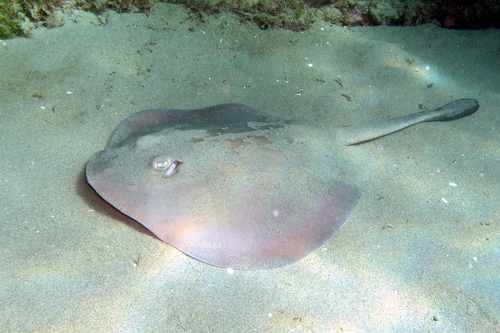
(c) Sascha Schulz, some rights reserved (CC BY-NC), uploaded by Sascha Schulz · cc-by-nc
Trygonoptera
Sign in to saveTrygonoptera is a genus of round rays endemic to the waters around Australia. Müller and Henle defined Trygonoptera in 1841. It has often been considered synonymous with Urolophus, but this has been refuted by recent studies. Trygonoptera can be distinguished from Urolophus in that the outer rims of its nostrils are enlarged into broad, flattened lobes; the two also differ in aspects of the skeleton.
Species
Eastern Shovelnose Stingaree
GENUS
- KingdomAnimalia
- PhylumChordata
- ClassElasmobranchii
- OrderMyliobatiformes
- FamilyUrolophidae
via GBIF
Museum specimens
- Specimen records
- 8
- Family
- Urolophidae
- Collections
- NMV, SAMA, WAM
- Recorded in
- Australia
Wikidata facts
- Instance of
- taxon
- Parent taxon
- Urolophidae
- Image
- Trygonoptera testacea sydney.jpg
Show 4 more facts
- taxon name
- Trygonoptera
- taxon rank
- genus
- topic's main category
- Category:Trygonoptera
- Commons category
- Trygonoptera
Sources (1)
via Wikidata · CC0
~1 min read
Encyclopedic overview
2 sectionsContents
- Species
- References
Trygonoptera is a genus of round rays endemic to the waters around Australia. Müller and Henle defined Trygonoptera in 1841. It has often been considered synonymous with Urolophus, but this has been refuted by recent studies. Trygonoptera can be distinguished from Urolophus in that the outer rims of its nostrils are enlarged into broad, flattened lobes; the two also differ in aspects of the skeleton.
==Species== There are currently six recognized species in this genus: {| class="wikitable" |- ! Image !! Scientific name !! Distribution |- | || Trygonoptera galba Last & Yearsley, 2008 (Yellow shovelnose stingaree)|| Australia |- |180px|| Trygonoptera imitata Yearsley, Last & M. F. Gomon, 2008 (Eastern shovelnose stingaree)||southeastern Australia, excluding Tasmania. |- |180px|| Trygonoptera mucosa Whitley, 1939 (Western shovelnose stingaree)|| southwestern Australia from Perth to Gulf St Vincent. |- |180px|| Trygonoptera ovalis Last & M. F. Gomon, 1987 (Striped stingaree)||southwestern Australia. |- | || Trygonoptera personata Last & M. F. Gomon, 1987 (Masked stingaree)|| southwestern Australia |- |180px|| Trygonoptera testacea J. P. Müller & Henle, 1841 (Common stingaree)|| eastern Australia, |- |}
Excerpted from Wikipedia’s “Trygonoptera” article, available under the CC BY-SA 4.0 licence.