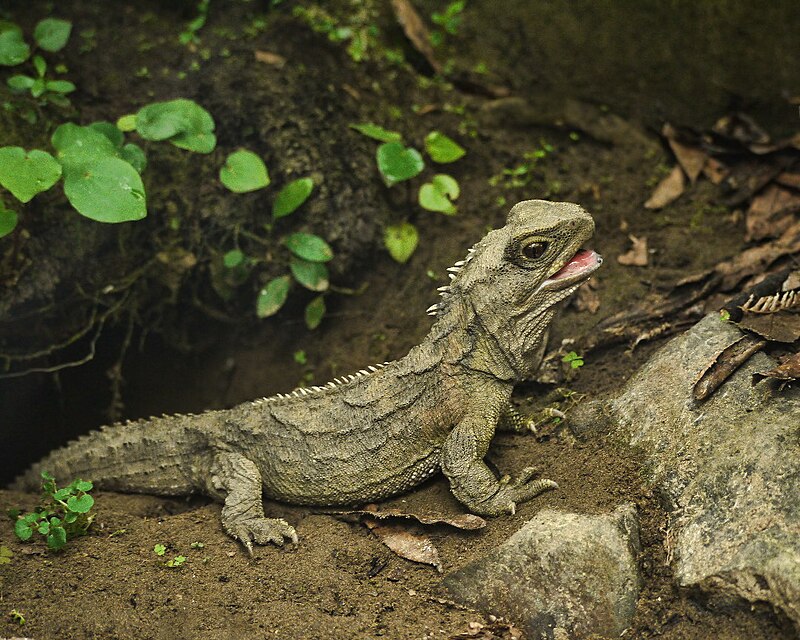
File:Tuatara_(5205719005).jpg · Wikimedia Commons · See Wikimedia Commons
tuatara
Sign in to saveAlso known as Sphenodon
The tuatara (, ; Sphenodon punctatus) is a species of reptile endemic to New Zealand. Despite its close resemblance to lizards, it is the only extant member of a distinct lineage, the previously highly diverse order Rhynchocephalia. The name is derived from the Māori language and means "peaks on the back".
OverviewAI-generated
The tuatara, also referred to as tuátara, is a reptile belonging to the genus Sphenodon within the family Sphenodontidae. This taxon has existed for approximately 240 million years. The species is endemic to New Zealand and is listed in Appendix I of CITES.
The tuatara is classified under the class Reptilia. It has been described in the Encyclopædia Britannica 11th edition. The organism is featured on the Wikipedia Vital Articles list at Level 4.
Synthesized by Vinony from 18 facts across 3 sources: Wikidata, iNaturalist, Vinony graph. Generated from structured data (not the Wikipedia text) and checked against those facts — may still contain errors.
Species
Tuatara
species
本文介紹的是紐西蘭特有的喙頭目爬行動物。關於中國特有的有鱗目爬行動物,請見「中國鱷蜥」。 喙頭蜥是楔齒蜥屬(学名:Sphenodon)动物的通称,因牙齒構造也稱為楔齒蜥。其他名稱也有鱷蜥或紐西蘭鱷蜥,亦可稱為刺背鱷蜥,僅分佈於紐西蘭科克海峽中的數個小島上,是喙頭目僅存的成員,只有1科1屬2種。由於鼬類與老鼠的引進,已瀕臨絕種。額頭有松果眼(英语:parietal eye)(又译作“顶眼”,俗稱“第三隻眼”)的痕跡,是非常原始的蜥蜴,被認為是活化石。
via
Wikidata facts
- Instance of
- taxon
- Image
- Sphenodon punctatus in Waikanae, New Zealand.jpg
Show 9 more facts
- endemic to
- New Zealand
- taxon rank
- genus
- taxon name
- Sphenodon
- Commons category
- Sphenodon punctatus
- topic's main category
- Category:Sphenodon
- start time
- 240000000-
- taxon common name
- tuátara
- CITES Appendix
- Appendix I of CITES
- on focus list of Wikimedia project
- Wikipedia:Vital articles/Level/4
Sources (3)
via Wikidata · CC0
~35 min read
Encyclopedic overview
28 sectionsContents
- Taxonomy and evolution
- Species
- Description
- Skull
- Sensory organs
- Eyes
- Parietal eye (third eye)
- Hearing
- Odorant receptors
- Spine and ribs
- Tail and back
- Age determination
- Physiology
- Ecology
- Reproduction
- Genomic characteristics
- Conservation
- Distribution and threats
- Climate change
- Eradication of rats
- Brothers Island tuatara
- Northern tuatara
- Captive breeding
- Cultural significance
- Notes
- References
- Further reading
- External links
The tuatara (, ; Sphenodon punctatus) is a species of reptile endemic to New Zealand. Despite its close resemblance to lizards, it is the only extant member of a distinct lineage, the previously highly diverse order Rhynchocephalia. The name is derived from the Māori language and means "peaks on the back".
The single extant species of tuatara is the only surviving member of its order, which was highly diverse during the Mesozoic era. Rhynchocephalians first appeared in the fossil record during the Middle Triassic, around 244-241.5 million years ago, and reached worldwide distribution and peak diversity during the Jurassic, when they represented the world's dominant group of small reptiles. Rhynchocephalians declined during the Cretaceous, with their youngest records outside New Zealand dating to the Paleocene. Their closest living relatives are squamates (lizards and snakes). Tuatara are of interest for studying the evolution of reptiles.
Excerpted from Wikipedia’s “tuatara” article, available under the CC BY-SA 4.0 licence.
Gallery (30)
Available in 72 languages
- Español
- Français
- Deutsch
- 中文
- 日本語
- Русский
- Português
- Italiano
- العربية
- Aragonese
- Armenian
- Assamese
- Asturian
- Azerbaijani
- Bahasa Indonesia
- Balinese
- Bangla
- Basque
Show 53 more
- Bikol
- Breton
- Bulgarian
- Burmese
- Catalan
- Cebuano
- Czech
- Danish
- Egyptian Arabic
- Esperanto
- Estonian
- Filipino
- Finnish
- Galician
- Georgian
- Guarani
- Hebrew
- Hungarian
- Icelandic
- Javanese
- Kannada
- Latin
- Latvian
- Limburgish
- Lingua Franca Nova
- Lithuanian
- Macedonian
- Malayalam
- Māori
- Mazanderani
- Navajo
- Nederlands
- Northern Frisian
- Norwegian
- Occitan
- Old English
- Polski
- Romanian
- Scots
- Serbian
- Serbian (Latin)
- simple
- Slovenian
- Svenska
- Tamil
- Tiếng Việt
- Türkçe
- Ukrainian
- Waray
- zh_yue
- فارسی
- ไทย
- 한국어
via Wikidata sitelinks · CC0