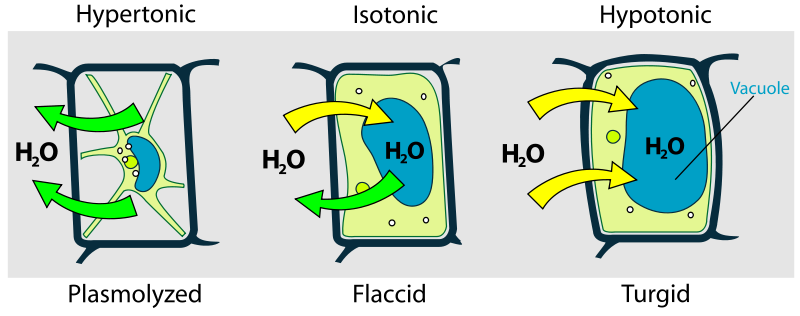
File:Turgor_pressure_on_plant_cells_diagram.svg · Wikimedia Commons · See Wikimedia Commons
turgor pressure
Sign in to saveAlso known as cell turgor
intracellular pressure exerted by the plasma against the cell wall
Wikidata facts
- Subclass of
- pressure
Show 1 more fact
- described by source
- Armenian Soviet Encyclopedia
Sources (2)
via Wikidata · CC0
~16 min read
Encyclopedic overview
Turgor pressure is the force within the cell that pushes the plasma membrane against the cell wall.
It is also called hydrostatic pressure, and is defined as the pressure in a fluid measured at a certain point within itself when at equilibrium. Generally, turgor pressure is caused by the osmotic flow of water and occurs in plants, fungi, and bacteria. The phenomenon is also observed in protists that have cell walls. This system is not seen in animal cells, as the absence of a cell wall would cause the cell to lyse when under too much pressure. The pressure exerted by the osmotic flow of water is called turgidity. It is caused by the osmotic flow of water through a selectively permeable membrane. Movement of water through a semipermeable membrane from a volume with a low solute concentration to one with a higher solute concentration is called osmotic flow. In plants, this entails the water moving from the low concentration solute outside the cell into the cell's vacuole.
Excerpted from Wikipedia’s “turgor pressure” article, available under the CC BY-SA 4.0 licence.