File:Animal_Cell.svg · Wikimedia Commons · See Wikimedia Commons
vacuole
Sign in to saveAlso known as GO:0005773
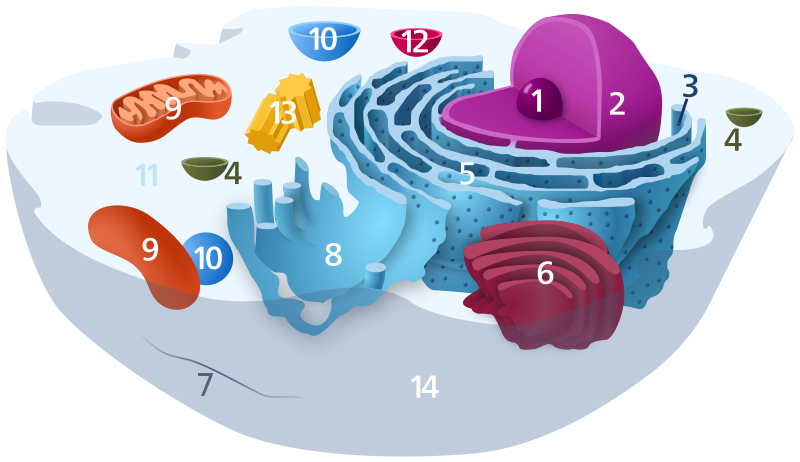
thumb|300x300px|Plant cell structure thumb|300x300px|Animal cell structure A vacuole () is a membrane-bound organelle which is present in plant and fungal cells and some protist, animal, and bacterial cells. Vacuoles are essentially enclosed compartments which are filled with water containing inorganic and organic molecules including enzymes in solution, though in certain cases they may contain solids which have been engulfed. Vacuoles are formed by the fusion of multiple membrane vesicles and are effectively just larger forms of these. The organelle has no basic shape or size; its structure v
A vacuole is a membrane-bound compartment inside cells that stores water and various molecules like nutrients and enzymes, found in plant, fungal, and some other cell types. These storage spaces help cells maintain their structure and function by holding and managing the materials the cell needs to survive.
AI-generated from the Wikipedia summary — may contain errors.
Research
55,927 papers- Vacuole Biogenesis in Plants: How Many Vacuoles, How Many Models?ReviewTrends in plant science · 2020Cui Y, Zhao Q, Hu S et al.DOI: 10.1016/j.tplants.2020.01.008
- A self-sensing vacuole/lysosome: V-ATPase dysfunction activates selective autophagy.Autophagy · 2026Huang Y, Klionsky DJDOI: 10.1080/15548627.2025.2604345
- Structure and function of the parasitophorous vacuole in Eimeria species.ReviewInternational journal for parasitology · 1998Entzeroth R, Mattig FR, Werner-Meier RDOI: 10.1016/s0020-7519(98)00079-4
- Parasitophorous vacuole: morphofunctional diversity in different coccidian genera (a short insight into the problem).ReviewCell biology international · 2002Beyer TV, Svezhova NV, Radchenko AI et al.DOI: 10.1006/cbir.2002.0943
- Transport of proteins to the yeast vacuole: autophagy, cytoplasm-to-vacuole targeting, and role of the vacuole in degradation.ReviewSeminars in cell & developmental biology · 2000Teter SA, Klionsky DJDOI: 10.1006/scdb.2000.0163
- Development of periodic tension in the contractile vacuole complex membrane of paramecium governs its membrane dynamics.ReviewCell biology international · 2002Tani T, Tominaga T, Allen RD et al.DOI: 10.1006/cbir.2002.0937
- PIKFYVE inhibition induces endosome- and lysosome-derived vacuole enlargement via ammonium accumulation.Journal of cell science · 2025Uwada J, Nakazawa H, Kiyoi T et al.DOI: 10.1242/jcs.262236
- Renal Oncocytoma With Both Lymphovascular Invasion and Prominent Intracytoplasmic Vacuole-Like Spaces: A Case Report and Review of the Literature.ReviewInternational journal of surgical pathology · 2022Luo X, Preciado C, Nayak A et al.DOI: 10.1177/10668969211041592
via PubMed
Wikidata facts
- Part of
- cytoplasm
- Image
- Rhoeo Discolor - Plasmolysis.jpg
Show 3 more facts
- described by source
- Brockhaus and Efron Encyclopedic Dictionary
- Commons category
- Vacuole
- exact match
- purl.obolibrary.org/obo/GO_0005773
via Wikidata · CC0
~10 min read
Encyclopedic overview
10 sectionsContents
- Discovery
- Function
- Types
- Central
- Contractile
- Digestive
- Histopathology
- Notes
- References
- External links
thumb|300x300px|Plant cell structure thumb|300x300px|Animal cell structure A vacuole () is a membrane-bound organelle which is present in plant and fungal cells and some protist, animal, and bacterial cells. Vacuoles are essentially enclosed compartments which are filled with water containing inorganic and organic molecules including enzymes in solution, though in certain cases they may contain solids which have been engulfed. Vacuoles are formed by the fusion of multiple membrane vesicles and are effectively just larger forms of these. The organelle has no basic shape or size; its structure varies according to the requirements of the cell.
==Discovery== Antonie van Leeuwenhoek described the plant vacuole in 1676. Contractile vacuoles ("stars") were first observed by Spallanzani (1776) in protozoa, although they were mistaken for respiratory organs. Dujardin (1841) named these "stars" as vacuoles. In 1842, Schleiden applied the term for plant cells, to distinguish the structure with cell sap from the rest of the protoplasm. In 1885, de Vries named the vacuole membrane as tonoplast. Christian de Duve discovered mammalian lysosomes using biochemical methods in the mid-1970s. De Duve named lysosomes based on their biochemical properties (from the Greek lysis – digestive and soma – body). Their physical form was confirmed shortly afterward by electron microscopy. Because the lysosome shares many properties with vacuoles across taxonomical kingdoms, the notion that vacuoles and lysosomes are distinctly different organelles is more historical than functional.
Excerpted from Wikipedia’s “vacuole” article, available under the CC BY-SA 4.0 licence.
Gallery (10)
Available in 78 languages
- Español
- Français
- Deutsch
- 中文
- 日本語
- Русский
- Português
- Italiano
- العربية
- हिन्दी
- Afrikaans
- Albanian
- Armenian
- azb
- Azerbaijani
- Bahasa Indonesia
- Bangla
- Basque
Show 59 more
- Belarusian
- Bosnian
- Bulgarian
- Catalan
- Cebuano
- Central Kurdish
- Croatian
- Czech
- Danish
- Esperanto
- Estonian
- Filipino
- Finnish
- Galician
- Georgian
- Greek
- Hebrew
- Hungarian
- Icelandic
- Ido
- Interlingua
- Irish
- Javanese
- Kazakh
- Kurdish
- Kyrgyz
- Latin
- Latvian
- Lithuanian
- Macedonian
- Malay
- Malayalam
- Manx
- Nederlands
- Norwegian
- Norwegian Nynorsk
- Oromo
- Polski
- Punjabi
- Romanian
- Serbian
- Serbian (Latin)
- simple
- Slovak
- Slovenian
- Sundanese
- Svenska
- Tamil
- Tiếng Việt
- Türkçe
- Ukrainian
- Urdu
- Uzbek
- Western Panjabi
- Wu Chinese
- zh_yue
- فارسی
- ไทย
- 한국어
via Wikidata sitelinks · CC0