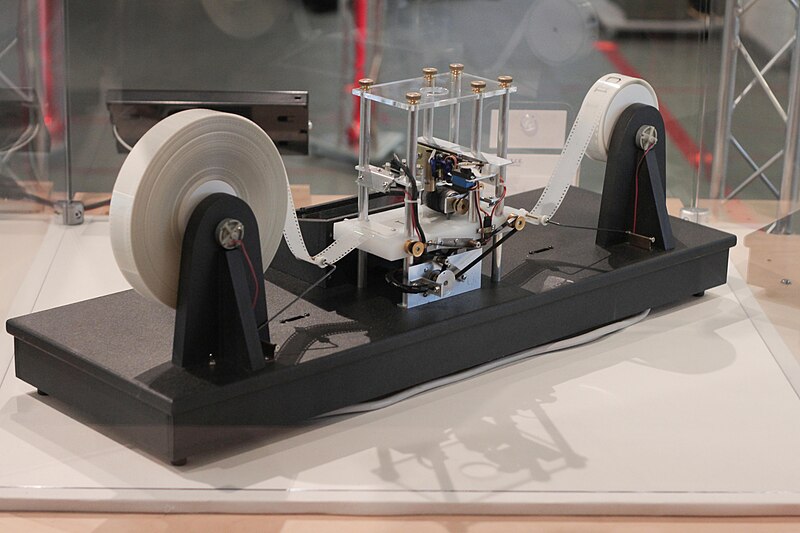
File:Turing_Machine_Model_Davey_2012.jpg · Wikimedia Commons · See Wikimedia Commons
Turingmachine
Sign in to saveAlso known as deterministic Turing machine
model van berekening en berekenbaarheid, ontwikkeld door wiskundige Alan Turing
A Turing machine is a theoretical device that performs computations by reading and writing symbols on a strip of tape while following a set of rules—it's not a real physical machine, but rather a mathematical model that helps us understand how computation works. It matters because it provides a foundational framework for thinking about what problems can and cannot be solved by any computing device.
AI-generated from the Wikipedia summary — may contain errors.
Wikidata facts
- Named after
- Alan Turing
- Image
- Maquina.png
Show 10 more facts
- discoverer or inventor
- Alan Turing
- Commons category
- Turing machines
- topic's main category
- Category:Turing machine
- Stack Exchange tag
- cstheory.stackexchange.com/tags/turing-machines
- Commons gallery
- Turing Machine
- maintained by WikiProject
- WikiProject Mathematics
- inception
- 1936-00-00
- location of creation
- King's College London
- studied by
- theory of computation
- used by
- computer science
via Wikidata · CC0
Article · Nederlands
In de informatica is de turingmachine een model van berekening en berekenbaarheid, ontwikkeld door de wiskundige Alan M. Turing in zijn beroemde artikel On computable numbers, with an application to the Entscheidungsproblem uit 1936-37. De turingmachine is een eenvoudig mechanisme dat symbolen manipuleert. Ondanks deze eenvoud kan men hiermee de logica van elke mogelijke computer simuleren. Hoewel technisch realiseerbaar (zo lang we willekeurige hoeveelheden band kunnen aanleveren) is deze machine niet bedoeld voor praktische computertechnologie, maar als een gedachte-experiment rond de limieten van mechanische berekeningen; ze wordt dus niet echt gebouwd.
Abstract from DBpedia / Wikipedia · CC BY-SA
Gallery (9)
Available in 68 languages
- Español
- Français
- Deutsch
- 中文
- 日本語
- Русский
- Português
- Italiano
- العربية
- Afrikaans
- Albanian
- Albanian
- Armenian
- Bahasa Indonesia
- Basque
- be_x_old
- Belarusian
- Bosnian
Show 49 more
- Bulgarian
- Catalan
- Central Kurdish
- Croatian
- Czech
- Danish
- Esperanto
- Estonian
- Filipino
- Finnish
- Friulian
- Galician
- Georgian
- Greek
- Hebrew
- Hungarian
- Ido
- Interlingua
- Irish
- Kikuyu
- Latin
- Latvian
- Lithuanian
- Lombard
- Luxembourgish
- Macedonian
- Malayalam
- Mirandese
- Nederlands
- Norwegian
- Norwegian Nynorsk
- Occitan
- Polski
- Romanian
- Serbian
- Serbian (Latin)
- simple
- Slovak
- Slovenian
- Svenska
- Tiếng Việt
- Türkçe
- Ukrainian
- Wu Chinese
- zh_min_nan
- zh_yue
- فارسی
- ไทย
- 한국어
via Wikidata sitelinks · CC0