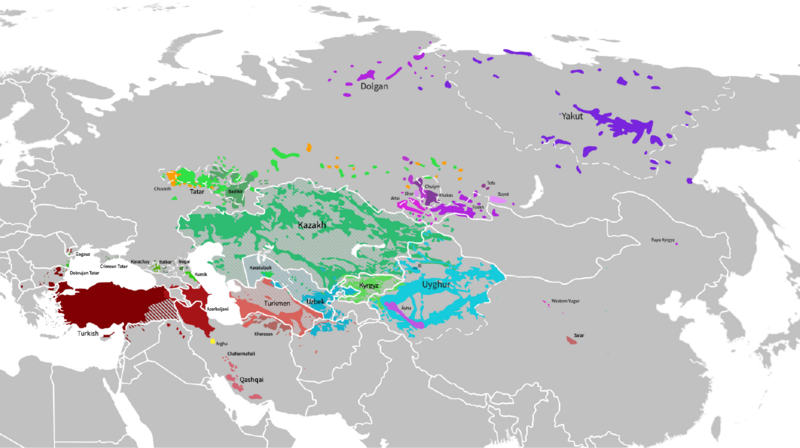
File:Turkic_Languages_distribution_map.png · Wikimedia Commons · See Wikimedia Commons
Turkic peoples are a family of ethnic groups spread across Eurasia who share linguistic and cultural connections. Understanding them matters because they comprise hundreds of millions of people across Central Asia, the Middle East, and beyond, making them a significant force in global history and contemporary geopolitics.
AI-generated from the Wikipedia summary — may contain errors.
Wikidata facts
- Instance of
- ethnolinguistic group
- Subclass of
- Eurasian
- Religion
- Judaism
- Population
- 180000000
Show 6 more facts
- Commons category
- Turkic peoples
- topic's main category
- Category:Turkic peoples
- studied by
- Turkology
- different from
- Turki
- topic has template
- Template:Turkic peoples
- language used
- Turkic
via Wikidata · CC0
~40 min read
Encyclopedic overview
Turkic peoples are a collection of diverse ethnic groups of West, Central, East, and North Asia as well as parts of Europe, who speak Turkic languages.
According to historians and linguists, the Proto-Turkic language originated in Central-East Asia, potentially in the Altai-Sayan region, Mongolia or Tuva. Initially, Proto-Turkic speakers were potentially both hunter-gatherers and farmers; they later became nomadic pastoralists. Early and medieval Turkic groups exhibited a wide range of both East Asian and West-Eurasian physical appearances and genetic origins, in part through long-term contact with neighboring peoples such as Iranic, Mongolic, Tocharian, Uralic and Yeniseian peoples.
Excerpted from Wikipedia’s “Turkic peoples” article, available under the CC BY-SA 4.0 licence.
Gallery (12)
Available in 93 languages
- Español
- Français
- Deutsch
- 中文
- 日本語
- Русский
- Português
- Italiano
- العربية
- हिन्दी
- Afrikaans
- Aragonese
- Armenian
- Asturian
- azb
- Azerbaijani
- Bahasa Indonesia
- Bangla
Show 74 more
- Bashkir
- Basque
- Belarusian
- Bosnian
- Bulgarian
- Burmese
- Catalan
- Central Kurdish
- Chechen
- Chuvash
- Croatian
- Czech
- Danish
- Egyptian Arabic
- Esperanto
- Estonian
- Finnish
- Gagauz
- Galician
- Georgian
- Greek
- Hakka Chinese
- Hebrew
- Hungarian
- Ido
- Ingush
- Javanese
- Karachay-Balkar
- Kazakh
- Kurdish
- Kyrgyz
- Latvian
- Lezghian
- Lithuanian
- Macedonian
- Malagasy
- Mazanderani
- Minangkabau
- Mingrelian
- Mongolian
- Nederlands
- Norwegian
- Norwegian Nynorsk
- Pashto
- Polski
- Punjabi
- Romanian
- Serbian
- Serbian (Latin)
- simple
- Slovak
- Slovenian
- Svenska
- Swahili
- Tajik
- Tamil
- Tatar
- Tiếng Việt
- Türkçe
- Turkmen
- Tuvinian
- Ukrainian
- Urdu
- Uyghur
- Uzbek
- Western Frisian
- Western Panjabi
- Wu Chinese
- Yakut
- zh_min_nan
- zh_yue
- فارسی
- ไทย
- 한국어
via Wikidata sitelinks · CC0