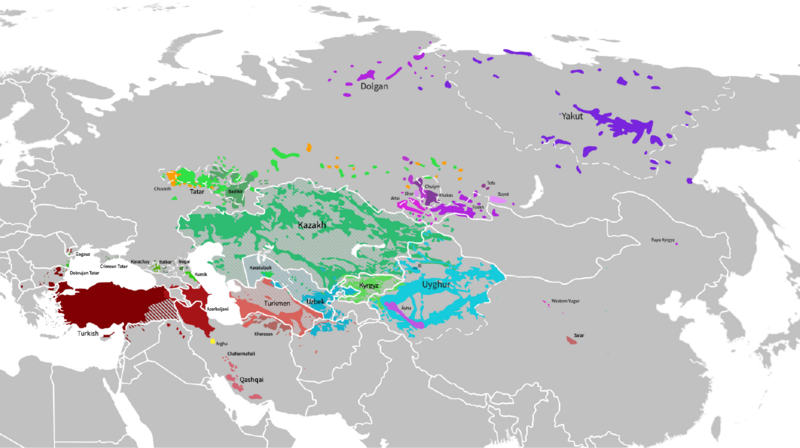
File:Turkic_Languages_distribution_map.png · Wikimedia Commons · See Wikimedia Commons
Turkic refers to a family of related languages spoken across a wide region stretching from Eastern Europe through Central Asia to China, with hundreds of millions of speakers. It matters because understanding Turkic languages and the peoples who speak them is key to understanding the history, culture, and geopolitics of a vast and strategically important part of the world.
AI-generated from the Wikipedia summary — may contain errors.
Wikidata facts
- Instance of
- language family
- Subclass of
- human language
- Has part
- Oghuric
Show 12 more facts
- described by source
- Brockhaus and Efron Encyclopedic Dictionary
- Commons category
- Turkic languages
- topic's main category
- Category:Turkic languages
- linguistic typology
- subject–object–verb
- topic has template
- Template:Turkic languages
- has list
- list of Turkic languages
- number of speakers, writers, or signers
- 300000000
- different from
- Old Tatar
- studied by
- Turkology
- on focus list of Wikimedia project
- Wikipedia:Vital articles/Level/4
- Stack Exchange tag
- linguistics.stackexchange.com/tags/turkic-languages
Sources (7)
via Wikidata · CC0
~22 min read
Encyclopedic overview
The Turkic languages are a language family of more than 35 documented languages spoken by the Turkic peoples of Eurasia, from Eastern Europe and Southern Europe to Central Asia, East Asia, North Asia (Siberia), and West Asia. The Turkic languages originated in a region of East Asia spanning from Mongolia to Northwest China, where Proto-Turkic is thought to have been spoken, and from where they expanded to Central Asia and farther west during the first millennium. They are characterized as a dialect continuum.
Turkic languages are spoken by some 200 million people. The Turkic language with the greatest number of speakers is Turkish, spoken mainly in Anatolia and the Balkans; its native speakers account for about 38% of all Turkic speakers, followed by Uzbek.
Excerpted from Wikipedia’s “Turkic” article, available under the CC BY-SA 4.0 licence.
Gallery (12)
Available in 127 languages
- Español
- Français
- Deutsch
- 中文
- 日本語
- Русский
- Português
- Italiano
- العربية
- हिन्दी
- Abkhazian
- Afrikaans
- Albanian
- Amharic
- Aragonese
- Armenian
- Asturian
- Avaric
Show 108 more
- azb
- Azerbaijani
- Bahasa Indonesia
- Bangla
- Bashkir
- Basque
- bat_smg
- be_x_old
- Belarusian
- Bosnian
- Breton
- Bulgarian
- Catalan
- Central Kurdish
- Chechen
- Chuvash
- Crimean Tatar
- Croatian
- Czech
- Danish
- Esperanto
- Estonian
- Fiji Hindi
- Finnish
- Gagauz
- Galician
- Georgian
- Greek
- Hakka Chinese
- Hausa
- Hebrew
- Hungarian
- Icelandic
- Ido
- Ingush
- Irish
- Javanese
- Kabyle
- Kashmiri
- Kazakh
- kge
- Kurdish
- Kyrgyz
- Latin
- Latvian
- Lezghian
- Limburgish
- Lingua Franca Nova
- Lithuanian
- Lower Sorbian
- Macedonian
- Malagasy
- Malay
- Malayalam
- Marathi
- Mari
- Mazanderani
- Mongolian
- Nederlands
- Northern Frisian
- Northern Sami
- Norwegian
- Norwegian Nynorsk
- Occitan
- Ossetic
- Polski
- Punjabi
- Quechua
- Romanian
- Santali
- Sardinian
- Saterland Frisian
- Scots
- Serbian
- Serbian (Latin)
- Shona
- Silesian
- simple
- Sindhi
- Slovak
- Slovenian
- Svenska
- Swahili
- Tajik
- Tamil
- Tatar
- Tiếng Việt
- Toki Pona
- Türkçe
- Turkmen
- Tuvinian
- Udmurt
- Ukrainian
- Upper Sorbian
- Urdu
- Uyghur
- Uzbek
- Welsh
- West Flemish
- Western Frisian
- Western Panjabi
- Wu Chinese
- Yakut
- Zaza
- zh_yue
- فارسی
- ไทย
- 한국어
via Wikidata sitelinks · CC0